



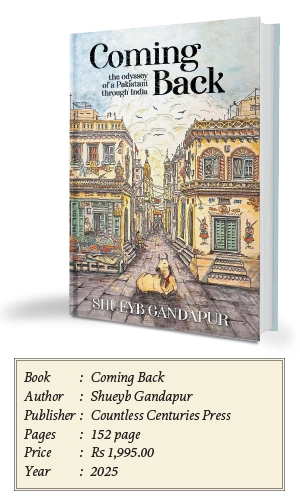
 The book titled ‘Coming Back’ by Shueyb Gandapur is the odyssey of a Pakistani through India. The book can be categorised as a travel memoir. A travel memoir is not just a detailed personal account of the places the traveller visits, but also a journey of inner transformation, as the experience of visiting different places redefines the author’s self-understanding and beliefs.
The memoir’s primary thematic concern is the constant sense of nostalgia families felt after partition, having had to leave their homeland. Hailing from Dera Ismail Khan, the author recounts the stories his grandparents told him of what it was like before and after partition. How movement across borders was freer, and visa requirements were more relaxed.
It is funny how unreachable we remain to each other, despite being the closest neighbours, writes Gandapur while reflecting on Pakistan and India. The author talks of his interaction with Hindus and Sikhs. ‘What I experienced in India ranged from exceptional warmth and hospitality from friends to being treated with suspicion by strangers, ’ he writes.
He talks about the export of the Indian film industry and the excitement and animosity between the two countries surrounding cricket. Cricket was a sensitive issue for both nations, often treated as a matter of life and death. Slogans of “Go India” and “Go Pakistan” echoed passionately from both sides.
The author highlights an important literary figure: the renowned author of the Urdu novel ‘Aag Ka Darya’, Qurratulain Hyder. He visited her grave, expressing his desire and curiosity to find more about the great novelist.
India is home to a multitude of identities, says the author, as Muslims, Sikhs, Hindus, Christians- raising the question of which identity he himself wishes to be known by.
During his visit to Delhi, he is surprised to see signboards in four languages, including Urdu and English. However, outside of Delhi, Urdu was not prevalent. The author regrets the ‘decline of Urdu from being a language of correspondence, law and commerce to one good for exotic poetic expression only.’
As the author visited India in 2017, he wrote his book in 2019 and finally published it in 2025. This timeline raises a pertinent question: would his experience of travelling to India a second time be the same? He answers candidly, acknowledging that places evolve, political landscapes shift, and attitudes change over time. The warmth extended to Pakistanis a decade or two ago, he notes, is no longer guaranteed. He addresses this sensitive issue with remarkable honesty and diplomacy.
Gandapur laments the state both countries have reached, where it’s difficult to talk to or visit each other. There is now an element of generational nostalgia, an inherited longing for a time never personally experienced.
Delhi and Lahore, Gandapur suggests, are mirror images of each other. Among the most common shared elements between India and Pakistan are bureaucracy, chai, samosa, and kachori. Yet subtle differences remain—for instance, the clay earthen cups used to serve chai in India, compared to the glass mugs commonly used in Pakistan.
Coming Back is a unique travel memoir offering a fresh perspective on the enduring connection between Pakistan and India. The title’s significance is deeply meaningful, as the author returns to a place where he feels he belongs—hence the title.
Leave a Reply