



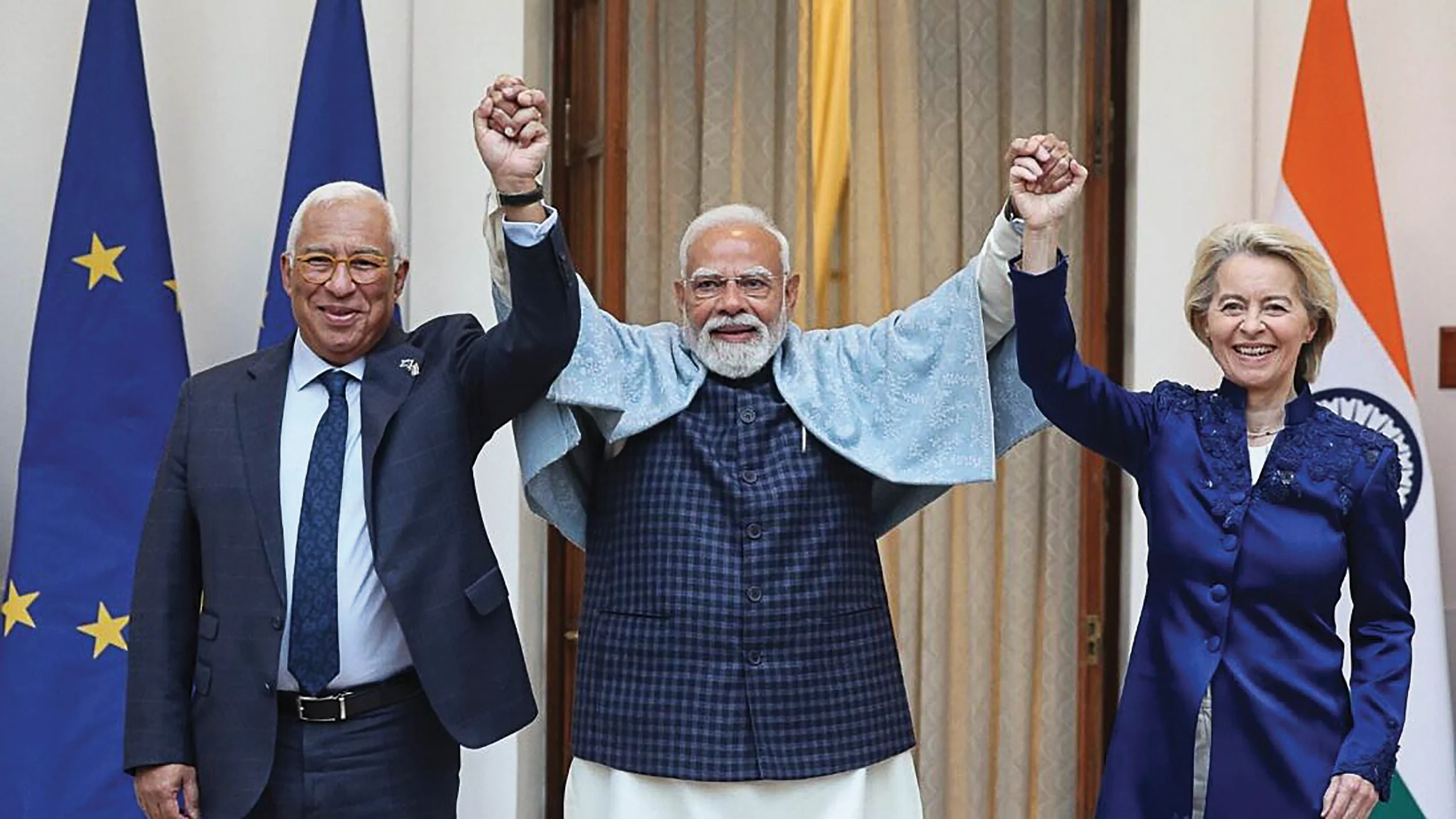
The India-European Union Free Trade Agreement (FTA), concluded on 27 January 2026 after almost two decades of talks, has been hailed as a landmark ‘mother of all deals.’ The agreement links the world’s fastest-growing major economy with one of its largest trading blocs, creating a combined market value of nearly $27 trillion. This landmark agreement was announced during an India-EU Summit in New Delhi, where leaders from both regions described the agreement as transformative for economic ties and global trade.
Trade data underline why both sides view the agreement as transformative, even though the United States remains the largest overall trading partner for both India and the European Union. Over the past decade, however, India-EU goods trade has expanded sharply, rising from roughly $74 billion in 2020 to about $ 136 billion in 2024-25, making the EU India’s largest goods trading partner. Both sides have set an ambitious target of expanding total goods trade to around $200 billion by 2030, a goal the new FTA is designed to accelerate.
According to India’s Ministry of Commerce and Industry, the FTA grants preferential access on more than 99% of tariff lines by trade value, providing immediate duty-free access for 70.4% of India’s exports, including textiles, leather, and footwear, tea, coffee, spices, sports goods, toys, gems and jewellery, and phased tariff reductions for additional products over three to five years.
On the EU side, the pact will eliminate or significantly reduce tariffs on around 96.6% of European exports to India, including machinery, chemicals, pharmaceuticals, automobiles, and processed foods, representing the deepest trade opening India has granted to any partner.
Industry benefits are substantial as European markets will see Indian tariffs fall from about 110% to as low as 10% under quota terms. Whereas machinery, electrical equipment, and pharmaceuticals will largely enter India duty-free over a phased period.
Agricultural products and sensitive goods received calibrated treatment, while Indian tea, coffee, spices, grapes, and processed foods are earmarked for preferential access. Sensitive items such as dairy, cereals, poultry, and soymeal remain protected to safeguard domestic interests. Likewise, the EU retains tariffs on beef, rice, and milk products, with quota-based openings for select items.
From India’s perspective, exports of labor-intensive and value-added goods, from apparel to marine products, will gain near-universal duty-free access to European markets, significantly improving competitiveness and export volumes. The deal also covers a broad range of services, investment facilitation, digital trade, intellectual property protections, and support for small and medium-sized enterprises on both sides.
The pact’s ‘services’ provisions are especially noteworthy. India has offered commitments in 102 services subsectors. At the same time, the EU has opened 144 subsectors, spanning information technology, professional services, education, and business services, and will facilitate simpler labor mobility for high-skill professionals. Such provisions are expected to accelerate services exports from both regions and deepen cross-border integration in emerging sectors.
India’s Ministry of Commerce and Industry expects that FTA is a robust mobility framework aimed at ‘powering India’s talent across Europe.’ The agreement establishes an assured regime for the temporary entry and stay of professionals in clearly defined categories, including business visitors, intra-corporate transferees, contractual service suppliers, and independent professionals. This framework provides greater legal certainty and transparency for Indian companies and skilled workers to operate in the European market, reducing procedural ambiguities that have historically constrained cross-border services trade.


The writer is an Associate Research Fellow at the Sustainable Development Policy Institute (SDPI). He can be reached at asifjaved@sdpi.org
Leave a Reply