


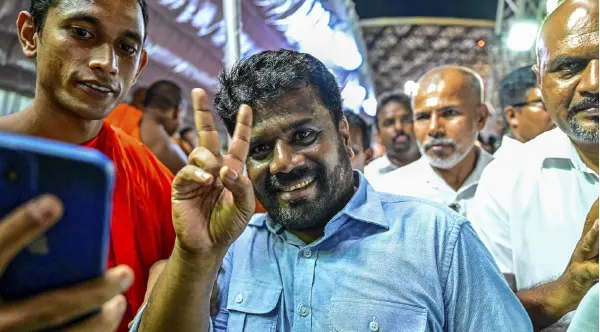
Sri Lanka’s recent elections have marked a historic political transformation driven by a collective desire to transcend the ethnic and religious divisions that have long defined the nation’s politics. The landslide victory of the National People’s Power (NPP), a coalition led by the leftist Janatha Vimukthi Peramuna (JVP), reflects a public mandate for unity and reform amid severe economic adversity.
For the first time since independence in 1948, a political force has secured widespread support across Sri Lanka’s Sinhala, Tamil, and Muslim communities, signalling a potential shift away from the identity-based politics that have fuelled discord for decades. The NPP’s unprecedented electoral success, winning 159 seats in the 225-member Parliament, including dominance in 21 of 22 electoral districts, has positioned it to implement an ambitious agenda of economic recovery and inclusive governance.
However, the new government faces immense challenges, from stabilising a crippled economy to addressing unresolved ethnic grievances, all while maintaining the fragile coalition of voters that brought it to power. The November 2024 elections underscored a dramatic rejection of Sri Lanka’s traditional political elites. The Sri Lanka Podujana Peramuna (SLPP), once a dominant force under the Rajapaksa family, was reduced to a mere three seats. At the same time, the United National Party (UNP) and its offshoot, the Samagi Jana Balawegaya (SJB), also suffered significant losses.
This collapse of established parties reflects public anger over their perceived role in Sri Lanka’s economic collapse, which saw soaring inflation, shortages of essentials, and a default on foreign debt. Historically associated with radical leftist movements, the JVP rebranded itself as a pragmatic alternative through the NPP coalition, emphasising anti-corruption, economic justice, and national unity. Its message resonated not only with the Sinhala majority but also with Tamil and Muslim minorities, who have historically distrusted Sinhala-majority parties due to decades of marginalisation and failed promises of devolution and reconciliation.
The NPP’s success in bridging Sri Lanka’s ethnic divide is perhaps its most remarkable achievement. In the Tamil-majority Northern and Eastern provinces, the coalition outperformed traditional Tamil parties like the Ilankai Thamil Arasu Kadchi (ITAK), securing seats in Jaffna and Batticaloa—regions that had long voted almost exclusively for Tamil nationalist candidates. Similarly, the NPP gained traction in Muslim-dominated areas over the Sri Lanka Muslim Congress (SLMC), which had previously monopolised Muslim political representation.
This shift can be attributed to several factors. First, the NPP actively courted minority voters during its campaign, pledging to address longstanding Tamil demands such as the release of political prisoners, the return of military-occupied lands, and reforms to the Prevention of Terrorism Act (PTA). It also promised to explore alternatives to the contentious 13th Amendment, which governs the devolution of power to provinces, signalling flexibility in addressing Tamil aspirations. Second, disillusionment with traditional minority parties played a role.
Many Tamil and Muslim voters felt these parties had failed to deliver meaningful progress on economic development or political rights, opting instead to prioritise patronage networks. The NPP’s emphasis on economic equity and anti-corruption appealed to voters who were weary of stagnant leadership. The economic crisis served as a unifying force, temporarily overshadowing ethnic tensions. With inflation peaking at over 50% in 2023 and unemployment soaring, communities across Sri Lanka prioritised survival over identity politics. The NPP’s campaign focused on immediate relief, such as subsidies for food and fuel, and long-term structural reforms, including state-led investments in agriculture, tourism, and technology. Its promise to renegotiate International Monetary Fund (IMF) austerity measures while protecting social welfare programs struck a chord with a population battered by years of austerity. However, balancing these promises with fiscal realities will test the government’s resolve. Sri Lanka’s debt restructuring process, initiated under the previous administration, ties the hands of the NPP to some extent.


The writer, based in Islamabad, holds a Master’s degree in Defence and Strategic Studies. He can be contacted at daniyaltalat2013@gmail.com.
Leave a Reply