New Delhi
Hindutva Beyond Borders
The BJP, with its keen focus on keeping its strongholds firm, continues to rekindle hatred amongst the minority groups in India.
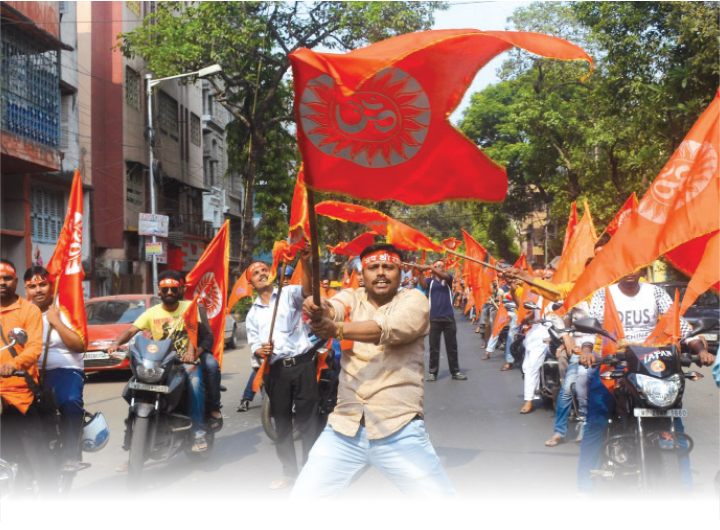
affronization of India can be witnessed as one skims through social media – be it a viral video of a man being beaten by a mob while the echo of populist Hindu chants can be heard creating ripples of hatred; or in other cases a 'beef eater' can be seen escaping the wrath of a highly charged, violent crowd.
These waves of hatred now crash across continents thousands of miles away from South Asia – a recent incident being in the British city of Leicester where Hindu-Muslim clashes erupted after a cricket match.
One wonders why now the ideology of Hindutva is being exported elsewhere. It is now that the crop of Hindu fundamentalism is being reaped across countries, being consistently sown by Hindu nationalists since decades. It only gained prominence across streets, locally in India, and elsewhere, since 2014 when the Bharatiya Janata Party (BJP) came to power. And with it the Hindu fundamentalist Prime Minister, Narendra Modi, also a lifelong member of the Rashtriya Swayamsevak Sangh (RSS) – an organization that works to preserve Hindu identity by using the path set out for a Hindu state.
The event in Leicester is just one single event out of a series of Hindutva signature strikes that have been occurring in other countries of the Global North. During the 2016 presidential elections in the United States, intensive campaigns were run by Hindu nationalists to lobby for Republican candidates whose rhetoric reeked of Islamophobia. Modi and Trump, at a ‘Howdy Modi’ event in Houston in 2019 was one moment when thousands of Indians came out in support of the Indian premier, thus spelling out support base of Modi’s in the U.S. And currently the might of the lobbying is now extended to the streets as well. On the 75th Indian Independence Day, the streets of Edison, New Jersey were seen with bulldozers, a classic Hindutva symbol which depicts the razing down of Muslim homes in India.
Moving on to Canada, a local Indian appreciated Modi’s democracy back home. Apart from that, there are reported incidents where university professors have been targeted by the followers of Hindutva ideology. All this is happening under the garbs of freedom of expression in the heart of democratic societies.
Will Modi’s support diminish at home, and abroad? That does not seem on the cards because he has been fulfilling the promises that are lauded by all in his sphere of influence.
The BJP, with its keen focus on keeping its strongholds firm, continues to rekindle hatred amongst the minority groups in India, especially the Muslims. Consider the perfect case study of ‘how to ignite ethno-religious clashes’ – case of the Ram Janmabhoomi Mandir (Rama’s Birthplace Temple) in Ayodhya, being constructed over Babri Masjid, a five-centuries-old mosque demolished in 1992 by a charged Hindu mob – a site which is a point of major contention between the Hindus and Muslims. The Hindu view being this was the birthplace of Hindu deity, Rama. The BJP and other offshoot groups like the Vishwa Hindu Parishad (VHP) or the World Hindu Council, and the RSS hailed the decision of India’s Supreme Court which ruled in favour of the BJP and its affiliates in 2019 to construct the temple in place of the Babri Masjid.
As saviours of the Hindu values, right-wingers under the umbrella of BJP, RSS, VHP and others portray to act as rescuers of the mores of Hindu society.
The current ruling party of the world’s largest democracy is using all means to reinstate the Hindu identity. The question of whether democratic practices are prevailing in the corridors of power is a cause of major concern. If ethno-democratic norms are what define Western democratic values, then perhaps, yes, Pakistan’s eastern neighbour is democratic – a certain ethnicity does enjoy the perks of democracy. But if strains of religio-nationalistic ethos are what define the existing ‘democratic’ system, then India is a true democracy. Identity politics reigns supreme. And that is what tugs the emotional strings across oceans and beyond borders for the Indian Diaspora who echoes the jingoistic narrative and actions in the liberal democratic nations they now call themselves citizens of.
And one cannot rule out the (mis)calculated moves carried out by the existing government in India, like instating of Yogi Adityanath as the Chief Minister of Uttar Pradesh (UP), the populous Indian state which is home to the contentious site of the once-existent Babri Masjid. One should not forget that the same chief minister happens to be the founder of the Hindu militant group, Hindu Yuva Vahini. Having an extremist hardliner in UP brings to the fore the kind of path India has set up to tread on – a dangerous, intolerant course.
The BJP leaders stand firm in continuing to propagate their ideology of a divided India for the minorities. Irrespective of being a ‘secular’ state as envisioned by Jawaharlal Nehru – former prime minister of India, and a secularist – India has come a long way of deviating from the path of being anything but for the right-wing in collaboration with the state machinery. The non-state powers are now at play leading to a right-wing ideology that is not creating ripples of hatred within India’s borders, but across borders too.
With constant reminders being sent in the form of mob attacks, display of bulldozers on the streets, to hateful chants, the Indian state continues prodding at the emotional strings of its hardliner citizens that the sole Hindu state in the world is at risk of change – change that will shred its values making it non-Hindu.
As saviours of the Hindu values, right-wingers under the umbrella of the BJP, the RSS, the VHP and others portray to act as rescuers of the mores of Hindu society cleansing it of the remnants of Medieval India and its rulers. Not realizing that the cleansing is transforming, and to certain extent, has majorly transformed the fabric of the Indian state into a highly polarized society, with effects that are seen across borders too.
Can an iota of tolerance, peace, respect for human rights, equal rights for all, and all other standard hallmarks of democratic norms and values be re-instilled in the Indian society, or is too late? Now, more than ever, the role of Indian leaders is to leave behind their populist, short-term wins for the democratic good. ![]()

The writer is pursuing her Master’s in International Relations from the University of Karachi. She is a freelance contributor and a UN Volunteer. She can be reached at mkhan1491@gmail.com
SICPA collaborates for flood relief
NBP donates Rs. 50 million for flood affectees
Former Tata chairman dies
PAA elects new Chairman and CEC
HABIBMETRO launches Pakistan’s first business debit card
Nestlé employees donate PKR 6 million for flood relief
Jemima sang classic Urdu song
MAP Dialogue Held
Mehtab Rashdi Honoured
Journalist Arshad Sharif Dies
Al Baraka Bank appoints new CEO


Leave a Reply