



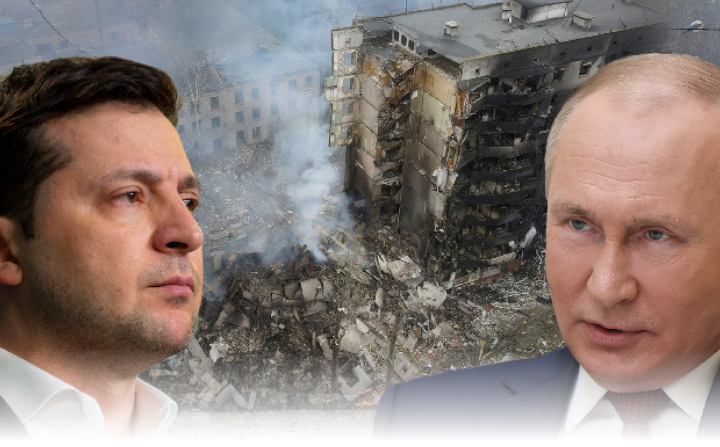
Ukraine became the largest sovereign state formed during the collapse of the Soviet Union 1990-91. The state had a population of 52 billion and a farming industry worth 20 billion. This eastern democratisation sparked western optimism, only to be short-lived with Ukraine’s Russian relations and geo-location positioning the state at the centre of communism. The Orange Revolution 2004-5 was a Ukrainian rebellion rooted in the initial corrupt election of pro-Russian Viktor Yanukovych – a result overturned with multiple run-off votes. The current president is Volodymyr Zelenskyy.
Despite Ukrainian independence, Putin has continued to view the state as a part of his nation. “Ukraine never had stable traditions of genuine statehood,” he has asserted. Alongside, Putin believed the West (NATO and European Union) would move to wage a proxy war using Ukraine. The only solution: ensure Ukraine’s neutral status. However, any proposition for this agenda, especially one suggesting alignment with EU and NATO, did not satisfy Putin and war ensued.
Putin’s movements were justified by the need to “demilitarise and denazify the state” An arguable statement when, in Ukraine, antisemitism is punishable by fines or imprisonment for up to 5 years. Putin simply wants to divide, capture and eventually annex Ukraine, a goal reflecting the historic ideal of Russian nationalism and thus a policy of de-Ukrainization, a mandate to restore Russia to its former Soviet Glory. Understanding this, Ukraine cannot be a part of NATO and NATO cannot exist within Ukraine.
Besides the evident human cost of war, global and inter-region economic consequences emerge, primarily because of sanctions and impeding trade.
On 21st February 2022, the day Putin orders troops to Ukraine, sanctions started. The UK blocked the provision of financial services to Russian citizens and froze the assets of five Russian banks. European Union froze assets and imposed travel bans on individuals (e.g. Putin, the Russian Foreign Minister Lavrov and 351 State Duma who voted in favour of the recognition of Donetsk and Luhansk on 15 February 2022). Biden’s executive orders banned all investment, imports and exports, while sanctioning VEB, PSB – financial institutions critical to the Russian defence industry.
As Russia is a major fossil fuel supplier globally, the most impactful sanction has been on oil and natural gas. Sanctions threaten to contract Russia’s economy by up to 10% this year and hike inflation by more than 20%. Meanwhile, Russia accounts for 29% of the global wheat supply, while both Russia and Ukraine supply 75% of the global sunflower oil supply. Globally, consequential supply chain uncertainties and disruptions have skyrocketed prices. The World Bank quantifies impact as a 0.7% decrease in global income primarily through global exports. Countries, for example, Vietnam, Thailand, and Mexico, have heavily imported Russian energy for manufacturing sectors, resulting in a clear negative impact. Trade sanctions and thus similar analysis extends to the Russian agriculture sector.
Resulting supply chain uncertainties and logistic disruptions in the broader region have caused global surges in cost of living. This is rooted in higher prices of longer air routes to avoid the Ukraine-Russia air space, blocked Ukrainian ports and thus slower Rail Transit relevant to transport between Europe and China. Higher transport costs from port congestion worsen commodity prices.


The writer is studying History, Politics and Economics at the University College, London. She can be reached at azaididua@gmail.com
Leave a Reply