To make sure that cities provide opportunities and better living conditions for all its residents, the concept of inclusive cities is essential, which involves a complex web of multiple spatial, social and economic factors, which include:
•
Spatial inclusion: urban inclusion requires providing affordable necessities such as housing, water and sanitation. Lack of access to essential infrastructure and services is a daily struggle for many disadvantaged households;
•
Social inclusion: an inclusive city needs to guarantee equal rights and participation of all, including the most marginalized. Recently, the lack of opportunities for the urban poor, and greater demand for voice from the socially excluded has exacerbated incidents of social upheaval in cities;
•
Economic inclusion: creating jobs and giving urban residents the opportunity to enjoy the benefits of economic growth is a critical component of overall urban inclusion.
However, the spatial, social and economic dimensions of urban inclusion are quite intertwined, which can lift people out of exclusion and improve lives. Therefore, The World Bank’s work in urban development aims to build sustainable cities and communities through an urbanization process that is green, inclusive, competitive, and resilient. It has adopted an integrated approach to transform the fundamental systems of cities, focusing on four priorities:
•
Enhance Planning System and Local Capacity building by helping cities strengthen their planning systems and local capacities to better design, plan, and manage city assets and urban environments.
•
Strengthening Fiscal and Financing Systems by supporting cities to maximize access to finance through private sources and enhancing fiscal and financial systems.
•
Promote Territorial and Spatial Development: Analyzing cities not only as individual entities but as interdependent networks and identifying priorities of lagging regions, connecting urban and rural spaces, and addressing spatial inequalities to enable faster economic growth.
•
Build Climate-Smart and Urban resilience: Improving cities’ capacity to adapt to a greater variety of changing conditions and to mitigate the impact of climate change through building infrastructure resilience, mobilizing capital, and financing climate strategy and analysis.
Leveraging Urbanization in South Asia
Rapid urbanization in South Asian countries provides an opportunity to the countries in the region with potential to transform their economies to join the ranks of richer nations in both prosperity and livability. However, one major problem is that the process of urbanization in South Asia has been messy and hidden. Thus, the region has a choice to continue on the same path or undertake difficult and appropriate reforms to improve the region’s trajectory of development, which are essential in making the region’s cities prosperous and livable.
The Case of Karachi
Pakistan is the most urbanized country in South Asia. Officially about 36% of its population is classified as urban; however, the World Bank’s estimates suggest that about 45% of Pakistan’s population lives in urban areas. Karachi is Pakistan’s largest city, growing at a rate of over 3% annually, mainly due to large scale migration from within Pakistan as well as the presence of illegal migrants from Afghanistan, Bangladesh and Myanmar. It was Pakistan’s capital till 1959 and now is the capital of Sindh Province. It contains about 8% of the former’s population and about one third of the latter’s population. During 1951-98, Karachi’s population recorded about nine-folds increase, from 1.1 million to 9.2 million. The 2017 census reported about 15 million inhabitants; however, it is largely believed to be an undercount and current population estimates are about 23 million. According to Sindh Government’s estimates, about 40% of Karachi’s population lives in squatter settlements. Thus, Karachi needs special attention for better urban planning, up gradation of slums and squatter settlements, improved public transportation, better sanitation, rational water use policies and waste management. During the past five decades, The World Bank has taken several initiatives to address these problems through loan facilities, particularly improving water supply, the sewage system and upgrading of squatter settlements and urban transport system.
More recently, in 2018, The World Bank took an initiative through undertaking a Diagnostic and Transformation Strategy compiling a Report on “Transforming Karachi into a Livable and Competitive Megacity”. The Report recognizes that Karachi is the country’s financial and economic hub, generating 12–15 percent of Pakistan’s gross domestic product (GDP), and is a powerhouse of manufacturing employment in the country. However, the City and its surrounding economic agglomeration are not generating economic productivity gains for the country. The stagnation of economic activity is problematic for long-term economic and social potential. However, substantial poverty reduction in the City, during in the past ten years is reported, with 9 percent of the city’s population living in poverty in 2014–15 compared to 23 percent in 2004–05. Despite this, there are pockets of high poverty and great variation in wealth within Karachi, due to its large physical and population size. The Report suggests Karachi could be transformed into a livable and competitive megacity city through proper strategic planning. Thus, in addition to large-scale public and private financing, the City needs major reforms to improve its urban governance, institutional capacity, and coordination so that it can become a more economically productive and livable city, based on four key pillars that will be important for the city’s transformation:
1. Building inclusive, coordinated, and accountable service-delivery institutions by creating strong coordination mechanisms among various public land-owning and service-delivery agencies. Improving the ability of these agencies to plan, finance, and manage development programs. Empowering local governments to take the lead in city management.
2. Greening Karachi for sustainability and resilience by investing in environmentally sustainable infrastructure gaps and safeguarding funds for its maintenance by creating mechanisms to protect vulnerable groups from the negative impacts of economic growth and climate change and building a resilient and sustainable environment with an emphasis on livability and regeneration.
3. Leveraging Karachi’s economic, social, and environmental assets by involving the private sector in infrastructure provision by creating an enabling environment via public-private partnerships; reducing delays and discretionary power for key business transactions under city and provincial authorities; improving cost recovery and revenue collection for basic services while safeguarding vulnerable groups such as the poor; leveraging the city’s land assets to finance critical infrastructure.
4. Creating a smart Karachi through policies and the use of smart tools and technologies, by innovating with smart policies to better manage city services; improving economic competitiveness, and facilitate through engagement with citizens. Interventions should also focus on improving the ease of doing business to help enable economic growth and job creation.
The report underlines the structural nature of the city’s problems and recommends a comprehensive, programmatic, and phased approach to strategically tackle these challenges. The World Bank has already taken some initiatives through loan facilities, in discussion with the Provincial Government. 




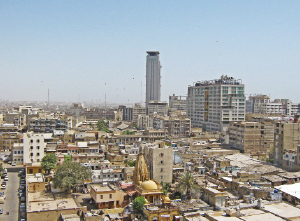 The two most important events since the end of second World War which have affected our life are: a phenomenal increase in the world’s population from about 2.5 billion to over 7.5 billion now and transformation of the world into a predominantly rural to a predominantly urban entity. For example, in 1950, 28% of the world’s population was living in urban areas: this had exceeded 50% in 2010. According to the World Bank’s estimates, today some 56% of the world’s population – 4.4 billion inhabitants – live in cities, Thus, cities will continue to grow since every year millions of people relocate mainly due to increasing population pressure on agricultural land, forcing people to migrate to cities. With the current growth, it is expected that, by 2050, about 7 out of 10 people in the world will live in cities. With more than 80% of global GDP generated in cities, urbanization can contribute to sustainable growth if managed well by increasing productivity, allowing innovation and new ideas to emerge. Thus, the sheer size of cities in developing countries cast doubt on their ability to continue providing improved standards of living. Kingsley Davis, a well-known social demographer, considered three traits as being responsible for the destruction of ancient cities; constant in-migration; high density with too many people living in small areas and; concentration of wealth in a few families. Indeed, in the early 1950s, he had warned that if the modern cities are unable to cope with these three traits, they will soon encounter spread of diseases, environmental depletion and street violence through internal conflicts, leading to deaths and serious injuries. It is important to note, that the speed and scale of urbanization brings challenges, including meting accelerated demand for affordable housing, well-connected transport systems, and other infrastructure, basic services, as well as jobs, particularly for the urban poor who live in slums or squatter settlements, which lack basic civic amenities. In many developing countries, on the one hand, there is constant migration of people from rural areas to cities in search of employment, and on the other, people also move to cities due to internal conflicts in remote areas and as a result of climate change causing floods, resulting in displaced people heading towards cities.
Leave a Reply