



 For those people who have been to the prime of Pakistan television, the alarm must be raised when they come to know about a new TV serial becoming all the rage among the audience. This premonition has more to do with the subpar aesthetic parameters espoused by the charade of cultural cognoscenti and amateur dramatics today than the intrinsic fault lines which delineate Pakistani plays at present.
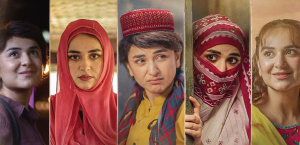
‘Bakht Aawer,’ a new TV serial currently on air on Hum TV, has many things to behold and bemoan. Since most play reviews acclaiming ‘Bakht Aawar’ are loaded with impressionistic views, a detached approach may help one deduce an underlying pattern from the on-going TV serial, making it another massive hit after ‘Habs,’ ‘Parizaad,’ and ‘Mere Paas Tum Ho.’
Glamourising a particular gender at the expense of belittling the other, ‘Bakht Aawer’ portrays a leading female protagonist, yet a gender-in-between character, who is hell-bent on manipulating gender stereotypes, while the rest of the cast does their utmost to endorse the gender-specific attributes they put on public view with great vanity.
What makes ‘Bakht Aawar’ a disturbing spectacle is the continuation of the trend of collective composition in the realms of performing arts in general and playwriting in particular. As is often the case, people who have nothing to do with TV production or screenwriting put their heads together to first frame the plot of the story, decide its central storyline, and then ask the screenwriter to turn their disorganised imagery and sparse ideas into a coherent script as per the dictated lines.
With too many cooks in the kitchen, the final script is even predicated on the expert opinions given by marketing professionals, brand managers, and advertising gurus. More than a work of an individual playwright, the play script winds up as a commercially written piece of group writing, shrewdly customised to be employed as a perfect business venture that could win TRPs, generate enormous ad revenue as well as achieve vested interests for the original content manufacturer working offstage.
Another common feature evinced in ‘Bakht Aawar’ is that almost every scene of the TV serial featuring Bakhtawar and his male side Bakhtiar alias Bakhtu is supported by an excessive amount of emotionally charged music together with a repeated rendition of the original soundtrack (OST) or its instrumental. Donning the guise of another gender, the immature portrayal of the male side of Bakhtawar has cleverly been subsided with some heart-wrenching music and supportive sound effects – the most common tactics employed in current TV serials to camouflage lousy acting and second-rate performance.
For a tomboy like Bakhtu, in technical terms, it takes more than a heavy and deeper voice coupled with cross-dressing to depict a young, male character. Compared with girls, ours is a society where young boys, colloquially known as pappu bachcha and chikna londa because of having a smooth, girlish face, suffer more harassment and sexual abuse at the hands of both men and women. Due to a litany of socio-cultural factors, however, their sufferings go unnoticed more than those of female victims.
Though the TV serial is powered by stellar production and meticulous camerawork, it is tainted with a well-executed mischaracterisation of religious-minded people yet again.
On the surface, the exponential rise of similar kinds of TV serials enjoying galactic popularity has steadily evolved into the ‘pulp production,’ a subgenre of TV drama, which is based on mawkish, schmaltzy stories published in Urdu digests and tawdry novelettes and are read by a large number of readers, mostly women, with drooling gusto.
In aggregate, if TV plays of yore were known for their powerful scripts and artistic excellence, TV serials today are characterised by a formulaic storyline based on an ulterior motive. To all appearances, ‘Bakht Aawer’ is yet another agenda-driven play that looks more of a social engineering tool than an intriguing prime-time show meant solely for family entertainment. 
Leave a Reply