



Eight years are enough to gauge the performance of any government. By the end of this period, the impact of policies enacted by the incumbent regime are obvious, and leave little doubt about its overall governance.
For India’s Prime Minister Narendra Modi and his BJP supporters, the completion of his government’s eight-year term on May 31, 2022 marks a very important milestone as it has dispelled much of the anticipation and optimism centered around Modi’s economic prowess.
In 2014, BJP cashed in on Modi’s persona and his success in running the affairs of Gujarat state which was under his control. The fact that Narendra Modi played an important role in Gujarat’s economic development is still contested by scholars who argue that the state was showing a high rate of economic growth in the 90s long before Modi took office. Moreover, despite economic development, the state of human development in Gujarat remained pathetic throughout Modi’s tenure.
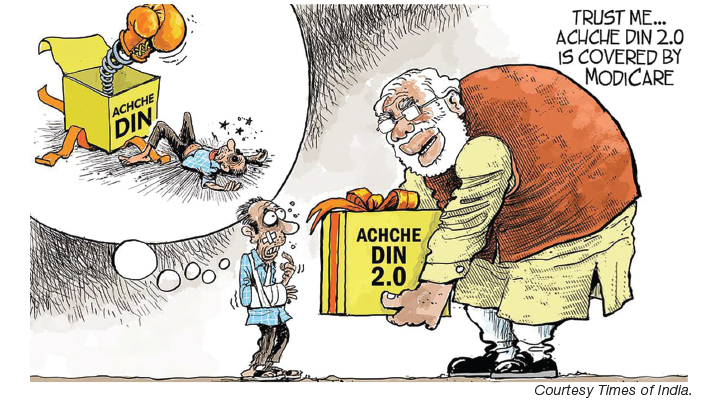
The BJP very cleverly downplayed these facts and campaigned on the promise of widespread reforms, economic growth and above all, equitable distribution of wealth. All of this was summarized in the catchy slogan ‘achche din’ or good days. It was a promise that if Narendra Modi was elected as prime minister, it will be the beginning of good days for the entire nation.
After eight years in power, Modi has yet to make good on his promise of ‘achche din’. In fact, for the masses, the reality has been anything but ‘achche din.’ Unemployment is high and inflation rampant. The Common man is burdened with high food prices. Life has become unbearable for low-income households. Meanwhile, BJP’s rhetoric of hollow economic achievements is adding insult to injury. Mr. Modi claims to have achieved 8.7% economic growth which is a joke considering 8% unemployment, around 8% inflation, a rapidly rising current account deficit and depleting reserves. The Indian rupee is in a nosedive against the dollar.
The ‘buray din’ or bad days of the Indian people started with the ill-conceived shock of demonetization in 2016 which failed to achieve any objective. This was followed by the equally spectacular failure of General Sales Tax (GST) implementation in 2017. The GST along with more than a thousand amendments complicated the taxation regime to the point of sheer incomprehension. Experts insist that the very structure of the GST is flawed and needs fundamental reforms. Then came the Non-Banking Finance Companies (NBFC) crisis of 2018. A succession of bank frauds over eight years has eroded public trust in the banking system. The combined effect of these crises has battered the economy and squeezed life out of the common man.


The writer is a freelancer and an investment banker based in Karachi. He can be reached at syedatifshamim@hotmail.com
Leave a Reply