Urban Life
My Zatara!
Urban planning is a definite science and somewhat of an art - and it is not practiced in a city like Karachi.

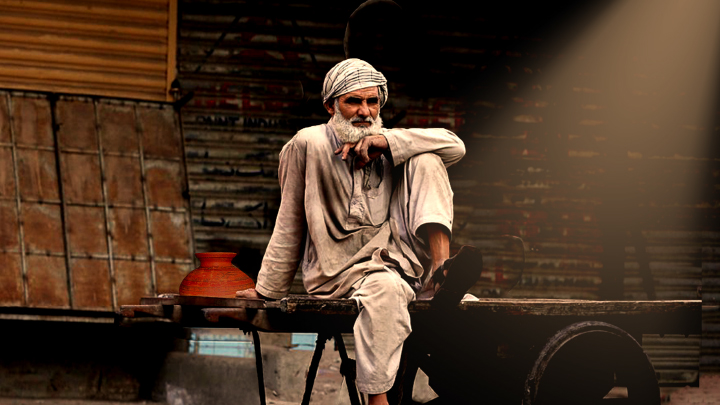
For me he is a character from the city of saints and madmen. Drifting through the streets, without any destination. The journey he is undertaking is all the purpose he has in life. It starts from one end of the street, and culminates at the other end. And then he starts all over again, after a pause of five minutes. When he exhausts himself, he rests on one of the footpaths, or drinks from one of the earthen vessels (matka) placed outside a big bungalow for the watchmen and security guards. I call him ‘Zatara’- and I come across him every day, although from a distance. Giovanni “John” Zatara also happens to be a fictional character appearing in comic books published by DC Comics, and in Spanish it is slang for driftwood, referenced in Count of Monte Cristo, “I shall call you, Zatara.”
Zatara is a middle-aged senile man, who lives on the street, and is found frequenting it day and night in an affluent neighborhood of Karachi. He doesn’t talk to anyone but himself, and doesn’t bother anyone either. The only time he loses temper is when someone interrupts his routine of walking up and down the street or calls him names. The pace of his strolls increase when it becomes dark, and he prefers resting more during the day. Yes, senile, but having a sense of the impact of the heat. He asks for food from the watchmen and domestic servants socializing on the streets, who willingly oblige. Many refer to him as ‘pagal’ and some think of him as an ISI agent, on a secret mission in disguise. The neighborhood children are scared of him, because their elders have told them stories of madmen being a source of harm, or causing discomfort.
For me he is someone who makes me think about ‘equity’ in a city. As professionals, engaged with the built form design and research, we talk about sustainable development, with equity being one of its major pillars. Equitable development means fair, impartial development without any discrimination based on race, income, ethnicity, religion, gender or caste. But how equitable are the buildings and cities we design today? Do we ever think about making our urban spaces and buildings inclusive for the ‘zataras’ of the city? In fact, our plans and designs are quite the opposite, and anyone who does not fall within our definition of ‘normal’ is excluded from these proposals and policies, resulting in the ‘zataras’ of the city being abandoned on the streets, or banished to nearby shrines.
My ‘zatara’ is just an example of someone who falls out of the norm. Do we design our cities for the elderly, for people with mobility issues, for expectant mothers, for mothers with young children, for ethnic minorities, or for women in general? Sadly, our cities are designed for a middle aged healthy Pakistani male belonging to a certain class and a certain income bracket. If you belong to this group, you are happy and content with your surroundings. If not, then you are an outcast and that too is your fault. Why were you born a woman, a differently abled person, or within an ethnic or religious minority?
If one were to actually understand the role of the informal processes, and out of the norm practices in a city like Karachi, one would realize the importance of planning for these madmen, instead of the saints. Many studies have been done which conclude that about fifty to sixty percent of residents live in informal housing in Karachi. According to the recent population census of 2017, Karachi has a population of sixteen and a half million.
Some effort was made to include the people sleeping on the streets, or ‘homeless’ in this count too. Although the detailed results of the census have not yet been officially announced and there is a lot of political debate behind these too, but even an attempt towards including the homeless in the counting of the census is a way forward. As per studies (architect/ planner Arif Hasan and Prof. Dr. Noman Ahmed), the housing demand in Karachi is one hundred and twenty thousand units per year, which the formal sector fails to fulfill. The formal sector provides forty-two thousand units per year followed by thirty-two thousand units provided by the informal sector. The remaining demand is adjusted through densification of existing squatter settlements. A sizable population also lives in over-crowded conditions. Not only do the poor have fewer housing options than the privileged, they are also constantly challenged in their search for housing. They end up making houses on the banks of nullahs, along the railway lines, under bridges and in other leftover public spaces. Although many of these housing colonies are set up through the patronage of the formal sector employees and through paying huge sums for under the table deals and bribes, but the fear of eviction keeps lingering over these poor members of society. The recent Nasla Tower case is an example of members of the formal organizations facilitating informal processes.
Informal processes also seep into the economic survival of the poorer sections of society. Karachi contributes 15% of the GDP and accounts for 25% of the federal revenue. It also accounts for an expanded informal sector that sustains employment for more than half of the city dwellers. It possesses a rich tradition of street vendors who sell goods and extend services to a large clientele. These vendors are categorized as informal enterprises due to absence of any legal cover. In such a precarious situation, evictions, confiscation of assets and demolition of the static or permanent structures added to the place of business, is a usual predicament encountered by them for many years.
Unfortunately, these informalities are not recognized as part of the larger master plans and fancy urban development plans drawn up for major cities of Pakistan, often via funding from international donors and aid agencies. Yet the conceptual framework put across in these fancy master plans is of sustainability and equity, but the question arises that can we even start to move towards sustainable development without addressing the stakes of numerous ‘zataras’ all around us. The various informal social, economic, planning and governance processes and procedures are not recognized either in these formal planning documents, although these informal practices hold firm ground for many of the locals, and are greatly valued by them, and they are an everyday reality for many.
This brings to mind the modern movement as a principle and a theory, where land use of the modern cities was divided between work place, residential place and recreational place. So you were expected to divide your day accordingly and spend equal amount of time in each of these types of land uses. You would work for eight hours, rest for eight hours, and engage in errands and recreation for the remaining eight hours in a day. Thus, if you happen to be someone who doesn’t have a nine to five job, or if you are a mother on maternity leave, or bringing up young children, or someone who is living a retired life, then this zoning doesn’t work for you, and you are an untouchable. The legacy of modernism still continues, where cities are being designed for the selected few, the fortunate few, the designated few, and are in no way equitable spaces.
The ideas of ‘equity’ need to be revisited and cities need to belong to ‘madmen’ as much as they belong to the ‘saints’. Afterall it is the informal spaces in our cities, which are most equitable, because they absorb all the ‘zataras.’ It is also the people living within these so-called ‘informal spaces’, or ‘katchi abadis’ or ‘jhuggis’ or ‘slums’ who attend to the needs of, and relate with people like ‘zatara’. No begum or sahab is worried about ‘my zatara’ being fed, it is the domestic workers, the watchmen and the sweepers who share their meal with him on a daily basis.
I often wonder what my ‘zatara’ thinks of me, and what planning and living options would he decide for me if the tables were to flip around. Yes, he is a madman because he doesn’t worry about getting a job, investing in properties, sending his children to Ivy league colleges, eating at fancy restaurants, or wearing branded clothes, but doesn’t that make him saner than many of us, who are running behind this image of a ‘perfect’ life, and calling that development, progress and equity. How I wish there were ‘zataras’ holding important ranks in the city! Wouldn’t the world be a much ‘equitable’ place, if the tables were to actually turn around? There is a requirement for scholars and planners to realize that the city can be both a site of potential and precarity for the marginal members of society, and to theorize these peripheral processes, and generate understanding and role of these in the larger urban realm to move towards a more equitable society. Perhaps, the planners and scholars need to role play as ‘zatara’.![]()

Suneela Ahmed is an architect, urbanist and academic associated with the NED University of Engineering & Technology, Karachi. She can be reached at suneela_mail@yahoo.com


Leave a Reply