



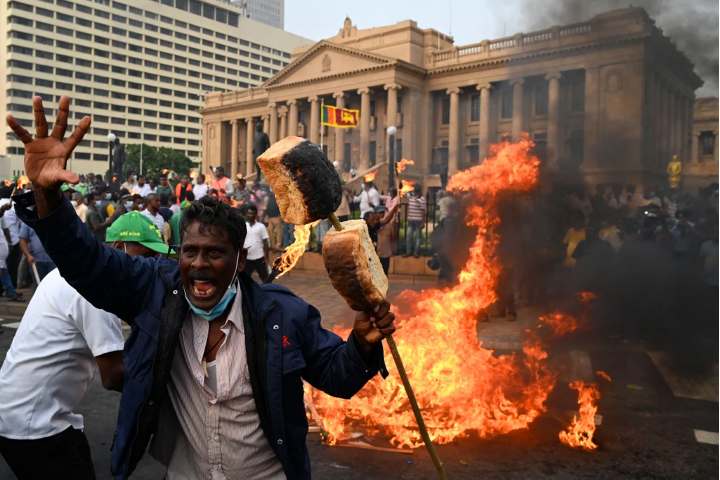
Until recently, the Civil War was the notorious highlight of the sovereign history of Sri Lanka. Fortunately (or not so much), that historical marker has been replaced as the leading symbol of recognition. Ironically, President Gotabaya Rajapaksa - hailed as the hero of the Civil War - has manufactured the current misery for the nation in the form of rampant inflation, depleting dollar reserves, mounting external debt, and shrinking necessities. The crisis has paralyzed the Sri Lankan economy. However, the blatant highlight is not the chaotic situation. The pandemic is predominantly to blame. Yet, the deteriorating conditions are (at least to a considerable extent) due to the lax economic policies alongside redundant political measures. A way out is still possible with a proactive approach towards immediate restructuring. However, the lingering scepticism and disorder in the ruling cabinet threaten any last remaining semblance of stability.
While many onlookers assume that this economic disparity stems from the pandemic, the reality dates back a few months further down. Since President Rajapaksa took office in 2019, the economy has struggled to maintain pace. The tourism industry is a prime example. It accounts for over 10% of Sri Lankan GDP and contributes as the third-largest foreign exchange earning industry. The infamous Easter terror attacks tripped the already struggling sector - the onslaught of tourists dropped by 21% relative to the preceding fiscal year. Excessive terrorism and radical political decisions hampered the flow of investments as well. According to government data, Foreign Direct Investment (FDI) dropped from $1.6 billion in 2018 to $793 million in 2019. The sharp slump in revenue was further steepened by the populist tax cuts in late 2019. The congregate evidence suggests that the pandemic was not the cause but a catalyst for economic deterioration. Through the rigours of the pandemic, the Sri Lankan economy contracted, inflation spiralled, and foreign exchange earnings plummeted while the debt burden swelled.
Today, the $81 billion economy is beset with a twin deficit. President Rajapaksa recently stated that the national trade deficit could crawl up to $10 billion in this fiscal year. Remittances have already plunged due to the Covid-induced recession worldwide. The core issue is the shortage of fuel and food essentials. The Sri Lankan rupee has already depreciated by more than 50% against the US dollar this year. The foreign exchange reserves have dried up by 70% to $2.31 billion - barely enough to finance a month of imports. The apparent inability to pay for even the most staple imports - sugar, cereals, and pulses - has led to severe shortages and clashes. The impact is reflected in the consumer prices as inflation clocked at almost 19% in March - the highest level in Asia. This year alone, projected debt payments stand at a prohibitive level of $7 billion. Clearly, a country running twin deficits with paltry forex reserves and a rapidly depreciating currency cannot finance the debt servicing costs without economic aid. Here lies the problem of successive political mismanagement and chaotic decision-making.


The writer holds a Bachelor's degree from the Institute of Business Administration (IBA), Karachi. He can be reached at szainabbasrizvi.14122@khi.iba.edu.pk
Leave a Reply