


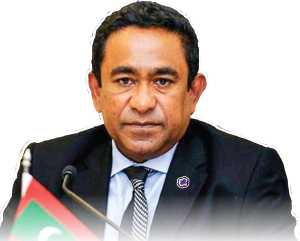
 In February 2019, the criminal court in the Maldives, ordered the arrest of former president of the Maldives, Yameen Abdul Gayoom who was held in custody on allegations of money laundering and the associated activities of fraud and corruption. Initial police investigations found illegal payments of around $1 million stashed in his bank account. Reports suggested that he may have siphoned off government money through a private company earlier involved in fraudulent real estate deals.
Yameen Abdul Gayoom, who is the half brother of former Maldivian president Maumoon Abdul Gayoom, served as the President of the Maldives from 2013 to 2018. He lost the 2018 elections to the joint opposition candidate, Ibrahim Mohamed Solih. In 2019, Yameen was sentenced to five years imprisonment with a fine of $5 million, but his jail term was converted to a house arrest because of the coronavirus pandemic. However, in a twist, the court overturned the money-laundering and embezzlement charges levelled against him on the basis of insufficient evidence in the case. Following the decision allowing him to contest in the next general elections, scores of Yameen’s supporters gathered at his residence in Malé, the capital of the Maldives.
The overturning of the verdict could change the equation for the opposition and for the candidates willing to contest against Yameen. One of his greater missions while serving as the President was to strengthen the country’ bilateral relations with China, a drastic move which was viewed with caution by India –a traditional ally of the island nation. At the domestic level, Yameen’s government was active in silencing the opposing individuals, groups and the media critical of his government’s actions. Yameen also played a part in overthrowing the government of Mohamed Nasheed, the first democratically elected president of the Maldives.
All set to resume his suspended political activities, Yameen will have a chance to undo what he did when he was in power. His opponents may not accept his return as his duplicitous acts are still remembered by his political adversaries.
Perhaps Yameen’s return to the political scene will create two factions within the Maldivian government. The first faction will comprise his close-knit political stalwarts favouring closer ties between the Maldives and China. The other faction, in a complete contrast, will consist of those politicians who are pro India. During his tenure as president, Yameen was also blamed for affording China an ample room to exercise its economic might in the Maldives, which is now under China’s economic debt trap. Opposition parties also blamed Yameen for allowing China to take hold of about sixteen islands mainly for his vested interests.


The writer has a special interest in social and political affairs. He can be reached at omariftikhar82@gmail.com
Leave a Reply