



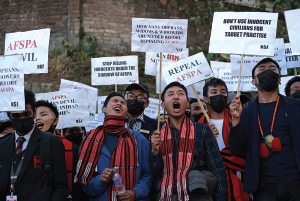
 The killings of 14 civilians at the hands of Indian armed forces in Mon district of Nagaland in early December has sparked outrage in India over the draconian use of the Armed Forces Special Powers Act 1958 (AFSPA). Along with the civil society, the chief ministers of Nagaland, Manipur and Meghalaya have become vocal against the repressive AFSPA and have been calling for its repeal. Talking to media on December 6, the chief minister of Nagaland and the senior leader of National Democratic People’s Party Neiphiu Rio said that he had urged the Union government to remove the AFSPA as it is “a black spot on the image of the country”.
Commonly referred to as the licence to kill, the AFSPA legislation has been opposed since its enactment, because the Act gives security forces extraordinary powers to use in counter-insurgency operations, not to exclude the power to detain, arrest, and kill insurgents challenging the state writ. It enables the security personnel to kill civilians at first sight even by opening fire, particularly on those who are perceived to possess any kind of weapons or are involved in contravening the law. Thanks to the tyrannous AFSPA move, it also allows the Indian security forces to destroy and damage property and search homes without a warrant, that too on the basis of mere “reasonable suspension” and without recourse to justice.
The law is applicable in areas which have been declared ‘Disturbed’ under Section 3 of the AFSPA by either Central government or Governor of the concerned State, or the administrator of Union Territory. The term ‘disturbed area’ refers to those regions struggling with law and order issues.
Tracing its origin back to colonial times, the AFSPA was enacted by the British government in 1942 in order to suppress the Quit India Movement. However, after the independence of the subcontinent from British rule, the then Indian government decided to retain the notorious law, keeping in view the so-called ‘disturbed conditions’ in the country’s north-eastern areas. After about a decade of India’s independence, the Indian Parliament passed the AFSPA Bill in September 1958, incorporating the infamous Act in its Constitution.
The Act has remained in force in a number of Indian States and Union Territories from time to time. For instance, it was enforced in Punjab in 1983 to suppress the emerging Khalistan Movement, but the Act was revoked in the late 90s. In addition to that, it also remained effective in the Meghalaya state until it was removed on April 1, 2018, making Meghalaya the last state to repeal it. The Act is currently operational in Assam, Nagaland, the Indian-occupied Jammu and Kashmir (since 1990), and Manipur (excluding Imphal municipal area) as well as in parts of Arunachal Pradesh.


The writer is a freelance contributor based in Larkana, Sindh. He can be reached at sjatoi831@gmail.com
Leave a Reply