



In the initial years of independence, India’s first Prime Minister, Jawaharlal Nehru, and the ruling Indian National Congress (INC) (chief legatee of the freedom movement) advocated for an Indian brand of multiculturalism and secularism. PM Nehru underscored that his modern, progressive, and secular strategies assisted him in striking a balance between ethnic, linguistic, and religious diversity, which was a significant strengthening and unifying force of the Indian society. Reckoning the noxious interpretations attached to Hindutva as an ideology, PM Nehru was conscious that if it was endorsed or integrated into politics, it would rend the unique traits of Indian society. That is why he kept Hindu fundamentalists at bay even in the Constituent Assembly when drafting India’s first constitution.
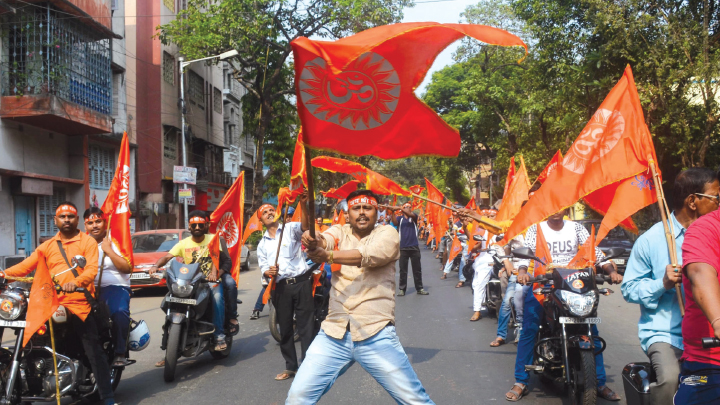
Seventy four years down the line, in today’s national political landscape, one is witnessing the exact opposite in India: orthodox political entrepreneurs promoting ethno-religious identities. The Hindutva ideology has today dramatically reshaped the dynamics of Indian politics under the stewardship of PM Narendra Modi. But, the shift has been called into question as it certainly does not favour the blueprint of the architects of modern India and the future of the country’s secularist traditions and assurance of diversity.
It is imperative, therefore, to reflect on ‘what went wrong’ in the decades leading up to the current Indian political milieu.
As published in the CISS South Asia Monitor, during the independence movement, the Hindutva ideology was ‘mobilized’ against the Congress Party’s secular and pluralist standpoints. While Hindutva goons considered the creation of Pakistan a betrayal of the Hindu nation, they also labelled Congress and Mahatma Gandhi as pseudo-secularist – minority appeasers.
In the early years after independence, Congress, under the leadership of Nehru, remained in power with no strong opposition. A variety of more or less newly formed political parties like the Kisan Mazdoor Praja Party (Farmer Worker People’s Party), the Revolutionary Socialist Party, etc. could not challenge the gigantic Congress.
Meanwhile, Jan Sangh (the political arm of Rashtriya Swayamsevak Sangh- RSS) aspired to consolidate India’s most prominent religious group – Hindus, into a solid voting bloc. Given the Hindu polity, they stood for the reunification of the motherland through Pakistan’s absorption (or perhaps conquest). They sought to ‘recreate’ the ‘golden age of Hinduism’, which never existed as a unified India under Hindu rule.
According to renowned French political scientist and an expert on Indian affairs, Christophe Jaffrelot, following Mahatma Gandhi’s assassination in 1948 by a Hindu fundamentalist, and an RSS member, Nehru’s fears of India’s communal divide ‘heightened’, since he believed that emerging Hindu communalism would ‘bring ruin and death to the country’– a concern he even raised during his 1951-52 campaign.
A staunch believer in sustaining a powerful centre, Nehru restrained politicians from promoting religious polarisation in their campaigns. It is widely acknowledged that his stringent scrutiny over the menace of Hindutva and his centralised strategy to rule saved India as a secular nation and prevented nurturing of this ideology in the country’s political terrain.


The author is a researcher at Centre for Aerospace & Security Studies (CASS), Islamabad. She can be reached at cass.thinkers@gmail.com
Leave a Reply