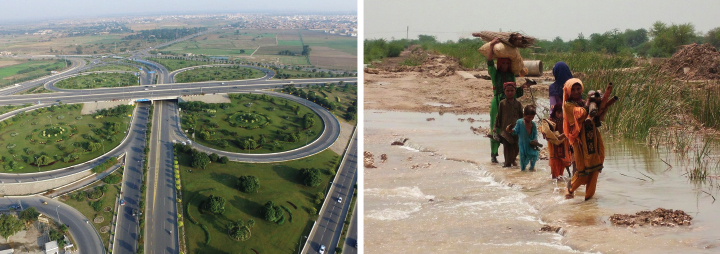
Burewala
Development Disparities
In terms of provision of services and basic facilities, an ever-increasing gap between the urban and rural areas remains the central form of regional disparity.

One of the inherent dilemmas facing the Third World countries is the fact that they are predominantly ruled by widespread inequality and rampant underdevelopment in their various sectors and areas. The imbalance in terms of development manifests itself in different ways, starting from deplorable conditions of human life to miserably untapped as well as unequal economic and development potential. An ever-increasing gap in the provision of services and basic facilities between the urban and rural areas remains the central form of regional disparity.
Ever since the emergence of Pakistan as an independent nation, a deep-seated intra-provincial disparity has been a serious issue as it even led to the separation of the country’s eastern wing in 1971. Though there is always a lot of room to learn from the past mistakes, the debate on regional and intra-provincial disparity has always been ignored to the extent of forgetting it. The successive governments in Pakistan have been trying to boost the economic outlook and put the country on the path of development by launching multiple fiscal and monetary policies. However, the desired results have never been achieved owing to a range of factors.
As things currently stand, the signs of rising social unrest among the people, coupled with deeply ingrained feelings of deprivation and neglect are evident in different quarters of the nation to the point of weakening the spirit of nationalism and social cohesion. Aimed at winning the public support during elections in particular, the political moves, are highly influenced by making investments in randomly focused infrastructure programmes, which are largely pursued to cover the vested interests of the powers that be, thus being one of the major causes of lopsided development in favour of one group but to the detriment of the other.
Such half-cooked policies can never achieve rewarding results. In this regard, the formulation of laws in relation to spatial planning policies is vital in order to enable an equitable and informed distribution of resources within the country. Committed out of political motives, a random selection of sectors for development widens the gap between different regions. If truth be told, cities tend to be the hub of innovation, liveability, diversity, cultural growth and economic development. Both at national and regional levels, however, only effective and result-oriented measures can make cities an equitable, efficient, economically advanced and sustainable place for all.
Regional disparities set in when decision making is not informed as such decisions should be based on a comprehensive, long-term policy that calls for equitable development and is comparable to the requirements of the region. It must have horizontal and vertical linkages in the laws to maintain an adequate development control and to ensure provision of services and facilities. In the case of stark disparities in development of different regions of the country, the urban areas are flooded with a non-stop influx of people from underdeveloped rural areas who move to urban localities in quest of better living conditions. In Pakistan, it is high time for think tanks, politicians and policymakers to redirect their attention towards a balanced and equitable development. Since cities and urban centres are integral to the economic growth and future prosperity of the country, pertinent efforts must be expedited to leverage urbanisation to make the most of economic and social potentials, which is not possible without devising a well-thought-of, all-encompassing national urban policy.
The policy, based on an integrated approach, must address macro level issues, such as reducing environmental impacts in urban areas, increasing their resilience to natural disasters and protecting people from climate changes. Next to the national urban policy are the regional plans, dealing with efficient placement of land use activities, infrastructure and growth across a larger area of land than a city or town. Regional plans should identify within a region the level of connectivity among the geographically located towns to take advantage of the scale and scope of services.
It is followed by the development authorities for metropolitan cities. Each successive category of a city or an urban town must have an integrated planning mechanism. In the hierarchical system of cities, large metropolitan areas generally lead the country’s economic growth, medium-sized cities provide support to their respective regions and small towns make a direct linkage with their rural hinterlands.
Pakistan must transform its urban centres as the prevailing rural-urban inequality, coupled with haphazard growth of its towns and cities has caused us more harm than good. As a country, we have not been able to develop conurbations as per international standards. The loss is enormous as we are raising our children in an environment that is not conducive, extremely degraded and is certainly directionless.![]()

Based in Lahore, the author is an urban planner, economist and an artist. She can be reached at erumashfaq52@yahoo.com


Leave a Reply