



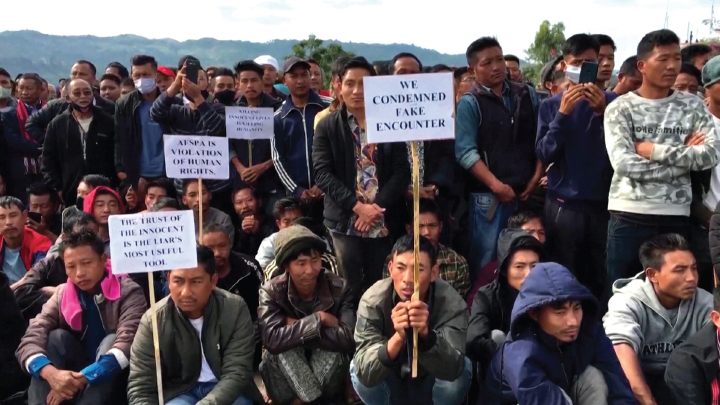
The already shattering Naga Peace-Process is expected to be further aggravated by the recent killing of civilians in the Mon district of Nagaland, a mountainous state in northeast India, bordering Myanmar. The civilian killings in Nagaland occurred as a result of careless operation by the Indian armed forces as they were supposed to target an insurgent convoy. The violent protests followed the unfortunate incident and Section 144 of the CRPC was enforced in the Mon district to restrict the movement of people and vehicles while internet services were also suspended by the state government. Though the government authorities took no time to condemn the attack, they miserably failed to acknowledge the sinister role of the military establishment responsible for the massacre.
As the protests erupted across Nagaland, a complete shutdown was observed in the entire district post-incident. The key Naga group ‘Nationalist Social Council of Nagaland’ NSCN (I-M) has termed the incident as the ‘black day’ for Nagas. The Naga National Political group has also blamed the ‘Armed Forces Special Powers Act (AFSPA) 1958’ for the brutal killings of innocent people and decided to appeal to the central government to totally abolish the AFSPA. Referred to as the licence to kill, the AFSPA act gives special powers to the armed forces to carry out counter-insurgency operations without the fear of accountability as they are provided an umbrella under this act.
Though Nagaland, unlike Indian-occupied Kashmir (IoK), is officially recognized as a part of the Indian Territory, the long-festering uprising in Nagaland is someway akin to the decades-long insurgency in the Indian-occupied Kashmir (IoK) as both Nagaland and IoK demand absolute independence from India. The central government views Nagaland as a remote land with little political and economic significance, giving less regard to the perpetual lawlessness and disorder in the northeast region. Running their own shadow governments, insurgents have maintained an excessive presence and influence in Nagaland for years. Now the recent killings have deteriorated the situation in Nagaland from bad to worse, there is a strong potential of insurgent groups using this incident for recruiting more insurgents in order to further strengthen their positions in the conflict-ridden region.


The writer is a researcher. She holds Masters in Peace and Conflict Studies and can be reached at aneezaamaham@gmail.com
Leave a Reply