



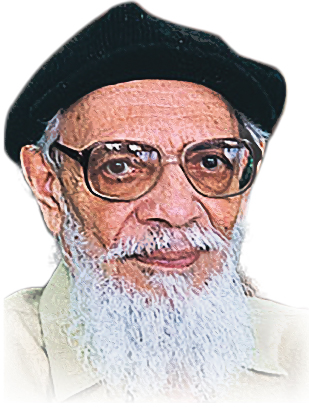
 On October 11, 2005, noted Urdu writer Shanul Haq Haqqi passed away in Ontario, Canada. His death created an intellectual vacuum that was increasingly difficult to fill. In his long, illustrious career, Haqqi took on many avatars and proved his mettle as a multifaceted literary figure. He was a poet, critic, broadcaster, translator, linguist and lexicographer - a formidable feat that few writers can accomplish in a lifetime. An esteemed Urdu writer once declared that Haqqi left behind a substantial body of work that would keep his memory alive for centuries.
Unfortunately, memory often has a fickle, fiendish quality and usually fades away. Sixteen years after Haqqi’s demise, his tremendous contributions to Urdu aren’t widely known or celebrated. In an age when even the most trivial tweets by celebrities regularly grab headlines, the media seldom spotlights the achievements of those whom we owe a debt of gratitude. At this critical juncture, a concerted effort needs to be made to remind the public about such notable figures. If this isn’t done on a war footing, their names would be forever lost in the annals of history.
Born in Delhi on September 15, 1919, Haqqi was the son of a distinguished man of letters. His father’s claim to literary fame stemmed from a valuable collection of short stories, a comprehensive study of Persian poet Hafiz Shirazi and a translation of Diwan-i-Hafiz in verse. Haqqee’s father also helped Maulvi Abdul Haq in compiling Lughat-i-Kabeer, an exhaustive Urdu dictionary.
It is only befitting that a child who was raised in this milieu would develop a fondness for literature. However, Haqqi’s university days exerted a much stronger influence on him in steering him towards literary pursuits. Haqqi pursued a BA degree at Aligarh Muslim University and obtained a Master’s in English Literature from St Stephen’s College. As per an obituary published at the time of his death, he recited his first ghazal at an annual poetic gathering of St. Stephen’s College. This is a glaring testament to his profound fascination in Delhi’s mushairas. Fuelled by his abiding interest in poetry, Haqqi went on to publish two anthologies of verse - Tar-i-Pairahan (1957) and Harf-i-Dilras (1979) - and later released a collection of his selected ghazals.
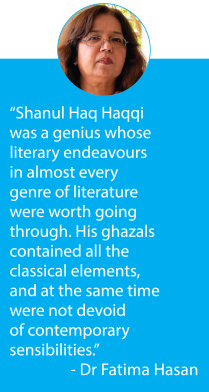 A quick glance at Haqqi’s oeuvre reveals that he wasn’t a prisoner to a particular genre. In a literary career that spanned several decades, he served the Urdu language through multiple avenues. Throughout his career, Haqqi also dabbled in a series of fairly little known genres of poetry, such as Paheliyan, Qitat-i-Tareekhi and Kehmukarnian. A vast majority of these works appeared in a collection titled Nazr-i-Khusru. In addition, he wrote poems for children that were released by the Hamdard Foundation.


The writer is a journalist and author. He analyses international issues and can be reached at tahakehar2@gmail.com
Leave a Reply