



Albert Einstein once said, "I know not with what weapons World War III will be fought, but World War IV will be fought with sticks and stones". Considering today's world scenario in the presence of nuclear warheads, Einstein's presage seems to be a likely possibility in the future. Being the most lethal and destructive form of weaponry, nuclear weapons pose a serious threat to humankind to the extent of its total extinction from the Earth.
Many people consider nuclear weapons as impediments in the way of war activities. This perception is not wrong. Since the making of nuclear weapons, the world has not seen a major nuclear war, except the atomic bombings of Hiroshima and Nagasaki cities in August, 1945 by the United States. Historically speaking, the first nuclear test was carried out by the United States during World War II under the 'Manhattan project'. Within a few seconds of the nuclear explosion, about 14,0000 people died in Hiroshima and some 74,000 in Nagasaki. This event changed the course of the war and kick-started a new race of nuclear weaponry in the world.
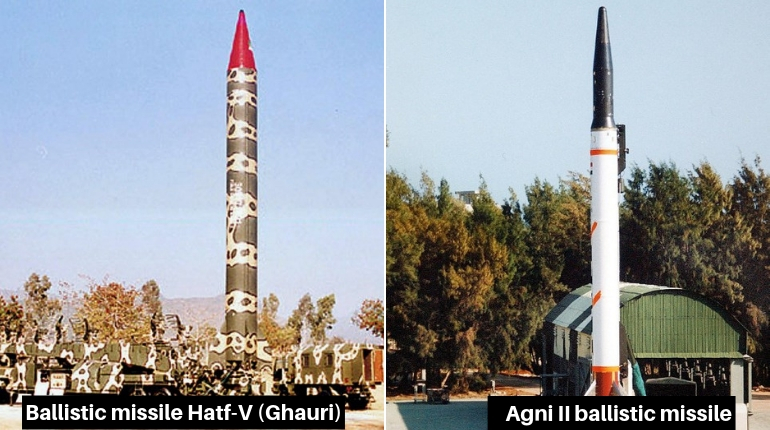
Pakistan and India have never gone to a full-scale war, since both the countries have developed nuclear weapons and stockpiles on both sides skyrocketed. However, the possibility of a nuclear war between both nuclear-armed nations is not far-fetched.
The Soviet Union conducted its first nuclear test in 1949 and the UK carried out their first nuclear test in 1952, France in 1960 and China in 1964. India and Pakistan declared themselves as nuclear states by the end of the 20th century. Reportedly, countries like North Korea and Israel also possess nuclear weapons.
The world's leading scientists, politicians, and human rights activists express their reservations over nuclear weapons. The international community has struggled with the basic dilemma: how to restrain the destructive effects of nuclear technology while harnessing its vast potential for peaceful uses. Many countries seem to have developed their nuclear arsenals in the garb of making the most of the nuclear energy for peaceful uses.
There are more than 15,000 nuclear weapons in the world, says Professor Brian Toon with over 35 years' research in nuclear studies. He posits that if there is a nuclear war between Pakistan and India there will be grave repercussions for these two countries as well as for the whole world, since the smoke produced by atomic bombs will cover the entire world in just two weeks.
The blockage of the sunlight reaching the surface of the earth would result in the shutting down of photosynthesis and more than 40% of wheat and rice crops would vanish. In addition to that, about two billion people would die in a matter of seconds if there is a nuclear war between Pakistan and India. Moreover, if a full-scale nuclear war prevails, about 94% of the entire population would be wiped out, according to research.
The United Nations has passed scores of resolutions against the nuclear arms race. Former US President Dwight Eisenhower founded the International Atomic Energy Agency (IAEA) in 1957 to propagate the peaceful use of nuclear energy in the world. In 1968, the nuclear states agreed to sign a treaty of non-proliferation of nuclear weapons known as the NPT, which is a landmark international treaty. The NPT is aimed at preventing the spread of nuclear weapons and the rest of the weapon technologies to non-nuclear countries. The NPT also promotes cooperation for the peaceful uses of nuclear energy, furthering the goal of achieving complete nuclear disarmament in the long run.
Security of nuclear weaponry is another perpetual dilemma, since nuclear arsenals are vulnerable to cyberattacks. The cyber attack wing of Israel hit the nuclear facility of Iran earlier this year, an eye-opener that helped the world realise a myriad of security concerns over nuclear weapons. In a similar vein, if there is a 1% probability of the nuclear weapons falling into the wrong hands, the world may face dire consequences. The world's leading institutions need to fully understand the importance of the security of these weapons.
Interestingly, since the last bombs dropped on Japan, no major wars have been waged among the world's powers. By drawing a comparison between before and after the invention of nuclear weaponry, it is evident that the world has had more wars before the invention of nuclear weapons. In the First World War, more than 40 million people were killed while in the Second World War, more than 80 million people succumbed to death, excluding the victims of Hiroshima and Nagasaki catastrophes. Global leadership is well-aware of the dire consequences of dropping or using nukes to settle their military scores and the world can never bear the brunt of such a devastating war. Dr. Abdul Qadeer Khan (late) believed that the nuclear weapons were the only reason that India and Pakistan did not wage a full-scale war against each other.
Even though nuclear weapons are considered to be a hurdle in the way of war, humankind cannot afford their presence in the world. One mistake could lead to the annihilation of human civilization and no one will be the winner of nuclear war. The world leadership must think seriously about the future of this planet and its well-being. A world without nuclear weapons must be a far better place than a world infested with nuclear warheads.

Based in Abbottabad, Pakistan, the writer has done his Bachelors in Physics from the Abbottabad University of Science & Technology (AUST). He can be reached at appshahji@gmail.com
yes nuclear weapons are threat to humanity.
i have never go through as such article about nuclear weapons and nuclear war before, very very informative and very simple.
Thank You Azam Hussain shah.
Wonderful and worth reading..
Well done Azam… proud of you
Keep doing….
So proudfull moment dear. Congratulations 👏
InshaAllah one day you will achieve your target.
Our prayers always with you. The hard work is the key of success, so never let the hard work to go. Just keep it up and go ahead.
Informativ….!
Outstanding way of delivering.
You have great knowledge.