



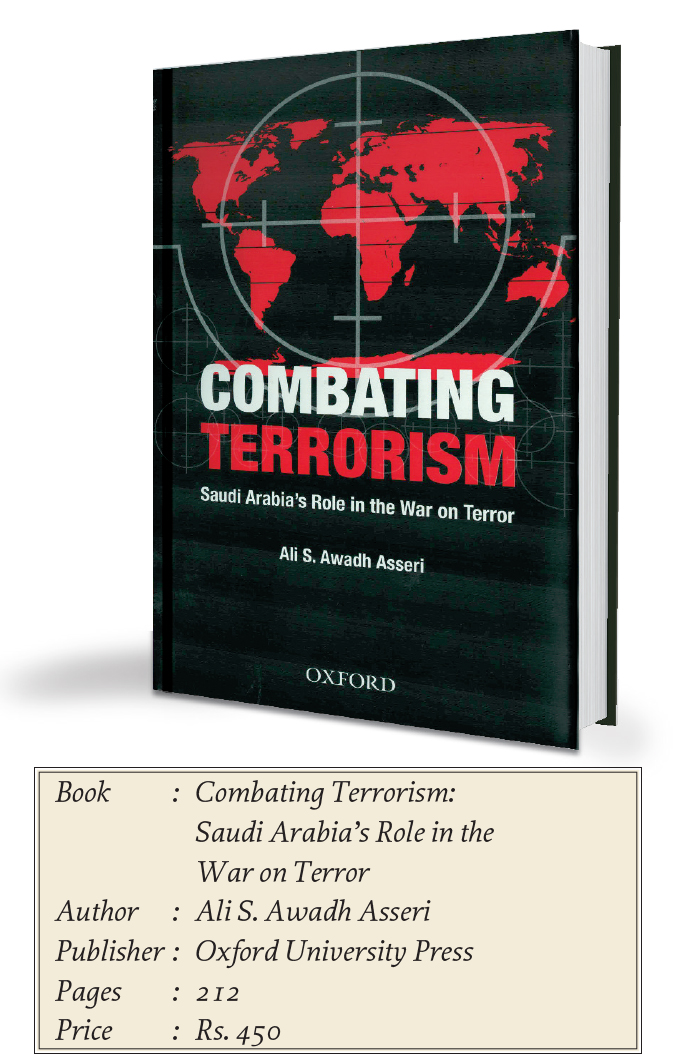
 ‘I understood that terrorism is a problem that cannot be blown off the face of the world,’ Ali S. Awadh Asseri says in the prologue to ‘Combating Terrorism: Saudi Arabia’s Role in the War on Terror.’
It’s all about winning the people’s hearts and minds of both the offenders and of those who suffer as a result of a terrorist attack. These words not only succinctly but also deftly describe the entire purpose of the book. Combating Terrorism discusses the Saudi government’s attempts to combat terrorism, with a focus on the unique three-pronged Saudi approach that has been successfully applied in the Saudi Kingdom. Asseri examines the issues surrounding the definition of terrorism by emphasizing the distinction between a terrorist and a freedom warrior before proceeding to a functional definition. He also analyses terrorism in practice, emphasizing its aims and ambitions, defines it from a historical standpoint, and finishes with terrorism committed in the name of religion.
The first half of the book summarizes current theoretical discussions on terrorism and attempts to address misconceptions made by western scholars regarding the character of Muslim terrorists. The author emphasizes the difficulties of reaching agreement on what defines terrorism based on any assessment of its history, origins, and aims.
Asseri believes that a long-term solution is required rather than a short-term answer that promotes the employment of coercive measures to combat terrorism. Saudi Arabia’s “soft approach” has shown to be the long-term answer that the globe requires. Due to the difficulty in describing terrorism, he has dedicated four chapters to explaining terrorism in theory, in reality, in the light of religion (primarily from an Islamic perspective), and by delving deeply into the fundamental causes of its existence.
Combating Terrorism examines the Islamic viewpoint on terrorism, outlining Islam’s abhorrence for terrorist acts, the true meaning of jihad, and the Islamic heritage of peaceful coexistence. Asseri delves into the underlying roots of terrorism, focusing on the concerns of Muslims throughout the world. He then describes how the “three-pronged Saudi approach is implemented on a domestic, regional, and international scale.”
The book goes on to explain how Saudi Arabia has fought terrorism using its effective and unique three-pronged counter-terrorism approach of Prevention, Care, and Cure, which has been used in local, regional, and international settings in recent years. The book also includes different test case studies in which other countries, such as Indonesia, have modelled their counter-terrorism strategies after Saudi Arabia’s, and suggests that other countries should do the same, but with modifications, as each country will need to implement a set of strategies tailored to its resources and environment.
Asseri emphasizes the difficulty of defining terrorism by citing the numerous definitions that have been used in the past. He points out that there is no worldwide agreement on what constitutes terrorism, which is why a terrorist act cannot be prosecuted before the International Court of Justice.
As in the last chapter of the book, the author writes “Saudi Arabia has chiseled the yardsticks of a credible domestic, regional and global counter-terrorism strategy.” While talking about the domestic circuit, the author argues that the counter-terrorism approach is premised and the Saudi government has put in place an extensive “outreach” campaign where religious scholars engage in a productive fruitful discourse with detainees and their family members. The author argues that there is a need to tackle terrorism in the context of terror attacks in Islamabad and Mumbai to develop a credible strategy. The author also argues the need to build a mutual strategy for global action against terrorism. The writer ends the book and argument in persistence and hope that given the will, determination and sensitivity, the war on terrorism can be pursued and won.
Leave a Reply