When asked about his influences, Dilip Saheb cited Ingrid Bergman (specifically in For Whom the Bell Tolls) and James Stewart in Harvey. He also had a lot of praise for Raj Kapoor’s father Prithviraj Kapoor, both as a professional and as a kind and caring person.
The Ultimate Method Actor
In the early 1950s, Hollywood gave credit to Marlon Brando as the pioneer of method acting, a technique by which actors completely identified with the characters they were playing. However, in the 1940s, Dilip Kumar had already started using this technique. In a BBC interview, in the 1970s, he said, ‘’When asked to play the role of a thirty years old, I take that character and do a speculative analysis of his past 29 years, his psyche, his social milieu, family background, the values he cherishes, etc. This helps me in getting under the skin of the character.’’
Devotion to His Craft
There are many examples substantiating Dilip Kumar’s extreme perfectionism as an actor.
Before playing a blind man in Deedar, he would visit the Bombay Central Station and closely watch blind beggars’ behaviour for days. For the number Madhuban mein Radhika…, in Kohinoor, he learned to play the sitar until he mastered it. He also spent several days in a village in Maharashtra learning majeera, an instrument played in rural temples, for the film Gopi.
Vicissitudes of Love Life
Despite being the most critically acclaimed actor of his time, Dilip Kumar’s love life wasn’t quite as successful. During the making of Arzoo, partially based on Emily Bronte’s Wuthering Heights, he fell in love with Kamini Kaushal, the film’s heroine. She was married and was thus unable to reciprocate his love.
Though there were insinuations of his feelings for Nargis and later Vyjayanthimala, there is no evidence confirming this. His affair with Madhubala spanning over a few years and became talk of the town. However, it ended on an unfortunate note when Madhubala’s father rejected him. This happened during the making of Mughal-e-Azam and a number of romantic scenes were shot subsequent to this, when the two were not on talking terms with each other.
Dilip Kumar finally found love in 1966 when he married fellow actor Saira Banu. They were together for more than five decades until his death.
A Model to Emulate
Critics agree that there was something magical about Dilip Kumar. His most remembered performances had distinct tragic undertones. As a prince in self-conflict who rebels against his father the emperor, his delivery was impeccably crisp and articulate in Mughal-e-Azam. From Amitabh to Sharukh, all the leading actors look at him with reverence – someone whose performances have taught them like no one else could.
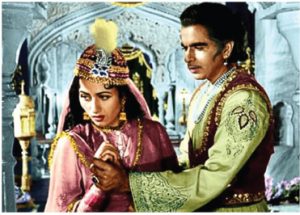 Amitabh Bachhan, speaking at the launch of the actor’s autobiography admitted that he saw Dilip Saheb’s Ganga Jumna 45 times. He couldn’t believe that someone who did not come from UP would pronounce the nuances and deliver lines in Awadhi with such immaculate fluency. He further went on to say, ‘‘When you see a particular scene enacted by Dilip Saheb, you are convinced there cannot be an alternative to it. Nobody could have done it better.’’
Dharmendra recalls that he decided to become an actor after watching a Dilip Kumar film. ‘‘He is a sparkling star from whom I have stolen a ray and used it to light my candle.’’ Dharmendra says this over and over. He stresses that Dilip Saheb was not his friend but a brother who gave him infinite love.
Jeetendra, like Amitabh, confessed that he pinched money from his father’s jewellery shop and saw the afternoon show of the same Dilip Kumar film 16 times because it had the best acting lessons. ‘‘There are countless stars in the sky but there is only one moon, today that moon has disappeared.’’ This was Jeetendra’s tribute after Dilip Kumar’s demise.
In the same vein, Anupam Kher watched Madhumati 18 and Ram Aur Shyam 40 times. He said in an interview, ‘‘There won’t be another Dilip Kumar ever. Every actor in India aspires to be like him. He was an institution from whom the coming generations of actors will keep benefitting.’’
Director Subhash Ghai said, ‘‘Dilip Saheb was my mentor. I learned from him not only about films but so many other things. He transformed me completely and gave a new direction to my life.’’
While shooting Prem Rog, Raj Kapoor wanted a certain expression on Rishi Kapoor’s face which the latter struggled with. Frustrated after a few takes and retakes, Raj Kapoor shouted, ‘‘Mujhe Yusuf Chahiye’’.
The Yashpal Sharma Story
Test cricketer Yashpal Sharma made it to the Indian national team on Dilip Kumar’s recommendation after he saw him bat in a Ranji Trophy match; Dilip Kumar was the chief guest. Yashpal Sharma spared no occasion to praise Dilip Saheb for his magnanimity.
Indeed, it was a spooky coincidence when Yashpal Sharma passed away five days after Dilip Kumar’s death. Sources close to him say that he always prayed, ‘‘Almighty, let me live at least until Yusuf Bhai is alive.’’
Beyond Stardom
Dilip Kumar’s contribution to social and human causes are by no means small. As the Chairman of the National Association of the Blind (NAB), he instituted ‘‘talking braille’’ for blind children.
In 1992, when Bombay was under curfew after the Ayodhya incident, he rode with Sunil Dutt to deliver food to the cordoned localities where food supplies were cut off.
A Personal Encounter
In 1981, I met Dilip Kumar for half an hour when he was sitting in the lawn in front of his chalet in Goa. After initial reluctance, I introduced myself and he asked me to pull up a chair. Russia had just invaded Afghanistan. He told me he was reading a review of VS Naipal’s book, Among the Believers and enlightened me on what Naipal had written and the geo-political climate of the region. I will never have enough words to describe his eloquence and diction. Proverbial honey poured through my ears.
Words of Wisdom
In the late 1980s, I saw an interview with Dilip Saheb on Sharjah TV’s Urdu transmission. The interviewer started by praising the actor with superlative adjectives and flowery phrases. When the camera zoomed in on Dilip Saheb, he smiled and said, ‘‘Mian, what all have you said? Do I deserve this? Let me tell you something, this world is like a screen and my significance on the screen is no more than a speck of dust that will just fade away in no time.’’
I think it is safe to say – this is not the case, and his legacy will live on. 




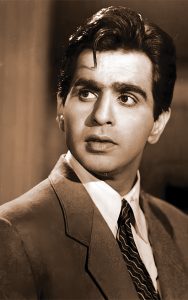 When Javed Akhtar was invited to the rostrum to deliver Dilip Kumar’s Lifetime Achievement Award by the Zee Network, he said, ‘’When Dilip saheb is the recipient of an award, it is the award that is honoured. Describing the profundity of his talent is impossible. Can anyone measure the depth of the ocean or the splendour of the sun?’’
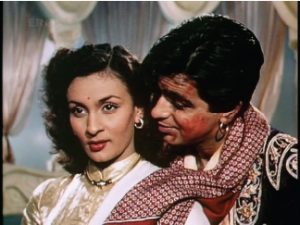 The most defining, even radical imprint of Dilip Kumar on screen was the dignity of silence, the unhurried moments in which he shone with elegance. When he spoke, his words found no reason to beat time. They flowed at their own pace, totally aligned with the character and the mood of the scene.
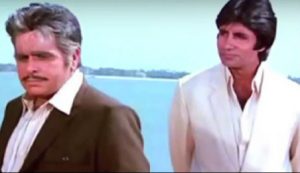 As the dejected lover, he created the celluloid template for the melancholic male heart. Dilip’s portrayal put him in a different league but it was also the last of his major attempts to depict the Devdas archetype. This was followed by a widening of his repertoire in 57 films as the lead actor: the character of a prince in Mughal-e-Azam (1960) and conflicting shades in Ganga Jumna (1961), being two of the more talked about among his other significant blockbusters in the late 50s and 60s.
Khalid Salamat has done quite a wholesome and splendid job of sharing many aspects of the celebrated Dilip Kumar’s status, life and times. I was happy to learn about some of the very interesting comments made by the living stalwarts of the Indian film industry about Yusuf Saheb.
Khalid, aap salamat rahen hazar baras, aour isi tarah khubsorat sincerely likhtay rahain. l read your write up about Daleep Kumar. lt is beautifully balanced article. l enjoyed it. lt is called sincerity in communication. Your brother Shahid was my colleague in Lintas.