


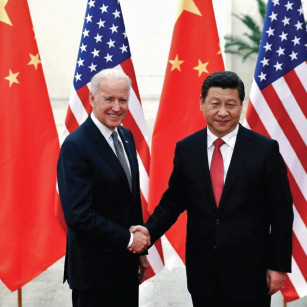
 The United States and China are entangled in a great power competition, even a confrontation that risks becoming dangerous. The risk is a military engagement that would be a serious danger not only for the two powers, but for the entire region – and the region under question is potentially vast. It could escalate to involve the entire Eurasian continent, or, in the term employed by pioneer British geo-strategist Halford Mackinder,the “world island” (which stretches from Brittany to Siberia, enveloping all of South Asia including the Persian Gulf and the eastern shores of Africa, perhaps also the Mediterranean and Africa itself, at least the Maghreb).
The People’s Republic of China has engaged in a momentous project to tie the world island to its interests, even its domination. The project, The Belt and Road Initiative, aims to connect China by land via roads, rail and sea around South Asia. The land route would realize the dictum of Mackinder, who maintains that the power that controls the Eurasian heartland controls the world island, and that whoever controls the world island controls the world. This principle helps to explain the Western grand strategy, led by the United States, during the Cold War. The long-term goal was to contain the Soviet Union, to prevent communist power from gaining control of all of the heartland. This was achieved. Today the Russian vestige of the Soviet Union is no longer viewed as a serious geopolitical threat; if anything, it is generally seen as a relatively weak economic power that is no more than a nuisance, although sometimes a grave one, around its historic borders, employing its military assets in non-respect of longstanding international norms.
China, on the other hand, is a great power, a rising great power in the full sense of the term. It obviously sees itself as such and is determined to exercise its growing power, not only by land, but by the maritime “belt” around the world island. This venturing by sea recognizes the dictum of the American geo-strategist Nicholas Spykman, who modified Mackinder’s thinking by turning it inside out. For the American of Dutch origin, it is rather the power that controls the littoral around the world island, the “rimland”, which gains control of all of it. Since the end of World War II, part of the American grand strategy has been the rimland encirclement of the Eurasian landmass, from Greenland to Alaska. Even today the People’s Republic is indeed largely surrounded along the rimland by nations that view with varying degrees of alarm its pretensions to expansion. So, we currently see a geo-strategic competition for the largest “island” on the planet between a status quo power, the United States, and a rising power, China. The history of great power competition demonstrates that this has always been a volatile situation, when a rising power challenges the existing international hierarchy. When this is not carefully and judiciously managed, it has led to major wars. In fact, it has rarely been well managed, short of war.
Within the context of this geo-strategic competition, we must now evaluate the geo-political assets of both great powers. In the Anglo-American, even Western world, power is conceived in two grand categories: Hard power and soft power. Military power is clearly hard power. Some forms of economic strength may also be viewed as hard power, especially when it offers the foundation for the construction of military power. The United States spends more on its military than something like the next ten armies combined. This is a lot of money, but represents no more than four percent of American GDP. Such a rich country can give itself this kind of military establishment at this relatively low cost. This is all the more a small burden since most of the spending is plowed into the American economy, a kind of economic stimulus. Countries without an arms industry do not have this advantage.
 However, it is not only the level of military spending that is vital, it is also the nature of the investment. Today’s first-tier military establishments, of which both China and the United States are pre-eminent members, have integrated into their militaries the most advanced post-modern, digital technologies – including the most recent innovations in artificial intelligence. It is impossible for outsiders to gain a clear understanding of which power exceeds in this realm of military technology because it is among their most closely guarded secrets. What we do know is that the United States is engaged in an effort to diffuse its military assets in order to deny China large, juicy targets like aircraft carrier task forces and big historic bases too close to China’s mainland, and thus vulnerable to the increasingly long range of Chinese missiles. There is a strategic movement to a myriad of small, dispersed weapons based on artificial intelligence – “swarm” weapons.


Steven Ekovich is Professor of International and Comparative Politics at The American University of Paris.
Rudy,
Well done and comprehensive.
There are strong indications, economic and military, that China seeks expansion.
However, freedom from a communist regime is mysterious yet present. I am not sure how peoples’ personal freedoms enter and nuance the Chinese government’s quest for the Europe-Asia island. Do the people eye this quest as strongly as their leaders? Perhaps so. Perhaps not. I don’t know their position on this Communist quest.
Also, the sovereign, independent countries may not concur with the Chinese expansion. Independence and sovereignty tip the balance against territorial takeover by the Chinese.
Plus, the US and its allies are “watchdogs” of these takeovers.
But, thank you, your article causes me to think outside my usual thoughts.
Thank you for sending this to me.
We have a nearby fire in Radar Road at CapeMeres, Oregon. Its smoke comes our way into Oceanside and mingles with the oceanic morning mist. It is drier than usual a ripe recipe for forest fires in the area.
Stay well. Thanks for your article.
Keep writing.
Afghanistan and the Taliban takeover augurs setbacks for all Afghani freedoms.
Phi