



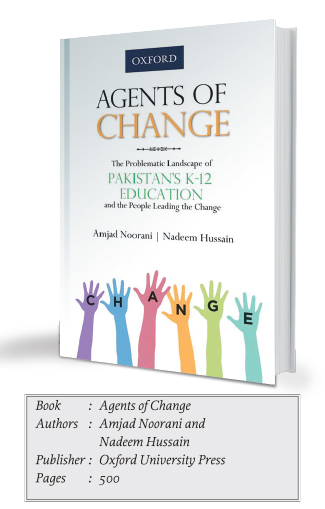
 There is social and political controversy surrounding the new education policy based on a Single National Curriculum announced by the federal government. 'Agents of Change', authored by Amjad Noorani and Nadeem Hussain, is an important work as it addresses different aspects of the schooling systems across Pakistan. The book specifically walks the reader through very diverse personal and professional experiences of K-12 education systems as narrated directly by educators and a former student belonging to an underprivileged community. Amjad Noorani, although having a background in clinical therapy, has made a tremendous effort in expressing his comprehensive observations in terms of education lapses. Nadeem Hussain is an education economist and a dedicated education activist. He presents important insights about schooling for the underprivileged, which remains an under-researched topic. Together, they also provide us information and solutions to address quality issues. The work follows the story of The Citizen Foundation and reveals all about the organization’s noble foundations, its growth, its evolution into existing structures and, most importantly, the monumental positive stories of economic impacts that this system of schools has brought into the lives of many deserving communities.
Unlike most other works that translate complex data into interpretative figures, this work relies on narrative accounts and responses to carefully articulated questions asked during interviews. What one finds most striking is how easily the book challenges the preconceived notion that demand for education remains low, whereas, the data shows positive trends in progression rates of TCF students from primary to secondary level in comparison to national figures.
One explanation is that parents are becoming more conscious about education standards and expectations and want to make a better choice for their children. It also leads to trust-building in what school or other educational institutions can offer to children within the community. As for the curriculum, it is important to note that TCF has designed its own learning materials based on lesson-planning for teachers and its own textbooks based on the 2006 curriculum, which it further improved after adding to its missing content. Also, for the language, there are successful examples of adopting a pragmatist approach, rather than an ideological approach, by using commonly used scientific terminology though instruction is in Urdu. This helps students to transition easily to English medium higher secondary schools.
This is what helped Sidra Saleem, a former TCF student from the impoverished Ibrahim Goth in Karachi, to adapt to English medium public higher education. She went on to become a doctor at the University of Illinois in Chicago. Similar -- yet each uniquely beautiful -- accounts of former students from humble backgrounds have been recorded in the book which are a testimony to how importance is given to education quality at schools and can do wonders for students, who otherwise might never have had been discovered.
It is also interesting to note that there is much to be desired in learning more about the specific challenges students face while transitioning from madrassah to conventional higher education institutions. Also, as the author mentions, the madrassah lacks the ability to integrate two systems of education. One finds it curious that despite some madrassahs providing conventional subjects, would the idea of a uniform curriculum be a welcome change for madrassah teachers? Seeing that only a few madrassahs are registered with the government, it is hard to tell what their expectations and demands are. In fact, the book inspires one to learn more about madrassah education.
For most people who are naturally driven to seek answers to causes of “education apartheid, the book may provide valuable information on how disparities are created in public schools, in the low-cost and elite private schools and in madrassahs. The authors leave space for readers to draw their own conclusions, depending on what they think is the most pressing issue that needs to be addressed.
Towards the end, the authors also appeal to readers to become active participants for ongoing advocacy for making education a political and economic priority. 
Leave a Reply