The poor people in Sri Lanka continue to pay the cost of a civil war that ended in 2009.
ByMubeen Ashraf | May 2021
A small island state that remained colonized by the Dutch, the Portuguese, and the British for more than 150 years, won independence in 1948. Then known as Ceylon and the present Sri Lanka, unlike other South Asian countries, is strategically located on one of the most significant sealanes of communication in the Indian Ocean. In a larger geopolitical dynamic, Sri Lanka’s position in the region holds strategic geopolitical relevance for major powers, such as the United States, China, and India. It is a multinational state and home to diverse cultures, languages and ethnicities. The two most prominent sections of the population in the island state are the Sinhalese, comprising almost 74.9% of the total population and the Tamils who are the largest minority and represent 11.2% of the population. They have also played an influential role in the island’s history and its present development.
Ever since the country became independent, it has been mired in ethnic conflicts between the majority and minorities, especially the Sinhalese and Tamils. To counter the efforts made by the Sinhala majority to dominate the island, a new force i.e. Liberation Tigers of Tamil Elam (LTTE) led by Velupillai Prabhakaran was formed in 1976. In response to the discrimination the Sri Lankan Tamils were facing, a separatist movement for a Tamil homeland in northern and eastern Sri Lanka was launched by the LTTE. The situation worsened when, in 1983, the LTTE ambushed a military convoy and killed thirteen soldiers. In the later years, due to its tactics used in the civil war such as suicide bombings, etc., the LTTE was declared a terrororist organization. The civil war between the government and ethnic groups continued for 26 years from 1983-2009.
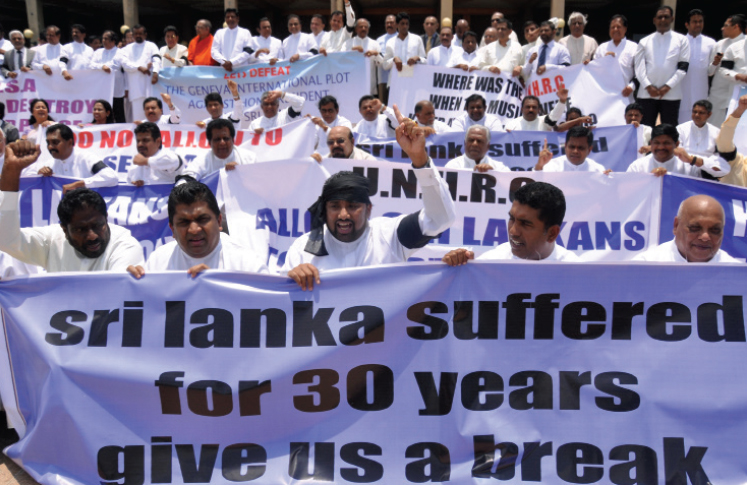
Many resolutions following pressure from various countries have been passed to investigate, rehabilitate, and reconstruct the war-torn country. The most recent took place on 23rd March, 2021 in Geneva with the theme to promote reconciliation, accountability and human rights in Sri Lanka. Out of 47 countries, 22 voted in favour, 11 against and 14 abstained..
The Indian position added an element of suspense to the final vote. On the one hand, India had immense pressure from Tamil Nadu while on the other, it had a responsibility to secure bigger foreign policy objectives, keeping aside domestic political rivalries.
Pakistan and China spoke in favour of Sri Lanka and voted against the resolution. India neither sided with the West-led Core Group to condemn Sri Lanka on human rights violations and war crime charges nor did it side openly with the Rajapaksa government. However, notable political and media figures in India supporting Sri Lankan Tamils condemned India’s abstention and were hugely disappointed. In any case, no Sri Lankan political party or leader questioned the Indian government for adopting a neutral policy and appreciated the Indians for maintaining silence.
There are a few possible explanations why India abstained. It seems India did not want to antagonize relations with Sri Lanka due to its strategic interests in the Indian Ocean, especially when the convergence of interests between Sri Lanka, Pakistan, and China are increasing exponentially. The UNHRC voting came at a crucial time for BJP and its allies and if India had voted against the resolution, the BJP and the AIADMK would have had to pay a heavy electoral price. The alleged human rights violations against Sri Lankan Tamils was a key electoral issue in Tamil Nadu. Also, alienating Sri Lanka was never in favour of India due to the former’s growing geopolitical importance in the context of China’s expanding influence in Sri Lanka in the economic sphere.
Other reasons include India’s promotion of a soft image in Sri Lanka since it has been tarnished by its authoritarian attitude in South Asia. Also, India needed to gain a bargaining ground in later engagements to ensure peaceful and constitutional protection and uplift Tamils in Sri Lanka. The efforts for the latter are being carried out in the form of pressuring Sri Lanka to not approve the 13th Amendment that would go against the Tamil minority residing in Sri Lanka. In a nutshell, the real cost of war has again been paid by the poor people of Sri Lanka. Any resolution that is passed in favour of the affected families, victimized groups, and other institutions, must be highly supported. India’s neutral policy in world affairs would not always let her escape from the responsibilities so swiftly. Also, if India claims to be a democratic republic, then abstaining from such resolutions is against the democratic values of the state. It was of significant importance for India to revive its relations in the region and to fulfill its dream of becoming a hegemon that is not entertained either by Sri Lanka or Pakistan.




 Pakistan and China spoke in favour of Sri Lanka and voted against the resolution. India neither sided with the West-led Core Group to condemn Sri Lanka on human rights violations and war crime charges nor did it side openly with the Rajapaksa government. However, notable political and media figures in India supporting Sri Lankan Tamils condemned India’s abstention and were hugely disappointed. In any case, no Sri Lankan political party or leader questioned the Indian government for adopting a neutral policy and appreciated the Indians for maintaining silence.

Leave a Reply