There needs to be a good degree of balance in the functioning of the State Bank of Pakistan and the government.
By Dr. M Ali Hamza | May 2021
The unstoppable and record-breaking price hike in the last two and a half years is the most damaging factor for the image of the government in Pakistan today. The people are agitated and losing hope. Meeting both ends meet is almost impossible for the masses. Survival has become a luxury for the major part of the population.
In economics, a price hike is called inflation: the higher the inflation, the higher the prices. While looking into the causes of inflation, there are proponents of varied views, like Keynesian and Monetarist views. Some argue that increase in aggregate demand due to increased private and government spending, etc. is the reason.
Others believe that a drop in aggregate supply, and potential output, known as cost-push or supplyshock inflation, is the cause. Some advocate that inflation is created through adaptive expectations, recognized as built-in inflation or price/wage spiral. It engages workers trying to upgrade their wages due to inflation, and firms tossing these higher labour costs to customers; leading to a feedback loop. Any of these three views are experimented through the fiscal policy of acountry.
There are the ‘Monetarists’ who believe that inflation being a monetary phenomenon, is primarily based on how fast the money supply grows or shrinks. They assert that any change in the amount of money in a system will change the price level. In any country, the Monetarist school of thought is tested through the monetary policy.
Recently, Pakistan’s national assembly approved the State Bank of Pakistan (SBP) Amendment Act 2021, in the name of central bank autonomy, accountability and price stability. The government is said to be influenced by the ‘monetarists’ and therefore has brought up such amendments. The opponents call it an IMF conspiracy to break Pakistan and others think it is against Pakistan’s national interest. The proponents contend that changes in the act will i) give more autonomy and power to the central bank, both in terms of defined policy goals and appointments, ii) minimize government, finance ministry, and political interventions, and iii) ensure partial impunity for SBP officials from federal and provincial investigation agencies in case of any alleged wrongdoing. The thought pulling question is whether an independent central bank is in Pakistan’s favour?
Both fiscal and monetary policy can affect inflation, but since the 1980s, most countries predominantly rely on monetary policy to control inflation. When inflation reaches an unacceptable level, the central bank has to slow down or stop the growth of money supply. If supply of money increases faster than real output (ceteris paribus: other factors remain constant) then inflation will occur. Imagine that you print more money but the amount of goods do not change. However, printing more money means that households will have more cash to spend on goods. If there is more money chasing the same amount of goods, demand increases and firms just raise prices because of supply shortage. To handle such a scenario the Quantity Theory of Money offers an equation: MV=PY (M-M= Money supply,V- Velocity of circulation (how many times money changes hands), P- Price level, Y- National Income). If we assume V and Y are constant in the short-term, then increasing money supply will lead to increase in price levels.
Earlier in Pakistan, the governments borrowed from the SBP to meet fiscal expenses, thus forcing the central bank to print more money. There is enough evidence to suggest that when central banks finance the federal budget by printing more currency, it not only leads to inflation but also gives the government an easy way out because it does not improve fiscal discipline. But the amendments will strengthen SBP enough to refuse funding quasi-fiscal operations and economic growth related activities for the sitting government. Moreover, as we have ‘Plutocracy’ dressed-up in parliamentary democracy, the the rich politicians craft rules that interest them rather than their voters. These politicians interfere in economic policies, but an autonomous SBP will be free from autocratic dictations. Beside autonomy, the opponents of amendments will raise questions on giving partial impunity to SBP officials from federal and provincial investigation agencies i.e. FIA, NAB and the like.
The logical and understandable answer is that nowhere in the world do such agencies investigate central banks because they are not equipped technically to do so. Moreover, the SBP has to take bold decisions against ‘bad banks’, many of which are owned by powerful people. Thus SBP officials take a big risk when they go after them. If this protection is not given, competent people will not join the SBP and, if they do, they won’t go after any powerful institution. This logical explanation points out the black sheep in our investigating agencies. This has to be sorted out and fixed. On face value, giving institutional autonomy to the SBP is a rational decision and can favour Pakistan. But in the entire governance structure, the SBP does not work in isolation, therefore fixing the other components like the judiciary, law enforcement agencies and political skeletons needs equal attention or autonomy will not erase the anomaly.




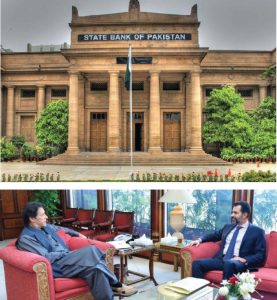
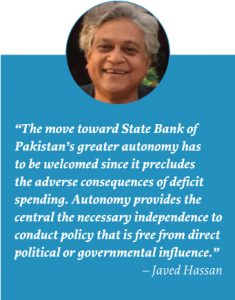 Recently, Pakistan’s national assembly approved the State Bank of Pakistan (SBP) Amendment Act 2021, in the name of central bank autonomy, accountability and price stability. The government is said to be influenced by the ‘monetarists’ and therefore has brought up such amendments. The opponents call it an IMF conspiracy to break Pakistan and others think it is against Pakistan’s national interest. The proponents contend that changes in the act will i) give more autonomy and power to the central bank, both in terms of defined policy goals and appointments, ii) minimize government, finance ministry, and political interventions, and iii) ensure partial impunity for SBP officials from federal and provincial investigation agencies in case of any alleged wrongdoing. The thought pulling question is whether an independent central bank is in Pakistan’s favour?

Interesting read. Yes the rest of the public departments need to get freedom from external influencing bodies as well.
Agree with the conclusion that complete package of Regulator, Judiciary, Law enforcement agencies and political skeleton is the only way to progress.