

Region
Judicial Bias
A Special CBI Court in Lucknow has in effect given judicial legitimacy to the ‘Ram Janmabhoomi Movement.’

A perceptive political commentator once remarked, “Indian politics is electionized, not democratized.”
Communal violence or violence between groups that define themselves by their differences from each other is one of the foremost human rights problems today. But the violence of the past 20 years differs from that of the previous decades. Responsibility for the current sectarian violence in India lies not with specific extremist groups but with governments that leverage inter-group hatred to gain power. Such systemic sources of communal violence threaten basic principles of democratic government and non-discrimination. The present-day communal violence originates in identity politics. Identity politics stress the group nature of rights, experience and identity, whether based on race, sex, caste, class, language, religion, or national or regional origin.
In India today, the greatest amount of sectarian conflict originates in tensions between Hindus and Muslims. A variety of explanations for the conflict exist. They include the Muslim invasions of India a thousand years ago, the forcible conversion of some Hindus to Islam; the cultural and religious differences between Hindus and Muslims. The psychological effect of the partition of the Indian subcontinent into a predominantly Hindu India and a predominantly Muslim Pakistan. The poverty of Muslims who remained in India after the partition; and the establishment of Hindu political supremacy in India.
It looks as if the RSS has openly come out to appoint its nominees at different places of governance. If one were to look around in the country, the BJP, a political wing of the RSS, has already taken over most of the country. The presidential election is only a few months away. Yet again, the names tossed around for the top position are from the RSS parivar. Today, there are as many as nine chief ministers of the BJP or, for that matter, the RSS pracharaks. They are: Manoharlal Khattar of Haryana, Trivendra Singh Rawat of Uttarakhand, Biren Singh of Manipur, Devendra Fadnavis of Maharashtra, Shivraj Singh Chouhan of Mandya Pradesh, Raman Singh of Chhattisgarh, Manoha Parrikar of Goa, Raghubar Das of Jharkand and the latest to join the list of RSS parivar is Adityanath Yogi of Uttar Pradesh, the most populous state in India with 80 Lok Sabha seats.
In the past ten years, three kinds of judicial decisions have tended to provoke hostile communal attitudes and to spark acts of sectarian violence. They include decisions which hold that certain religious practices are un-Indian; decisions which, out of concern for national integration, undermine the rights under Articles 25 and 26 to profess and practice religion; and decisions that resolve cases involving communal crimes based on overriding political considerations. Each type of decision has challenged the constitutional relationship between religious and secular law. Judicial decisions that endorse a narrow, rigid view of the Indian identity contravene principles of Indian secularism and fuel xenophobic communal attitudes. In 1994, the Supreme Court reemphasized the fact that the Constitution prohibits the state from identifying itself with or favouring any particular religion or religious sect or denomination. Judicial opinions that favour a monolithic view of the Indian identity are therefore unconstitutional. Nonetheless, the decisions discussed below illustrate the influence of communal thinking on the judiciary and suggest one way in which the judiciary can trigger communal animosity. Increasingly, in India today, the terms “true Indian,” “un-Hindu,” or “true Muslim” surface in judicial decisions. Typically, the “true Indian” argument appears concerning cases where religious law conflicts with other religious or secular law.
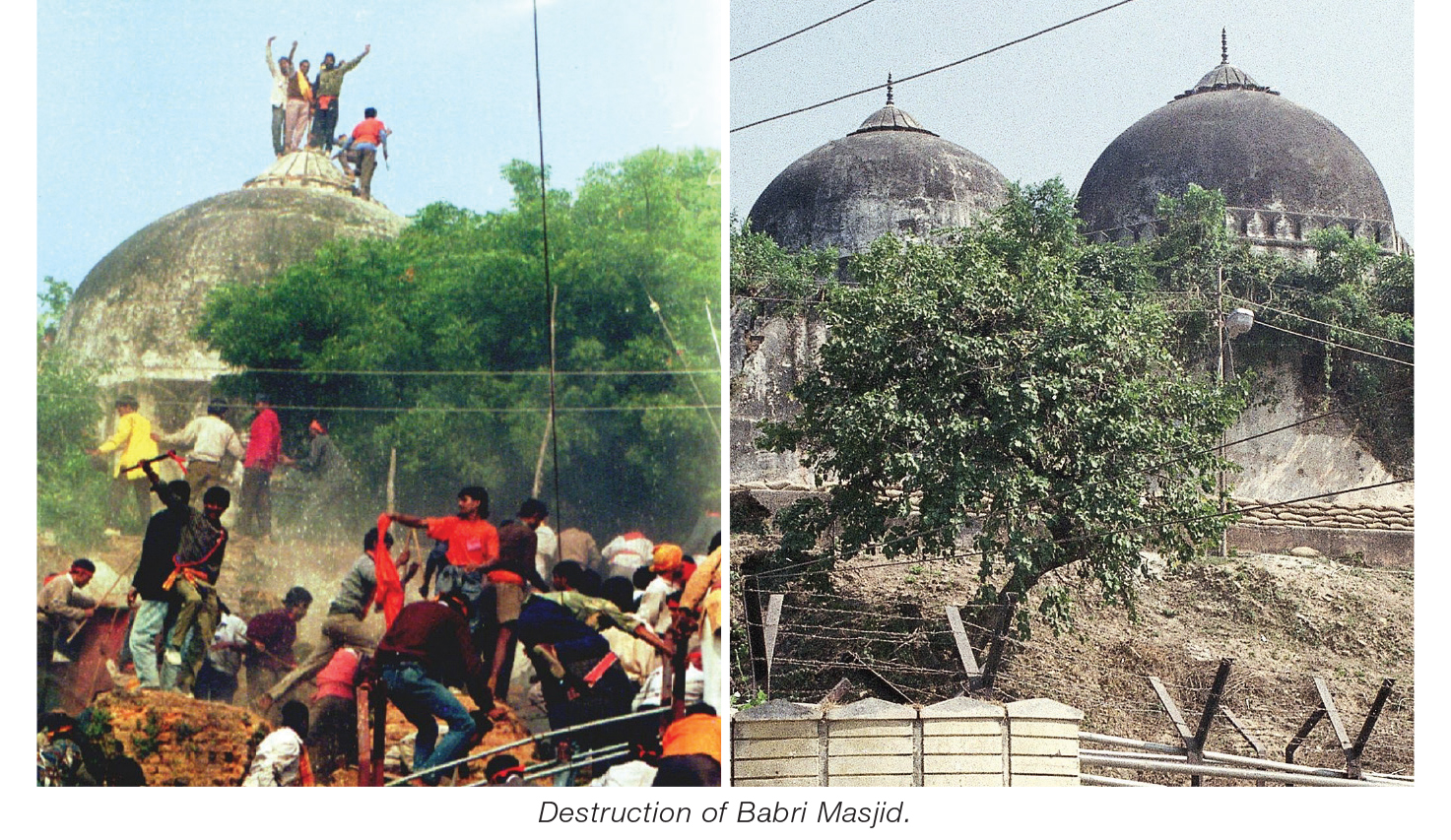
India cannot afford successive judicial setbacks to secular values and the rule of law. The ruins of the Babri Masjid were cleared in record time by the hordes of vandals mobilised for demolishing it. Some detritus was still left, though: there was a belief among many that justice would be done and the Constitution and the rule of law would be upheld if the criminal court punished those who plotted the events of December 6, 1992. Even when the Supreme Court handed over the empty site to those who wanted the mosque brought down to build a Ram temple, its recognition of the demolition as an “egregious violation of the rule of law” gave rise to the hope that the ends of justice would be served by the punishment of those who mobilised the vandals.
A Special CBI Court in Lucknow has now cleared the remaining debris with an unconscionable judgment. Throwing to the winds the Supreme Court’s observations on the demolition, the trial court has in effect given judicial legitimation to the ‘Ram Janmabhoomi Movement’ by acquitting all those indicted for conspiracy to bring down the structure. Its conclusions are drastic and defy logic and fact. The court’s finding that the demolition was not planned in advance flies in the face of the entry of more than a hundred thousand volunteers into Ayodhya that day, armed with crowbars, spades, hoes and ropes and every implement needed to bring down a sturdy structure and clear the site. The proponents of the movement, headed by L.K. Advani, Murli Manohar Joshi and Uma Bharti among others, had positioned themselves at vantage points to witness the occasion and celebrate with pride what ought to have caused shame and disgust.
The nondiscrimination and equal protection clauses of the Indian Constitution, in conjunction with the guarantees of freedom of conscience, prevent the state from giving a particular religion or sect preference over others. Hence, courts should instead base their decisions on “secular” arguments and policy considerations independent of sectarian notions of “true Indian” identity. The Court in Sarla Mudgal could have done so in several ways. For example, the Bombay High Court had previously held that religious practices that undermine public order, morality, or health must give way to the good of the people of the State as a whole. In several bigamy decisions, Indian courts had held that a Hindu or Christian who converts to Islam to remarry is not exercising his freedom of conscience and converts fraudulently. The Supreme Court verdict in the Babri Masjid case was contrary to both public order and morality and was an injustice to both Hindu and Islamic law. It also violated the spirit of the constitutional guarantee of freedom of conscience. The fraudulent conversions show the biasness of the Indian judges and could potentially worsen group relations.![]()
The writer is a legal practitioner and columnist. He can be reached at shahrukhmehboo@gmail.com |
|
Cover Story
|
|
News Buzz
|
Update |


Leave a Reply