

Region
Clean Air Roadmap
Air pollution is a major issue in Pakistan and requires the immediate attention of policymakers.

London was long known for its distressful atmospheric conditions where a blend of fog and smoke made breathing fresh air nearly impossible for citizens in winter. The Great London Smog of December 1952, that took thousands of lives in eastern London within a week due to a dense envelope of smoke-filled stagnant air hovering for five days at a stretch, is considered a turning point in environmental legislation. The trauma was so intense and its effects so long-lasting that it necessitated proper parliamentary legislation to empower the government to regulate smoke emissions from industrial and domestic sources in accordance with the standards set for this purpose.
The enactment of the Clean Air Act 1956 of UK was the first legal instrument anywhere in the world designed to curb air pollution through regulatory provisions. Through the CAA 1956, a complete moratorium was enforced on the use of coal and emission of black smoke from any source, height of the smoke spewing chimneys was fixed, and industrial units asked to relocate outside human population centres. This was again re-enacted in 1968 with further improvements in regulatory provisions to control air pollution in the UK.
On the other side of the Atlantic, in the USA, the issue of air pollution was mainly dealt with by laws framed at state and county level till 1963. However, realizaing the necessity of a federal role to restrict air pollution, the US Congress passed the nation’s first Clean Air Act in 1963, authorizing the federal government to set emission standards for stationary and mobile sources and determine timelines for compliance. The CAA 1963 established a federal program within the U.S. Public Health Service and authorized research in techniques for monitoring and controlling air pollution. A few years down the line, the Clean Air Act was re-enacted in 1970 to empower the federal government to set up National Ambient Air Quality Standards (NAAQS), State Implementation Plans (SIPs) and National Emission Standards for Hazardous Air Pollutants (NESHAPs). Further amendments to CAA 1970 were made in 1977 and 1990.
A remarkable development to control the menace of air pollution was the signing of the first international treaty in 1979 by 32 member states of the United Nations Economic Commission for Europe (UNECE), known as the Convention on Long-range Transboundary Air Pollution to control damage to forests and the rest of the ecosystem from dispersal of various air pollutants. The treaty came into force in 1983.

The success of these legislative interventions at national and international levels has amply demonstrated that air pollution and its ill effects on human health can be controlled through compliance to various standards and other punitive regulatory provisions and polluters can be prosecuted in courts and punished. Such laws empower national and state governments to shut down industrial units if violation of standards continue even after imposing fines. Enforcement of such laws has compelled industrialists to switch over to clean technology and control emission of particulate matter and gases at source before their release into the ambient environment.

According to the WHO, Environmental-Health refers to such aspects of human health,as quality of life, that are affected by physical, biological, social and psychological factors of the environment. Ambient air, being an external factor of environment, adversely affects the quality of human life through diseases, impairment of respiratory organs or death, if polluted beyond a certain threshold.
Air pollution refers to the presence of undesirable substances, in otherwise clean fresh air, that create have an adverse impact on human health if inhaled in large quantity or over a long period. Particulate matter comprises a mixture of inorganic and organic solid and liquid particles ranging in size from half a micron to over a hundred microns and include smoke, black carbon, dust, dirt, pollens, moulds and bacteria. The common sources of these pollutants are power generation units using fossil fuels, transport, industrial units, agriculture and livestock, and the domestic sector.
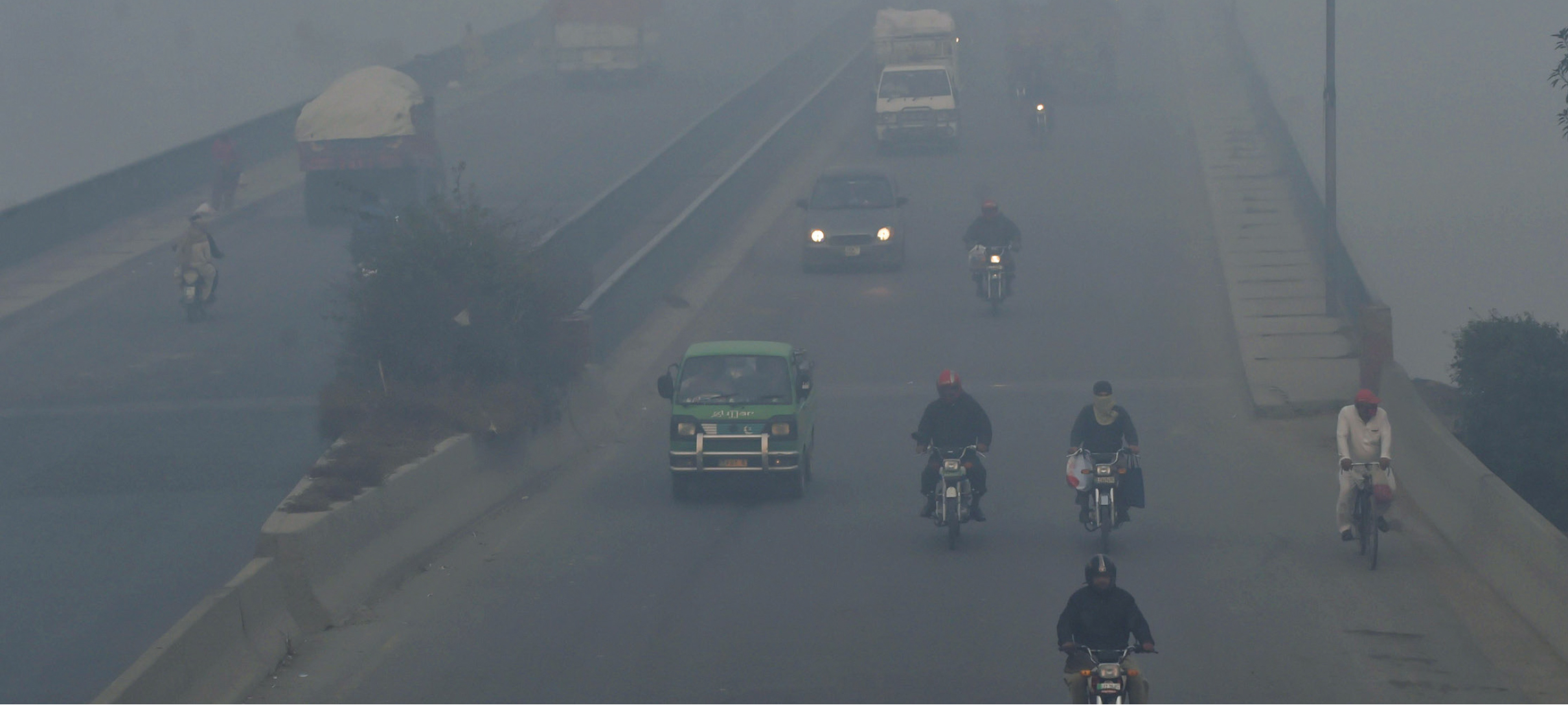
Pollution in major cities of Pakistan is now making headlines. A WHO global air quality survey (2013) conducted in 1600 world cities ranked Karachi, Peshawar and Rawalpindi at 5th, 6th, and 7th positions among the ten most polluted cities of the world. Another WHO survey (2016) conducted in 3000 cities of the world reported Peshawar at 2nd, Rawalpindi at 4th, and Karachi at 14th position. The 2018 World Air Quality Report from over 3000 cities ranked Faisalabad at No. 3 and Lahore at No. 10. Similarly, Pakistan as a whole ranked as the 2nd most polluted country in the world, successively in 2018 and 2019. Lahore and other cities of Punjab often face smog conditions which can turn into killer impact or make the quality of life miserable for millions of people.
Of all the pollutants listed as particulate matter, especially PM2.5, is considered to be extremely damaging for human health and can be controlled with strict implementation of laws through a vigilant monitoring system. Regrettably, there is not only acute scarcity of local data but also lack of air pollution specific legislation or an action plan. Pakistan has not spent enough money on installation of air quality monitoring devices even in major cities, so the country seems to prefer to remain oblivious of the real-time changes. Smoke emitting vehicles still ply on roads in the thousands, brick kilns still operate on cheap coal and used rubber tyres, smelters, steel mills, particleboard manufacturing, stone crushing and grinding units still work, no holds barred.
Like most other countries, the parliament in Pakistan had enacted a more generic law - the Pakistan Environmental Protection Act in 1997 – to put in place a system of environmental governance in the country, set standards for emissions and effluents, to prevent all sorts of pollution but no specific legislation was ever carried out to control air pollution separately. In 2005 an unproductive effort was made to establish the Pakistan Clean Air Program through the Pakistan Environmental Protection Council, but it did not bear fruit. More recently, the Ministry of Climate Change has launched the Pakistan Clean Air Program 2020, while the Punjab Government also decided to form the Punjab Clean Air Commission in 2018. The 18th Constitutional Amendment 2010, devolved the subject of environment to provinces, after which Punjab, Sindh, Khyber Pakhtunkhwa, Balochistan and Gilgit-Baltistan have enacted their provincial Acts and respective provincial Environmental Protection Agencies have been made responsible for their enforcement.
Although, provincial environmental tribunals are meekly functioning to prosecute cases of polluters and violators alongside the higher and superior judiciary of the country through suo moto notices or public interest litigations, breathing clean air remains a dream at least in major urban centers with large industrial states and heavy vehicular traffic.![]()
The writer is Advisor to the Quality Assurance Program, Higher Education Department, Government of Khyber Pakhtunkhwa. He can be reached at srsyed55@gmail.com |
|
Cover Story
|
|
News Buzz
|
Update |


Leave a Reply