

Book
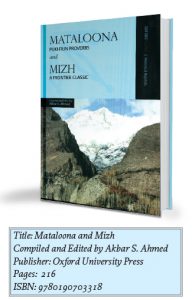
Mataloona and Mizh
Panache and Poise

Mataloona and Mizh by Akbar S. Ahmed is an inspirational, thought-provoking and a much-yearned-for rendition of the Pakhtun language, history and culture. The author is an Islamic scholar, poet, playwright and filmmaker, and has been described as the “leading authority on contemporary Islam” by the BBC. His book comprises two parts, Mataloona, the section listing and explaining a diverse variety of Pakhtun proverbs and Mizh, which is a frontier classic carrying out an exegesis into Pakhtun culture, predominantly focusing on the Mahsud tribe, its leadership dynamics, organizational structure and historical depths.
Mataloona is an awe-inspiring section of the book that features the beauty of the Pakhtun language, sheds light on the fecundity and vitality that this language encapsulates. As we see the world transforming into a global village, the banes of an extremely fast-paced, super-practical life in today’s world have mitigated the practicality of most languages that were previously revered in academic and social circles with panache and poise. However, Ahmed’s book is a powerful contribution to the literary pool of linguistics and anthropological discourse, which convincingly highlights the need to restore and subsequently revive the use of languages that are slowly losing their efficacy. The book not only evokes emotions, but also plays a substantive role in identifying how “proverbs reflect a great deal of the social thinking of a people”. Mataloona shows how people think and react and how this emotive quality of their reactions is then illustrated through the proverbial semantics. It is phenomenal how this book showcases the traditional and rustic life in Pakistan’s north-west frontier.
Mataloona highlights how proverbs in every language — despite the divisions and differences in the origins of these languages, their contemporaneity and of the cultures in which these languages fall — encompass many similarities in terms of evoking sentiments and translating attitudes of the people in every era. An example is the attention-grabbing Pakhto proverb, transliterated as, “Grandmother died and her fever ended”, which equals the Shakespearean proverb, “Death is the end of all. He who dies pays all debts.” These proverbial similarities, therefore, bring cultures and peoples closer in a very interesting way.
The author pens numerous Pakhtun proverbs, the English equivalent is then given below each one in Roman type and the transliteration follows in italics; where the “literal translation appears awkward and esoteric, the corresponding English equivalent proverb hopes to give it clarity… ” According to the author, “In Pukhtomataloonais collected the wisdom and good sense garnered over a thousand years and from places that range from the peaks of the Hindu Kush to kingdoms along the Ganges”.
Mizh, meaning “we” is a great analysis not only relevant for global scholars, educationists and academicians, but also the current government and contemporary political leaders of Pakistan. Ahmed believes that in order to administer and govern the north-west better, it is of paramount importance that the politicians, as well as other influencers visit the pages of history and get themselves well-acquainted with the traditional rituals and leadership dynamics of the people. The Mahsud tribe, till date, is the most influential Pakhtun tribe in Pakistan, and in order for the implementation and subsequent execution of essential policies, it is a vanguard for our leaders to understand the subtleties associated with this dominating Pakhtun tribe. Only then policies can be made in tandem with these tribal subtleties, and better administration can be ensured.
The book offers an in-depth analysis of the social system in Pakhtunkhwa and FATA, as well as the historicity and rootedness of the Mahsud tribe in this part of Pakistan. Mizh discusses in detail, the general deportment and behaviour of the Mahsud leaders, and the way they have been functioning and ruling in their respective areas over the course of history. From the dominant role played by Mulla Powinda as leader of the tuman; his recognition by the government and eventual fall from grace; his struggle with the old malik; to the depredations of the Mahsud outlaws residing in Afghan territory and their connections with Mulla Powinda, all is secured well in this eye-opening review of the influential Pakhtun tribal history and the prevalent political setup of this locality.
In conclusion, a book like this will undoubtedly help channel the untapped treasure that dwells in this part of Pakistan, and would provide scholars with reasonable urgency to further look into the linguistic heritage of the Pakhtuns for research, as well as pedagogical and intellectual exploration, while giving the present government and leaders pragmatic advice on how to deal with the untameable, yet influential Pakhtun tribes, keeping in consideration their historic strength and importance.![]()
|
Cover Story
|
|
News Buzz
|
Update |


Leave a Reply