

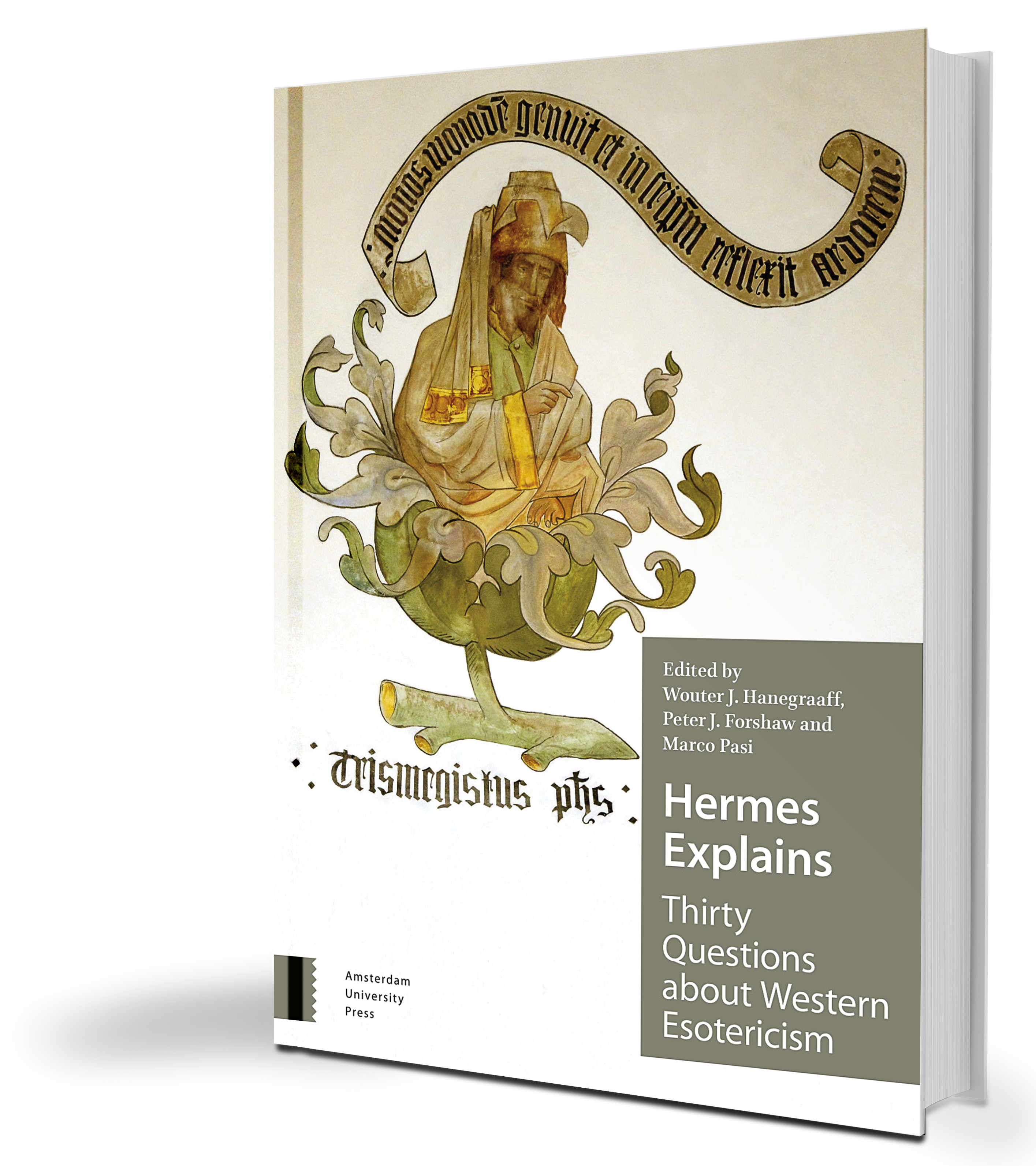
Book
Hermes Explains
Esotericism Redefined
| Book Title: | Hermes Explains: Thirty Questions about Western Esotericism |
| Editors: | Hanegraaff, Forshaw, and Marco Pasi |
| Publisher: | Amsterdam University Press |
| Pages: | Hardback, 320 pp |
| ISBN: | 9789463720205 |
This collection of thirty essays, predominantly concerning the relatively new academic field of Western Esotericism, commemorates the twentieth anniversary of the creation of a center for Hermetic Philosophy and Related Currents at the University of Amsterdam. The actualization and materialization of this center was made possible by the efforts of Mrs. Rosalie Basten, and ever since the formalization of this venture, the field has proudly witnessed the proliferation of numerous publications, book series, conferences, and other modes of scholarship, not just within Europe but across the globe.
The introduction creatively notes that just as Morpheus gave Neo a choice between taking a blue pill or a red pill in The Matrix (the blue led to a mainstream, more mundane existence; the red towards arguably greater awareness), the essays can be regarded as a red pill each, that (separately as well as collectively) address questions about the field in order to promote greater awareness within the reader as to what this discipline primarily entails. No book review can do full justice to so many essays, but I hope the handful that I choose to dwell on will provide an academically enticing picture.
Emeritus Professor of Music at Colgate University, Joscelyn Godwin, outlines the fundamentally close relationship between music and esotericism. The essay is a joy to read, primarily because Godwin expertly underscores the mathematical aspects underlying musical harmony. He synoptically presents the classical concept of the music of the spheres and the significance of planetary motion, as evinced by the work of several major composers. Naturally, those who were imbuing their compositions with esoteric codes did not intend for just anyone to be able to appreciate this, but a highly skilled singer or musician would have been able to get a sense of the implicit symbolism. I should add that Godwin has made enormous contributions to the humanities branch of esotericism — most of the field’s major scholars are affiliated with religious studies.
In Pride and Prejudice, Mr Bennett said that when it came to his five daughters, he was partial to his Lizzy. I will indulge in my own partiality now by alluding to the work of the notable Scandinavians in the field, Henrik Bogdan and Olav Hammer. Outside the United Kingdom, Bogdan has virtually single-handedly made several leading contributions to the academic study of Freemasonry. In response to a query by his school-going daughter as to whether the Illuminati are ruling the world in some sinister fashion (he eventually informs us that they are not), Bogdan outlines how Freemasonry has survived and thrived from the Enlightenment up to the present day. A particularly fascinating aspect of his essay focuses on how strict and violent penalties could historically be imposed on those who gave away Masonic secrets, although this tenet was eventually abolished over time. I especially enjoyed Olav Hammer’s meticulously scientific essay on whether esotericism is irrational or not. Hammer assesses that in aggregate it is no more or less irrational than many other disciplines, but the traps of perceiving false cause and effect are perhaps more numerous in academic areas such as this field (as they are for ambiguous medical practices such as homeopathy). Clear, logical and meticulously laid out, Hammer’s arguments should ideally have come right at the commencement of the volume — I understand the egalitarian manner in which the entries are alphabetized, but Hammer’s contribution to the volume is as significant as Richard III’s opening soliloquy is to the Shakespearean mini-canon.
Holding his own magnificently in this volume is CESNUR founder Massimo Introvigne (an Italian), whose highly illuminating piece on Satanism and esotericism should be made required reading for every introductory Religious Studies course. Introvigne asserts that those who worship an entity such as Satan have as much a right to their beliefs as the followers of any other belief system, provided they remain within the boundaries laid down by the law. Ostensibly scary though the statue of Baphomet (based on Eliphas Levi’s famous drawing of the Pan-like deity) might be, the real threat to society is not Satan per se, but CRMs (criminal religious movements). Introvigne’s argument is wonderful in its simplicity and were more people to take the time to grasp it, far less energy would be wasted chasing Satanists who may be doing nothing wrong whatsoever. Introvigne does a great deal to dispel some of the phobias associated with this issue, while sensibly noting that violence, homicide, sexual and child-abuse are exponentially more problematic than honouring Baphomet!
Mark Sedgwick’s essay usefully delineates some of the commonalities between Islamic esotericism and Western esotericism, while Julian Strube rightly calls for a more nuanced assessment of the relationship between occultism and fascism, with special respect to tropes such as the Nazis’ Black Sun at Wewelsburg, among other things. Jeff Kripal comments on comics, superheroes and esotericism, as he has on more than one occasion prior to contributing to this volume. Particularly intriguing is his point that while people now fanatically revere superheroes, just a few decades ago they were considered far more marginalized figures. I suppose Kripal has subversively done a great deal to change that (especially by means of his own scholarship), and the book contains a delightful photograph of his office which is crammed with fun stuff—like a sculpture of the Silver Surfer! Indeed, the general illustrations of the volume are eye-catching and academically relevant, as well as beautifully presented. I would not have minded though if a couple of pictures had been substituted by an essay from either Arthur Versluis or Kocku von Stuckrad, who have both made enormous contributions to the field of esotericism in their time. But I guess their scholarship now belongs to the realm of the blue pill. I will reach for one of those instead.![]()
|
Cover Story
|
|
Tributes
|
|
Special Editorial Feature
|
|
News Buzz
|
Update |


Leave a Reply