Improving the infrastructure of the education sector could be implemented as a first step. Not only does Pakistan need a greater number of schools and institutions of higher learning, particularly in rural areas, its students also need an updated curriculum and talented teachers. Imran Khan’s government should also introduce programmes with regard to vocational and technical training so that an effective labour force can be developed. Technological advances should also be employed to build on workers’ productivity on top of creating new jobs in relevant industries.
While changing global business trends dictate an emphasis on the service sector, Pakistan still relies on its diminishing manufacturing industries for most of its economic activity. The dismal security situation in the country, however, continues to undermine any government efforts to develop its tertiary sector. Until peace prevails across the country, tourism and the hospitality business can neither flourish, nor accommodate the youth.
Every now and then, labour agencies warn the international community of the risks posed to the youth population at the hands of the fragile global economy. A recently released report by the International Labour Agency estimated as many as 71 million jobless young people across the world, a figure even higher than the entire population of Thailand.
However, the fact that such disheartening states of affairs have now become a global phenomenon, should be considered as an even greater challenge for Pakistan. It should effectively use its workforce to achieve sustainable development. The prevalent wide disparities between men and women workers in the country should also be addressed on an immediate basis. Pakistan should actively invest in female education to increase women participation in economic spheres.
While there are many micro and macroeconomic factors that affect youth unemployment, the primary reasons may vary between countries. For example, the Greek youth unemployment rate is attributed to the country’s crippling debt while in Malaysia, Malaysian Industrial Development Finance Research says, the problem is attributed to a skills mismatch, with a higher demand for low-skill jobs than high-skill occupations.
Other reasons that have been cited in various reports include a lack of job opportunities and work experience, inadequate qualifications and a discrepancy between a graduates’ asking salary and the salary offered by employers, among others.
The number of the unemployed in Pakistan increased to 3,790,000 in 2017 from 3,620,000 in 2015. The unemployed averaged 2,508,000.17 from 1987 until 2017, reaching an all-time high of 3,790,000 in 2017 and a record low of 903,000 in 1988
Collateral consequences
A lack of involvement of this dynamic segment of society in the labour force, though hardly always by choice, has many negative implications on the lives of youth as well as on the economy.
This includes youth being unable to pay off their student loans and other forms of debt, which will cause interest to accrue and affect their credit score and ability to get future loans. To boot, youth unemployment has been related to mental health problems; a Swedish study has found that the problem appears to be strongly associated with alcohol and drug-use disorders.
It can also negatively affect the physical well-being of youth, impede their skills development, potentially cause homelessness and a lower output, loss of human capital and increased poverty, especially in developing countries.
It is clear that being young, educated and involuntarily unemployed has profound effects on an individual’s future, as well as the broader economy.
Future force
As the reasons for youth unemployment vary between countries, each country needs to ascertain the right solution that would help them tackle the problem of youth unemployment effectively.
For some, it might involve turning to vocational education to minimize the skills mismatch between graduates and what the labour force needs.
A report in the British centre-left newspaper, The Guardian, says vocational education ‘tends to result in a faster transition into the workplace, and countries that have it at the core of the curriculum – such as Germany, Switzerland, Austria and the Netherlands – have been successful in maintaining low youth unemployment rates’.
While there may be other factors at play that have contributed to their low youth unemployment rates, such as favourable economic conditions, it serves as something other countries could potentially emulate.
Starting a business as an entrepreneur will require a whole lot more than just a willingness and interest to do so, so it’s hardly always the most viable option for everyone. Those who never feel confident enough to take such a risk could also consider joining the gig economy – becoming an independent contractor or freelancer and taking up short-term jobs or projects relevant to their expertise on contract basis.
With tech disruptions and virtually every industry going digital came the rise of the gig economy, a trend that can be extremely beneficial for fresh graduates looking to join the workforce. It’s also an opportunity for them to learn the art of the hustle, which will sharpen their survival skills in the long run, especially in a dog-eat-dog world.
Apart from the afore-stated, governments could also consider spending more effort on developing education programmes that will benefit youth. This is being done in Spain, where the government has said it aims to ‘promote training programmes that come with a promise of a job at the end, by working hand in hand with companies’, reports The Local Spain. It adds that the government has said it will inject €2 billion ($2.3 billion) into battling youth unemployment, which stands at a whopping 33 percent.
While the intricacies of youth unemployment suggest that there is no one-size-fits-all approach to tackling the issue, it is clear that a multifaceted approach is needed to address the problem.




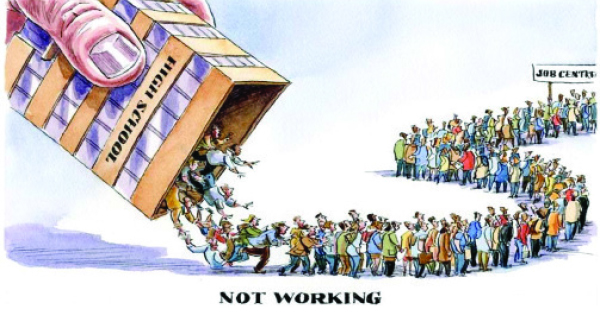 A traditional lifecycle for some people may typically include: studying, getting a job, getting married, and retiring. However, this concept is growing archaic as more and more young adults are finding it tougher to find employment after graduation. This obviously derails their future plans such as paying off their student loan debt, buying a home, starting a family and being able to save and invest.
Informative article