



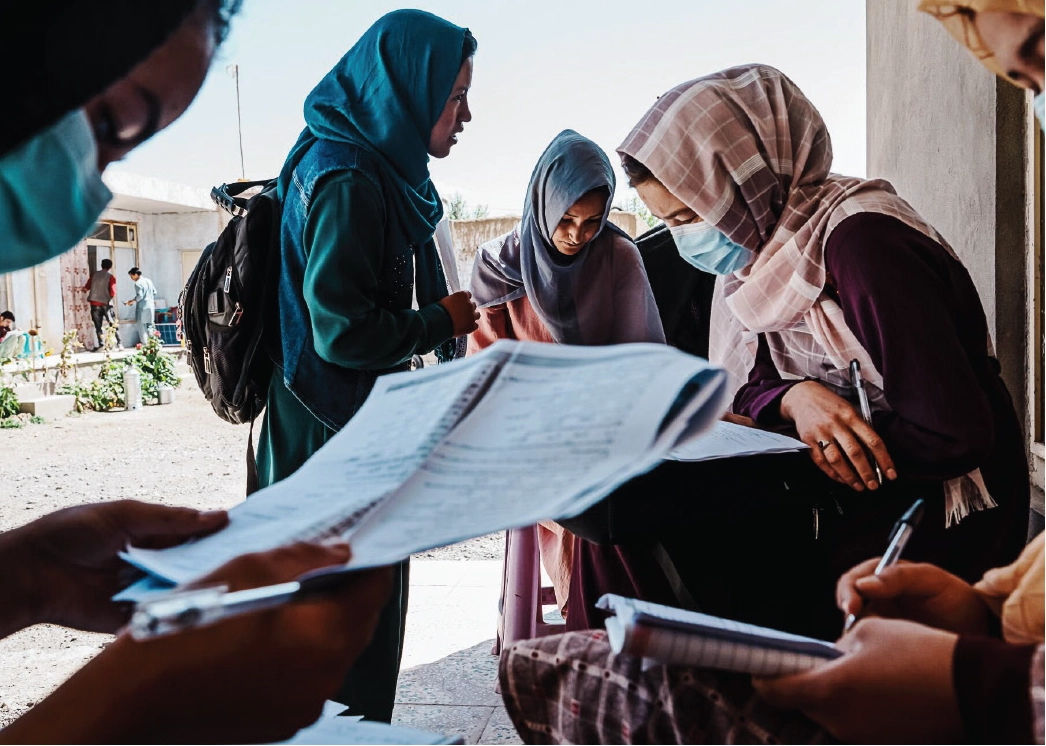
Three years after the Taliban’s return to power in August 2021, the status of Afghan women has plummeted to one of the worst in the world. Following the hasty withdrawal of U.S. and NATO forces, the hard-won gains in women’s rights, education, and public participation have been dismantled under the Taliban’s rigid interpretation of Sharia law. What has unfolded since then is not merely a policy of regression but ‘gender apartheid.’
Soon after coming to power, the Taliban banned secondary and higher education and made it mandatory for women to be accompanied by a male guardian when traveling more than 77 kilometres. In fact, in some cases, women traveling less than that are often questioned and harassed.
According to UNICEF, the number of girls not receiving education has reached 2.2 million. UN Women warns that depriving girls of their education is projected to increase the rate of early childbearing by 45% and maternal mortality by at least 50% by 2026. These figures show how the Taliban’s restrictions are not only violating rights but threatening the lives and futures of generations.
The ban on girls’ education is going to cost Afghanistan dearly. If it continues, Afghanistan’s economy will lose USD 9.6 billion by 2066, which is two-thirds of the country’s current GDP. Other estimates point to an annual loss of 2.5% of GDP. The human cost, however, is even more staggering.
The ban on the free movement of women has caused immense problems. The orphaned and widowed women who have no male guardian are living in pain and misery. They face harassment at the hands of authorities. Also, it has become virtually impossible for them to work outside their homes.
While the Taliban regime has largely presented a united front in public, internal dissent is growing over the harsh restrictions on women. One of the most significant developments came earlier this year when Mohammad Abbas Stanikzai, the Taliban’s deputy foreign minister, publicly condemned the education ban on women and girls. In a rare and bold speech at a religious school ceremony in January, Stanikzai urged the group’s reclusive leader, Mullah Haibatullah Akhundzada, to lift the restrictions. “Just as there was no justification for it in the past, there shouldn’t be one at all,” he said. In a video widely circulated on social media platform X, he added: “We are committing an injustice against 20 million people out of a population of 40 million, depriving them of all their rights. This is not in Islamic law, but our personal choice or nature.” The fallout was swift.
Akhundzada reportedly ordered his arrest and issued a travel ban. Stanikzai has since then fled to the United Arab Emirates, indicating the deepening fissures within the group on the matter of women’s rights. Another influential voice, Abdul Salam Zaeef, a founding member of the Taliban and former ambassador, also broke ranks with the hardline Taliban over female education. On March 5, he criticized the extremist leadership’s stance on modern education: “Those who oppose modern education or invent arguments to undermine its importance, they are either completely ignorant or oppose Muslims under the garb of Islam,” he wrote on X.
These rare but important expressions of dissent suggest that not all Taliban leaders support the regime’s hardline policies. Some sane voices want to be on the right side of history. Hence, the ideological split can lead to internal reform or further suppression of dissent.


Based in Larkana, Sindh, the writer is a freelance contributor and can be reached at sjatoi831@gmail.com
Leave a Reply