



 Classical music has often been billed as an anachronism in these modern times. Once regarded as an esteemed and glorious genre of music in the subcontinent, it has now been relegated to a dying art. For decades, classical music has been weighed down by a heady mix of institutional and cultural neglect, as well as the stiff competition it has received from more popular genres. Despite its dwindling popularity, the genre continues to attract a modest yet abiding audience that seeks comfort in the skillful compositions of legendary vocalists, instrumentalists, and maestros from the subcontinent.
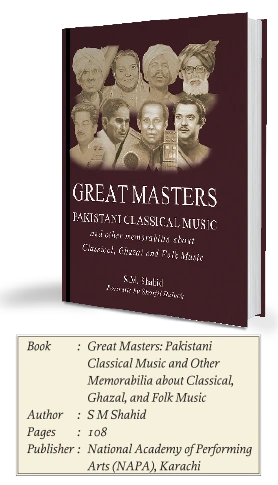
S M Shahid’s Great Masters: Pakistani Classical Music and Other Memorabilia about Classical, Ghazal, and Folk Music may come through as a token of sorts for these devoted fans of the genre. The text offers succinct biographical sketches of 20 Pakistani classical musicians, including Ustad Bundu Khan, Roshan Ara Begum, Ustad Amanat Ali Khan, and Ustad Fateh Ali Khan. Each biographical note is laced with rare, refreshing insights about the lives and illustrious careers of these maestros. These accounts are accompanied with exquisite black-and-white portraits of the musicians prepared by versatile artist, filmmaker and environmentalist Sharjil Baloch.
At first glance, the cover transports us to a bygone era with its striking collage bearing the portraits of eight celebrated doyens. Readers familiar with the minutiae of Pakistani classical music may perceive this visual as a noteworthy reminder of these unforgettable legends. For other less enthusiastic aficionados, this might be an opportunity to put a face to the names of classical musicians they may hazily remember.
A respected musicologist, Shahid is well-placed to tackle the subject of this book. Using the coffee-table format to significant effect, he turns an intimate gaze on the challenges classical musicians face in Pakistan. In a short introductory note, he delineates the difficulties encountered by these maestros in ensuring that their craft survived amid widespread shifts in the country’s cultural milieu.
Be that as it may, Shahid doesn’t allow his work to become a lamentation of the perceived demise of classical music. With the tenacity of an optimist, he reminds readers that this “exclusive art” has been kept alive as many esteemed maestros passed it down to their children. Undaunted by the dwindling audiences, these gifted scions went on to become proficient practitioners in their own right.
The biographical sketches of the maestros are also fuelled by this spirit of optimism. While these entries aren’t hagiographical in nature, they are seeded with an air of hopefulness. Each crisp biographical entry contains factual information and is mercifully devoid of conjecture. A deliberate attempt is made to focus on the contributions of these maestros instead of depicting their lives in needlessly melodramatic hues. With an eye for detail, Shahid deftly chronicles the achievements and struggles of each maestro without compromising on the crucial ingredient of authenticity. He, therefore, succeeds in producing an accessible and immersive text that could prove to be a starting point for a more detailed appraisal of the decline of Pakistani classical music.
A concerted effort has also been made to acknowledge the contributions of the existing practitioners of Pakistani classical music. Furthermore, Shahid has included enlightening details about the traditional instruments practitioners use and the various musical households or lineages, among other intriguing trivia. As a result, readers are provided with a useful guidebook that captures the genre’s essence.
Shahid’s text is a tribute to the rich scope of Pakistani classical music and should be viewed as a valuable cultural and historical document.
Leave a Reply