



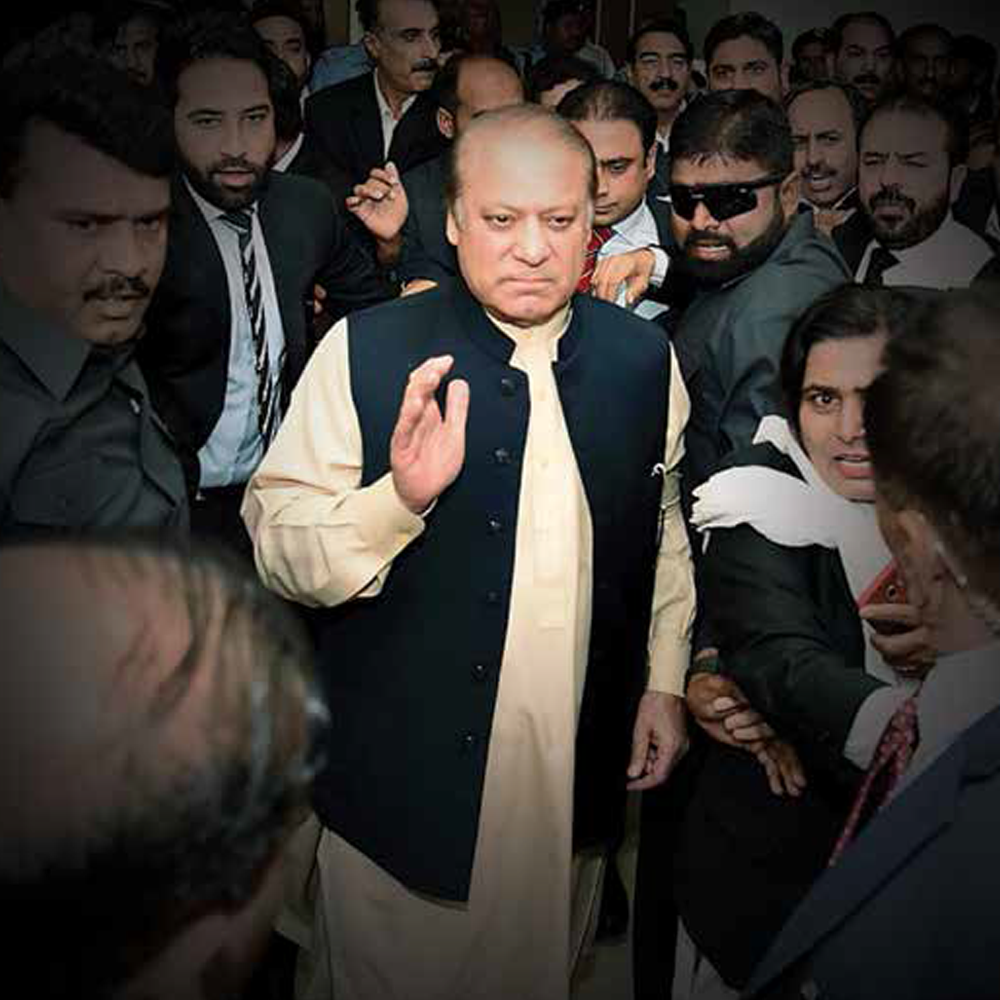
Former Pakistani prime minister Nawaz Sharif is Pakistan’s longest-serving prime minister, having served nine years across three tenures. He was first expelled from office in 1993 on suspicion of corruption. He won an election in 1997, only to be ousted and exiled after a military coup in 1999. He returned to Pakistan in 2007 and took power once more in 2013 until his ousting in 2017 on the charges of corruption and was convicted by the Supreme Court of Pakistan.
Once again, he left the country in 2019 for medical treatment while serving a prison sentence for corruption but then defied the authorities and never came back. From 2019 to 2023, he remained in self-exile in London. In October 2023, he returned to the country. Back with a bang, he is in Pakistan now and granted a protected bail by a federal court. Today, he is promising the nation’s economic prosperity that it has been struggling with a financial crisis. The general elections are slated for February this year. But it is of utmost significance to understand that a veteran leader like Nawaz Sharif can contest elections. If yes, what is the status of the Supreme Court’s decision that declares him an absconder?
A Pakistani anti-corruption court jailed former Prime Minister Sharif. He was sentenced to seven years in jail and imposed a heavy fine by an anti-corruption court in December 2018 after he failed to convince the court that he had nothing to do with the steel mill set up by his father in 2001 in Saudi Arabia. Sharif was also sentenced in July to 10 years in prison by the same court on charges related to purchasing upscale Avenfield apartments in London after the Supreme Court removed him from power.
Upon return, the Islamabad High Court acquitted Sharif in the Al-Azizia Steel Mill corruption case. What is surprising for the general public is that a lower court is suspending the judgment of the Supreme Court of Pakistan. He has already been acquitted in the Avenfield case, in which he was convicted in July 2018 and sentenced to 10 years by Pakistan’s highest court. Looks like this was to remove a significant legal hurdle on his way to lead his party in the forthcoming elections. He also got relief in the Flagship corruption case in which the court declared him innocent in 2018. Still, the acquittal was challenged in the IHC by the National Accountability Bureau (NAB). A division bench comprising IHC Chief Justice Aamer Farooq and Justice Miangul Hassan Aurangzeb heard the appeal against conviction by the anti-corruption court in 2018 in a case filed by the NAB, the national accountability watchdog.
The above are unprecedented acts in Pakistan’s legal system where a lower court nullifies the superior court’s judgment.


The writer is associated with the National University of Sciences and Technology, Islamabad as an Assistant Professor at Department of Government and Public Policy. She can be reached at farahnaz@s3h.nust.edu.pk
Leave a Reply