


Special editorial feature
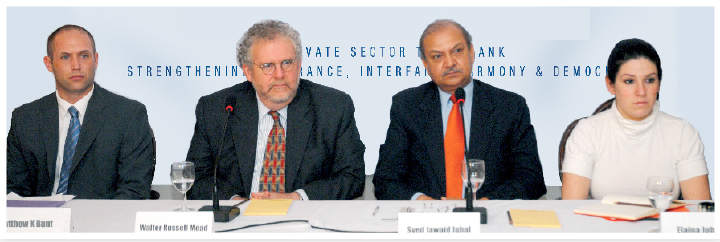
Prominent US foreign policy expert Walter Russel Mead is speaking on “American foreign policy and how it changed the world” at a seminar hosted by the Society for Global Moderation, a private sector Think Tank. Picture shoes (L to R) Matthew K Bunt, Public Affairs Officer, US Consulate; Guest Speaker; Syed Jawaid Iqbal, Chairman SGM and Elania Johnson (US Consulate).
Society for Global Moderation (SGM) was set up as a think tank to forward the concept of tolerance, interfaith harmony and democracy in society. It was in the aftermath of 9/11 that the idea came to me and I shared it with a few friends. They agreed that there was a need for a platform which should aggressively counter the narrative of extremism and intolerance being spread by the West.
The Society for Global Moderation (previously known as The Moderates) was established in 2003. It promotes Pakistani society – and people around the world – as generally peace-loving and tolerant.
SGM is not against any religion, custom or creed and supports a society based on moderation. To further its viewpoint, it has been inviting prominent scholars and thinkers from around the world to speak on subjects that are in conformity with its ideals.
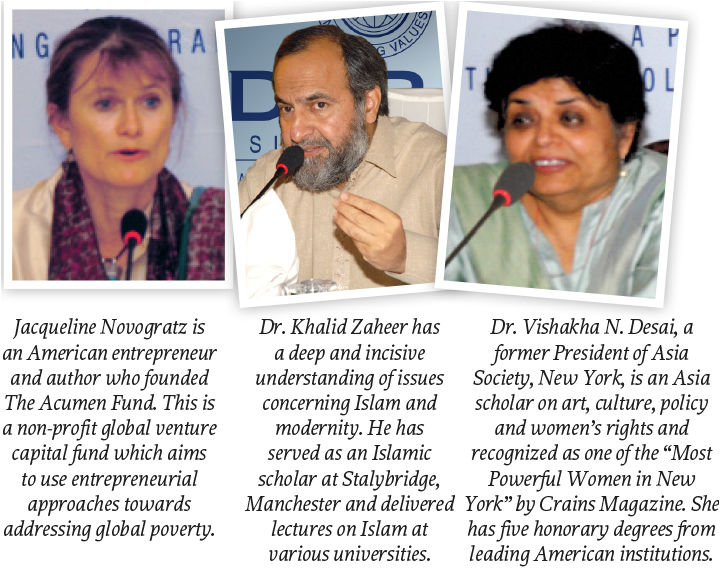
Among these are: Walter Russell Mead, US foreign policy expert, who has served as the Henry A. Kissinger Senior Fellow for U.S. Foreign Policy at the Council on Foreign Relations. Subject: ‘India, Pakistan and Afghanistan.’ Marguerite H. Sullivan, US Public Affairs and Communications Specialist and Director of the Center on International Media Assistance. Subject: ‘Media Freedom and Sustainable Democracy’. Jacqueline Novogratz, founder and CEO of Acumen Fund. Subject: ‘Philanthropy and Leadership’. Vishakha Desai, President Asia Society. Subject: ‘Pakistan’s Perception among the U.S. Populace.’ Dr. Zaheerul Islam, Islamic scholar. Subject: ‘Islam in a Modern State.’
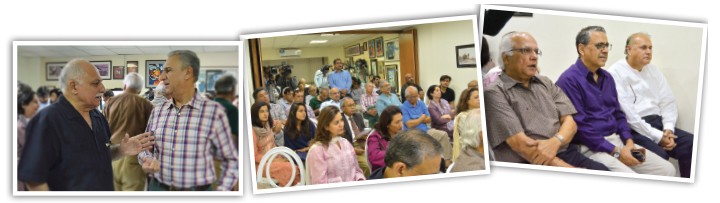
With a view to achieve its objectives, the Society has been holding meetings on relevant subjects from time to time. Leading experts on their subjects are requested to speak before society’s members, guests and media. Some of the events are given below:
Foreign Policy Challenges and the New Government
Najmuddin A. Shaikh
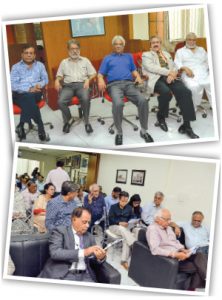
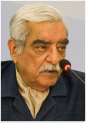 Najamuddin Shaikh said that a country’s foreign policy emanates from its domestic policy and if its internal policies are strong, this will certainly lead to strong external policies. He said that the new government in Pakistan will start moving towards a new identity and that it would recognize terrorism as a recurrent theme.
He was of the view that since every country has its own interests to look after, Pakistan must also accept the realities surrounding it and must accept that the Taliban are a reality though it must make sure that it does not become a party to the conflict.
18th Amendment: Applause and Criticism
Senator Mian Raza Rabbani
 Senator Raza Rabbani was of the opinion that the 18th Constitutional Amendment was introduced after a long struggle which grew after the smaller provinces in the country realised their sense of deprivation and began to feel that they had no control over their own resources. They had begun to feel that they were not a part of the decision-making process and the 18th Amendment attended to this grievance.
Senator Raza Rabbani said that Pakistan is a multi-ethnic and a multilingual state, and if the autonomy given to the provinces is taken back, it will have very serious consequences for the federation. There was thus a need to amend the Constitution and the 18th Amendment was the outcome.
Pakistan-India Relations - future, known and unknown
Senator (r) Javed Jabbar
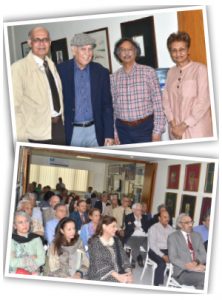
 In his talk, Javed Jabbar said that Pakistan and India have a complex bilateral relationship. There are no other two nation states in the world with the kind of multilayered complexity as Pakistan and India have. The people of both countries have a long history together and yet there are great differences among them. By and large, people in the region are driven by a hysterical media and are also restrained by their mindsets.
He said improving relations was within the control of people of both countries but they needed to foster a positive psyche and attitude about the other country.
Does Karachi Belong to Anyone?
Nisar A. Memon
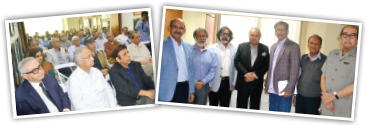
 Nisar Memon remembered Karachi as a city of cities, also known as the Pearl of the Arabian Sea. He said there was a time when Karachi was known as the cleanest city of Asia and today it had become a administrattive nightmare as neither the city government nor the provincial government were willing to take ownership of Pakistan’s largest metropolis.
He emphasised that there was a question of good governance as the city had lost its way. He said if the city was to be given its glory back, the citizens would also rise up.
Is the Population Bomb Ticking in Pakistan?
Dr. Mehtab S. Karim
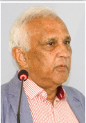 Dr. Mehtab Karim was of the view that South Asia, with over one-fifth of the world’s population, had suffered from a high infant mortality rate, a low level of literacy and endemic poverty.
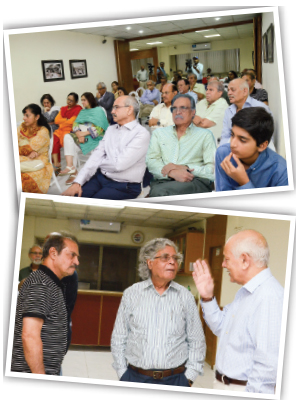 He said that most social scientists and demographers believe that fertility is generally embedded in cultural and religious factors.
Population planning in Pakistan, Dr. Mehtab said, was based on a faulty framework and the population explosion may become a threat to the very existence of the nation.
Post-Indian Elections Scenario: Challenges and Options for Pakistan
Dr. Moonis Ahmar
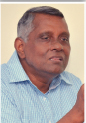 Dr. Moonis Ahmar said Pakistan should brace itself to confront the myriad of challenges during the second term of Narendra Modi. He said, Modi's fascist approach and vendetta-based politics reflected the surge of populism in India.
He said Pakistan needed to be tactful and mindful in dealing with the situation that has come up after the Indian elections.
Pakistan - a perspective, irrespective
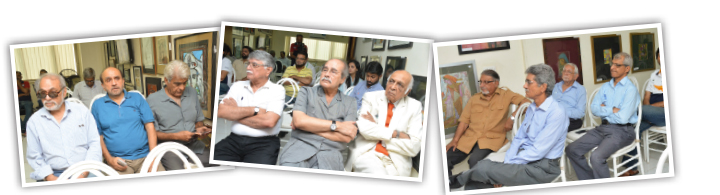
Idris Kothari
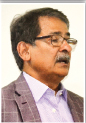 Idris Kothari said, Pakistan now had a leader who was honest and sincere. Pakistan also had a whole body of youth which was very energetic and mathematical-minded. He said the world was short of 85 million IT workers because Europe was not producing many children and all the baby boomers were moving up in age and retiring.
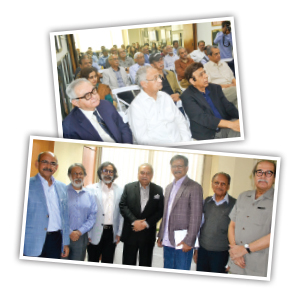 Kothari also said Pakistan now has the opportunity of a lifetime as a nation to make a change and was of the view that one small change will make the difference as change had now arrived. He said it was time to act and asked everyone to do one small thing for the nation. He said, “There are 220 million of us. If we started to pick up one pound of garbage from the streets, the entire country would be clean. If we started to help in any way, shape or form, for the common good and not in self-interest, this country will change”.
Leave a Reply