Based on true events in the 1971 backdrop, writing this article was like piecing together a jigsaw puzzle since the primary narrator, Brig Amir (pronounced Ameer) is above 90. He struggled with collecting thoughts from his fragmented and much blurred memory. The narrative was put forth by the two sisters, who, owing to their tender ages, could not have imbibed what they underwent as juveniles.
ByCol Arslan Qadeer (Retired) | April 2022
1954 PMA Kakul – A bunch of excited cadets from the 11th PMA Long Course made their way into the room of their fellow cadet Amir Muhammad Khan (pronounced ‘Ameer’). On being stormed by his fellow cadets, a bewildered Amir Muhammad Khan, obviously intrigued, asked them as to what was up? The cadets asked him as to why did he not inform them that his younger brother was to join 13thPMA Long Course, and that his brother was already there. They told him that if it was not for his striking resemblance with him they wouldn’t know if his brother was there. This put Cadet Amir into puzzlement as any brother of his was not supposed to join the incoming course, nor was there anything of the sort on the cards. A curious Amir accompanied them to see the young cadet who had just reported. On seeing the newcomer, Amir was taken aback to see that the cadet did have a staggering resemblance with him. Though, the confusion was sorted out quickly through the rest of the period of training at PMA, the two more often than not used to be taken as brothers by the various physical and weapons instructors and teaching and administrative staff till the time Cadet Amir and 11thPMA was passed out in 1955. At that time neither Amir Muhammad Khan nor the younger cadet had the wildest idea as to what destiny had in store for them and at what juncture their respective paths were to converge. More about this later…
1968 – When young Major Muhammad Hussain along with his youthful wife Imtiaz Begum and one year old daughter whom they had named Sadaf was embarking on the journey to East Pakistan, he did not have the faintest notion as to what tragedy was awaiting him and would devastate his small happy family. Major Muhammad Hussain was posted on deputation from army, 14 Punjab to East Pakistan Rifles (Paramilitary Border Security Force of the then East Pakistan provincial region under civilian administration. Officers from the army were transferred to command EPR troops). Reaching the shores of East Pakistan was a unique experience for Muhammad Hussain and his wife who hailed from Village Munara in the hilly town of Chakwal. He was both spirited and excited. Soon he was posted to the segment falling in the vicinity of Thakurgaon. This segment was responsible for surveillance and security of the border with the Indian province of Bihar. Since Major Hussain was part of the border guards serving in the border belt, he decided to set up his household in the same vicinity. The nearest army garrison where his Headquarters was located was that of Rajshahi, around 250 kms south of Thakurgaon, whereas Dhaka was 380 kms in the east. Muhammad Hussain was allotted a civilian bungalow in the main hub of Thakurgaon. There, his responsibility envisaged border surveillance and anti-smuggling operations. Soon the house turned into a small heaven for Muhammad Hussain’s small family and life shone in its absolute benevolence. During the next two and a half years, Muhammad Hussain and Imtiaz were blessed with another girl whom they named Irum, followed by a son Khurrem. During the first couple of years, there was nothing visible on the political horizon as far as life in Thakurgaon was concerned. Perhaps history was taking a long siesta. There was political turbulence but it was mostly beneath the surface. By March 1971, following the general elections and the events that followed, conspicuous black clouds started to show up. Havoc was about to unleash –a dormant monster was slowly coming to life. That was not the time of media. Television was limited, the only means of information, apart from word of mouth, was the state-controlled radio and the newspapers.
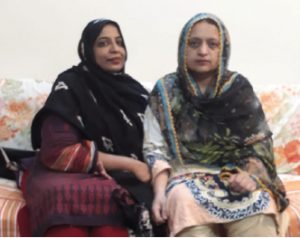
Reunited: Irum (on left) with her sister Sadaf (on right)
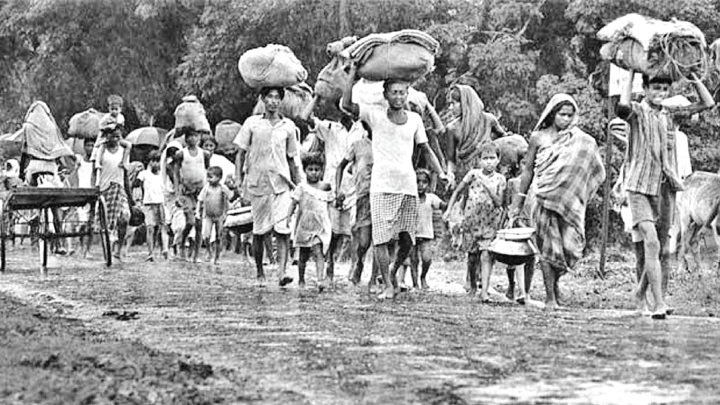
Predominantly, life surrounding troops is kept simple yet banal. Troops are kept away from unnecessary gossip-mongering. Information is filtered to muzzle the spread of rumour, breeding of politicized notion that may trigger panic or anarchy. The hallmark of army training is to keep the rank and file spirited. This is necessary to keep the morale high and to arrest any fissiparous tendencies. The advent of 1971 was trumpeted with widespread political incongruities. The rancorous sentiments that had until now been raging inside the cauldron began to take the face of armed ethno-centric clashes. Non-Bengali dwellings to include West Pakistanis and Biharis were now being subjected to target killings, immolation, lynching, plunder and pillage. The RAW-trained militant groups of rebels of Mukti Bahini aided and abetted by the Indian army were no more in hibernation and had openly started challenging the law enforcing agencies. In a bid to cripple law and order and to scuttle the communication system, they started laying road blocks sporadically, thus paralyzing the entire administrative apparatus of the country. Opportunist and subversive elements including the outlaws, masquerading as freedom fighters, joined hands to loot, torch and vandalize public and private property in broad daylight. One of the bloodiest chapters of human conflict was being unleashed in its monstrosity. Appalling atrocities against the hapless non-Bengali population started to unveil in the most barbaric manner. The Pakistan Army was mainly being demonized as the epicenter of all political ills befalling the East Pakistan part of the country, while Bengali people were being depicted as victims. The Mukti Bahini as well as the pro-liberation elements guided by Indian intelligentsia drove the East Pakistani populace towards violence and national rebellion, translating into xenophobic violence against the non-Bengalis. The town of Chittagong, Khulna, Santahar, and Jessore were the first to get embroiled in this blood-smudged episode of ethnic violence. Men, women and children were massacred on the streets, solely on the basis of ethnicity. The killings were executed with shocking bestiality, while incidents of sieges around West Pakistani and non-Bengali dwellings, raids and ambushes increased by the minute. Isolating and cutting exit routes, mutilating and violating hapless inmates, and ransacking their belongings, was a frequent sight.
The Mukti Bahini as well as the pro-liberation elements guided by Indian intelligentsia drove the East Pakistani populace towards violence and national rebellion, translating into xenophobic violence against the non-Bengalis.
Major Muhammad Hussain residing in Thakurgaon with his small family of wife, two daughters, aged around four and three, and a few months old infant son, was cognizant of the situation brewing around him. Especially owing to the fact that most of the Bengali troops of his battalion had deserted to join the rebellious Mukti Bahini and that, they would certainly make an effort to storm his house. His 2IC (second in command), a captain from West Pakistan, was also living with his nine months pregnant wife. With the road to Dhaka and Rajshahi having been blocked by the rebels sporadically, and telephone and signal communication already destroyed, Muhammad Hussain’s family was now completely marooned surrounded by the blood-thirsty Mukti Bahini. A whirlwind was about to gather around his small heaven. The scenario was now less murky. Sensing the situation, Muhammad Hussain arranged a 12 bore shotgun with some ammunition for self-defence in his house. He decided to stay back in his house and wait till the routes were cleared and support arrived. As for his 2IC, since his wife was full term pregnant, he had no option but to bid good bye to them in the dark hours of the night in a jeep in a do-or-die situation to find safety at the nearest hospital. The next day, the couple was hunted down and cut to pieces.
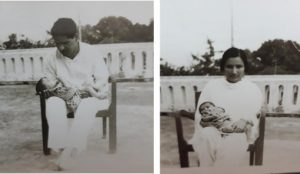
Muhammad Hussain and Imtiaz with their infant son Khurrem
July 1971 – Amir Muhammad Khan, now Lieutenant Colonel was boarding the last Dhaka-bound flight from Karachi to take over as Commanding Officer of 34 Punjab located in Dhaka. On reaching Dhaka, Lt. Col. Amir came to know that his battalion-to-be had been engaged clearing road blocks and hurdles put up by the rebels and restoring the lines of communication as well as relief and rescue of the stranded West Pakistani troops and their families from their besieged homes. In Dhaka, he was briefed about the situation in hand with reference to the operation and what his battalion was undertaking. Among the West Pakistani troops stranded at different locations, one name particularly rang bells in his ear. This was Major Muhammad Hussain. Amir immediately realized that he (Hussain) was the same officer with whom he bore identical resemblance while at PMA. He was directed to join his battalion’s main body without wasting anytime. The battalion had just entered Thakurgaon…
On reaching a desecrated Thakurgaon, Amir called for the whereabouts of Major Muhammad Hussain’s house, the paramount aspect that had been pricking Col Amir’s mind so badly. With some effort and quick search patrols, the house was spotted. When Col Amir entered the house he confronted an indescribable ghastly scene. What he was witnessing was more of a slaughter house. With blood stained walls and floors the house presented a deadly spectacle. It was too late. The details were provided by the locals. The massacre had occurred a few days before 34 Punjab entered Thakurgaon. He was a brave man and died a brave death. As expected, his house was besieged one night by the pro-liberation mob of Mukti Bahini aided by his own deserted Bengali troops, the locals told a heavily crest-fallen Col Amir.
Muhammad Hussain along with his wife, two daughters an infant son and a Bengali Ayah (maid) was trapped in his own home. Despite his waning strength, for two days he kept resisting the Mukti Bahini blood-lusty assailants by firing back from his shortgun before running short of ammunition. Soon a grenade was lobbed into the house that injured Muhammad Hussain and his wife. The house was then stormed from all directions. A few mukti attackers armed with rifles barged into the house and upon spotting Muhammad Hussain and his wife clutching to her infant son, fired pointblank killing Muhammad Hussain and his wife, with the infant son still clinging to his mother. On this the entire mob fell into the house and started looting. During the frenzy, the Bengali Ayah took the two girls and tried to escape from the backyard. One ruffian spotted her, chased her and while she was making an exit from the backyard, knifed the younger daughter (Irum). The Ayah, in a bid to save her own life as well as of the elder daughter (Sadaf), had no option but to abandon the younger child whom she thought dead and escape with the elder one still alive. The mob in a looting frenzy started stabbing the bodies of Muhammad Hussain and his wife. As it was not enough, they then dragged the corpses across the village before hanging them upside down with a rope from a tree. Col Amir was informed that the Bengali Ayah having successfully escaped from the scene went into hiding for a few days. Later, when the dust settled, she contacted the local authorities. A search was already going on. By that time the army parties had reached the scene. On indication by the local authorities, the Ayah was contacted and the traumatized little girl (Sadaf) was recovered. An L-19 aircraft was arranged which took the girl and the Ayah to Dhaka. In subsequent weeks after collaboration between Headquarters of Eastern and Western Commands, the latter managed to locate the maternal grandfather of the girl whose name was Sher Muhammad; he was a headmaster in a school in the village of Padhar of District Chakwal. Sher Muhammad was living with her younger daughter Ghulam Fatima and son Malik Mumtaz Ahmed (later Colonel). Evacuation of the girl was arranged and the Bengali Ayah was sent all the way to West Pakistan by air to hand over the girl to her maternal grandfather.
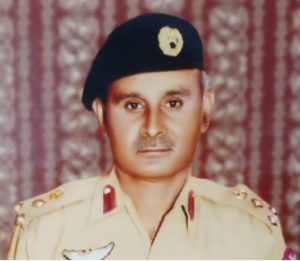
Brigadier Amir Muhammad Khan
However, a different kind of predicament had engulfed Col Amir. On indication of the locals and army personnel, he saw the graves of Muhammad Hussain, his wife Imtiaz and their infant son Khurrem. He did not have an idea of what happened to the younger daughter Irum. The Ayah (who lived in the vicinity of Thakurgaon) had told him that she was knifed by one of the assailants, and that there was no way that she could possibly be alive. But the one lurking question which did not let Col Amir at ease was; if the rest of the corpses had been found and buried, why not that of the younger daughter. Could she be alive? Or taken away and buried elsewhere? The chances of this, given the circumstances, seemed improbable. Amir then spread the word everywhere and also dispatched a number of search parties in the area to seek the whereabouts of the girl. It is said miracles happen to those who believe in them. At last, Col Amir got the news that a little girl, seriously wounded, had been found on the roadside unconscious, by a sweeper woman from village Boda. On hearing this, Col Amir dispatched parties to the village. By that time it was around September. The hunting parties located the woman and brought her to him. On further inquiry, the woman told him that she had picked up a little girl, around three years of age, on the roadside. Thinking her to be dead, she intended to hand her over to the municipal authorities for burial. However, while handling her she realized that she still had a pulse. She then took the girl to her hut and dressed her wounds. The next day she handed her to the DC (Deputy Commissioner) specially deputed to perform Martial Law duties in the area. This news thrilled Col Amir and he, without wasting a minute, dispatched parties to establish the veracity of the information. The Deputy Commissioner was easily located and it was revealed that the little girl was indeed in his custody. Almost a month had elapsed. However, the wound had not fully healed, and the girl was still in a state of coma, unable to speak. Col Amir’s sixth sense kept steering him towards the idea of this girl being Major Hussain’s daughter. He then decided to send for Major Hussain’s domestic housemaid who now lived in Thakurgaoun, to have her come and identify the girl.
When the maid saw the little girl, the girl was laying in bed, etherized, unconscious. The maid swiveled her eyes across the girl’s face and responded, “Nahi, sahib jee, ye nahi hai” (No, sir, she is not the one). This dropped a dampener upon Col Amir’s spirits, who had eagerly wished her to be Major Hussain’s daughter. Dismayed and disappointed, he asked the maid to return to her village. However, just as the maid left, the girl began to slowly raise her eyelids. The face she could view before her now was Col Amir’s and in a matter of seconds, she gaspingly uttered, “Abu” (Father). At first, Col Amir considered this a figment of the girl’s imagination, a result of weeks of emotional and physiological trauma, but then almost instantaneously, his mind was hit by a kaleidoscope of images that took him back to PMA Kakul where everybody confused him and Hussain as brothers, as a result of their uncanny resemblance.
He shouted and called the maid who had fortunately not left the house yet, and asked her to come and consider checking the girl one more time. “Check closely once more”, he insisted, and at that, the maid took a closer look with patience, this time identifying the girl as Major Hussain’s daughter. In order to reconfirm, Col Amir asked the maid as to what made her change her mind?. The maid referred to the birthmark above the girl’s eyebrow—the birthmark that had been an eyesore for late Imtiaz (Major Hussain’s wife), who displayed her contempt for it in front of the maid on numerous occasions.
The girl, Irum, was taken care of until she completely recovered. The maid was asked to chaperone her to West Pakistan, delivering her safely in Chakwal to her maternal grandfather, Sher Mohammad, where she was reunited with her elder sister, Sadaf. Sher Mohammed’s other daughter, Ghulam Fatima (Imtiaz’s younger sister) embraced the two girls as a mother and never got married.
Years later when Col Amir returned to Pakistan, the first thing he did was to visit Padhar village in Chakwal, where upon ringing the doorbell at Sher Mohammad’s house, he was welcomed by Irum, now 6 years old, wearing a beautiful smile on her face.
Had it not been for the similitude that Amir and Hussain had, Irum would never have uttered the word “Abu” before Col Amir upon opening her eyes that day—a miracle from heaven destined to unite her with her sister Sadaf amidst the catastrophe, trauma and heartache that stamped lifelong reminders on the canvas of their lives.
The author is a retired Cavalry officer. He has spent 27 years in uniform and has a published collection of short stories By the Autumn Trees to his name. He is a historian and an avid traveller, having a number of travelogues published in leading newspapers. He can be reached at arslan9h@gmail.com
Amazing story.
The uncanny resemblance of the two officer prompted the minor injured girl to call the Col. Abbu (father). That one word defined her own identity.
Excellent research Col. Arslan.






Amazing story.
The uncanny resemblance of the two officer prompted the minor injured girl to call the Col. Abbu (father). That one word defined her own identity.
Excellent research Col. Arslan.