



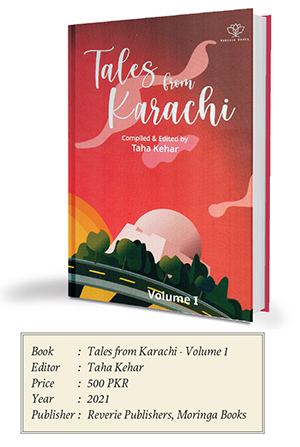
 ‘Tales from Karachi’ is a collection of flash fiction and poetry about Karachi, once referred to as ‘The City of Lights.’
The anthology ‘Tales from Karachi’ is compiled and edited by Taha Kehar, a young novelist, journalist and literary critic. The book captures the essence of the lost glory of the Karachi city, weaving its way to portray how Karachi has been transformed from a heavenly abode to a demonic, almost distressing condition.
The book addresses issues such as extra-marital affairs, the taboo of being a single woman, Diaspora, superstitions, bloodshed and violence, patriotic betrayal, environmental concerns, political upheavals, religious sectarianism, and the ensuing lack of tolerance and affinity between different ethnic groups living in the city.
Briefly put, the book beautifully highlights the quintessence of what life in Karachi is all about at this point of time. Karachi has been robbed of its ‘crowning glory,’ and been reduced to a ‘glorified ghetto.’ And who is responsible for it? No one other than its citizens along with administration and security authorities.
And the tragedy becomes more profound given the fact that all want to live and cherish its bounties, but no one is willing to own and take the responsibility of the most neglected urban centres of the world.
Karachi has become a land of ‘pungent trash’, a ghoulish city but the resilience of its citizens is remarkable for they still have hope of a better tomorrow!
The lines from Khilona Ghar by Mahek Khawaja:
‘You belonged to Karachi’s foetus once.’
Where the children “play with dreams, aspirations, ambitions. Often breaking fragile toys into countless pieces.”
As the book suggests, Karachi is like a matriarch for its children protecting them from the hardships of life. ‘Your land never betrays you’, showing how you always can count on your roots. Your country, your city, your home will always be a source of comfort and will never abandon you,’ writes Aiman Siddique in her story ‘Beautiful Ruins.’
Anything by Hafsa Maqbool reinstates the same patriotism and affinity with the city.
“If I could be anything, what would I be?
Truth is, without you, dear Karachi, would I even be?”
In Kora Kagaz by Rumana Mehdi says:
Would I recognize home if I went back? Playing with the idea of identity again.
“One foot here
Other foot there
my soul is forever
dangling
my heart cut into
two.
Nostalgia has no nationality.”
She accurately wraps the form of nostalgia. It knows no borders, no boundaries. It is just there!
‘The Dead Never Lie’ by Kamila Rahim Habib, shows the irony of death as not being static but ‘brimming with life.’ Yet the author empowers death with a disturbing truth, which is bitter and chilling.
‘Language of Whispers’ by Sameer Shah is a delectable poem talking of the bilingual paradox. The following lines describe her predicament in an elegant and precise manner.
“I often wonder if my children will speak the language of whispers with the same gusto and ease.”
The book concludes with the story, ``Karachi is” by Asna Feroz who takes us back to a ‘happier time.’
“A time when people of Karachi were free. The air wasn’t polluted with screams and pleas, and the pipes had not run dry.”
In a wave of nostalgia, Feroz pens the current situation of Karachi in a powerful and gripping manner. And I quote:
“Karachi is in mourning. It mourns for itself and for its people who have forgotten it.”
“Karachi is lost. Lost in a sea of suffering. Karachi screams. It screams out in pain, in longing for the city it used to be. But it’s screams are lost. Lost in the rivers of red that flow down its streets.”
Addressing the conscience of the Karachiites, the book ends with a glimmer of hope and suggests how to heal and alleviate the city’s long festering wounds before it’s too late. 
Leave a Reply