



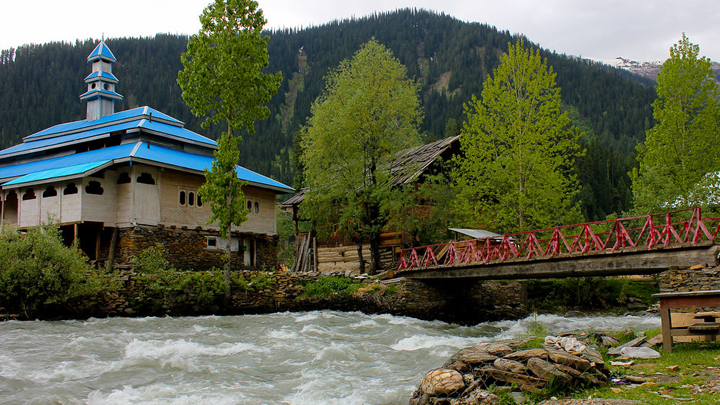
The Neelum Valley in Azad Kashmir is rich in natural beauty and has been gifted with high mountains, streams, waterfalls, lakes, glaciers, pastures, forests and wildlife. There are many places to visit in Neelum Valley, but the Gagai Valley tops the list.
The largest pasture in the Grurez Valley, the Gagai Valley is located at the end of the Neelum Valley, standing 6,000 to 13,000 feet above the sea level. The pasture is surrounded by two major Nalas, Dudgai Nala and the Gagai Nala. The Gagai Valley is surrounded on the east by Qamri Pass, on the west by Taubut, on the north by Gujjar Nala Phulaoi and Riyat Astore and is surrounded on the southeast by the Line of Control (LoC), the line that marks where the region of Kashmir is divided.
During the winter season, the land routes to the Valley are blocked due to heavy snowfall of 6-10 ft. In summer, locals from Dudhnial, Sharda and Gurez Valley move their cattle here, while Bakrwal brings a large number of cattle from different parts of Azad Kashmir and Pakistan. From May till the end of September, people tend to live in the Valley with their livestock.
In order to visit Gagai Nala, one needs to travel from Islamabad to Muzaffarabad. Taubut serves as the base camp for exploring and travelling to the area. Beyond Taubat Bala, there is no road in this area and only a footpath and a horse trail is available to travel. Those who want to see Dadgai (Small Gagai) need to start their journey from Taubat Bala on the Nalla to the south-east.
Dudgai Nalla is a beautiful pasture. In this Nalla, there are beautiful pastures, such as 'Ratta Pani' (red water). The water of Ratta Pani stream is clear but the colour of the soil under this water is completely reddish. Opposite to Ratta Pani, there lies an area called Zian (Indian-occupied Kashmir), which is part of the occupied Gurez valley. The pasture here is called "Bake" in the local Shina language.
One needs to start the journey to the large Gagai Nalla in the eastern direction. On July 11, 2021, the writer along with his friends set out on a trip to Gagai Nalla. We parked the jeep at Taubut Bala and started travelling towards Gagai. In this drain, the banks of the Taubut community come first and are followed by the banks of the Parma community. On the way here, the Shakargarh Nalla is divided to the south. The last elevated area of Shakargarh Nalla meets Riyat Astore and Gujjar Nalla Phullawai. Most of the Bakrwals go to this Nalla with their cattle in summer. On the same track, at the beginning of Shakargarh Nalla, there is an ancient graveyard of Bakarwals. If anyone from the Bakrwal community dies in the summer, they are buried in the same burial ground. We crossed the Shakargarh Nalla and continued our journey straight towards the east. On the way, some members of the Malik community invited us for tea. As we were tired, we accepted the invitation with pleasure. In their camp, we ate "Chori" made from ghee with a delicious kind of desi tea. There are the pastures "Choti Khorian" and the "Bari Khorian". Along the way, one can see beautiful waterfalls, plains, avalanches and rivers. After having a four-hour journey, we arrived at the beginning of the 'Biloor Kassi Nalla'. People also take livestock to Biloor Kassi Nala. The area is rich in precious stones and herbs.
Our intention was to reach Jalkhat, the most beautiful pasture (bake) of the area, by evening to enjoy beautiful views of the area in the morning and in the evening. From there, we travelled through a difficult mountainous area and reached “Jalkhat” in another half hour. The residents were very hospitable. They welcomed us and offered accommodation. Staying up all night, we were served local food and dishes such as karri, curd, ghee and cornbread. The delicacy and taste of such indigenous food can never be compared with the food offered by five-star hotels.
Hundreds of people from Marnot, Phullawai and Dudhnial were camping in Jalkhat. People in this area tend to engage themselves with their livestock. Along with the livestock, people extract herbs from mountainous areas for livelihood, which are sold locally at reasonable prices. At dawn, the elderly men and women wake up and offer breakfast and then manage the cattle for grazing. When the cattle is returned to the area in the evening, milk is extracted from the teats of the animals. People here mostly use lassi, milk, tea, karri, saag karam and rice for food and drink. Most of the food is indigenous, simple and pure.
There are precious stones along with herbs in this area. Some people lease out the area of Bilore Kassi to extract stones from here, and the most common gemstones are tourmaline, bilore and abraq. Beyond Jalkhat are the areas of Larryan and Saraat. From here the Qamri district of Diamer starts. Most people in summer travel by Qamri route by foot. They also venture into small-scale trade with the locals. The area of Mini Marg comes after the Qamri Pass, which leads towards Dewosai. That is why this area is very important as well as beautiful.
Due to the negligence of the government, the local people are facing numerous issues related to education, health and employment. The government should set up at least one rural health centre (hospital) in the area's base camp, Taubut, to provide local population with timely medical care. In addition to that, mobile schools should also be established in this area. Improvement is possible if the government is resolute to take drastic measures and offer employment in the field of mineral resources and tourism. The government must construct the road to facilitate the local community as well as to help tourists and visitors explore the area.
Leave a Reply