



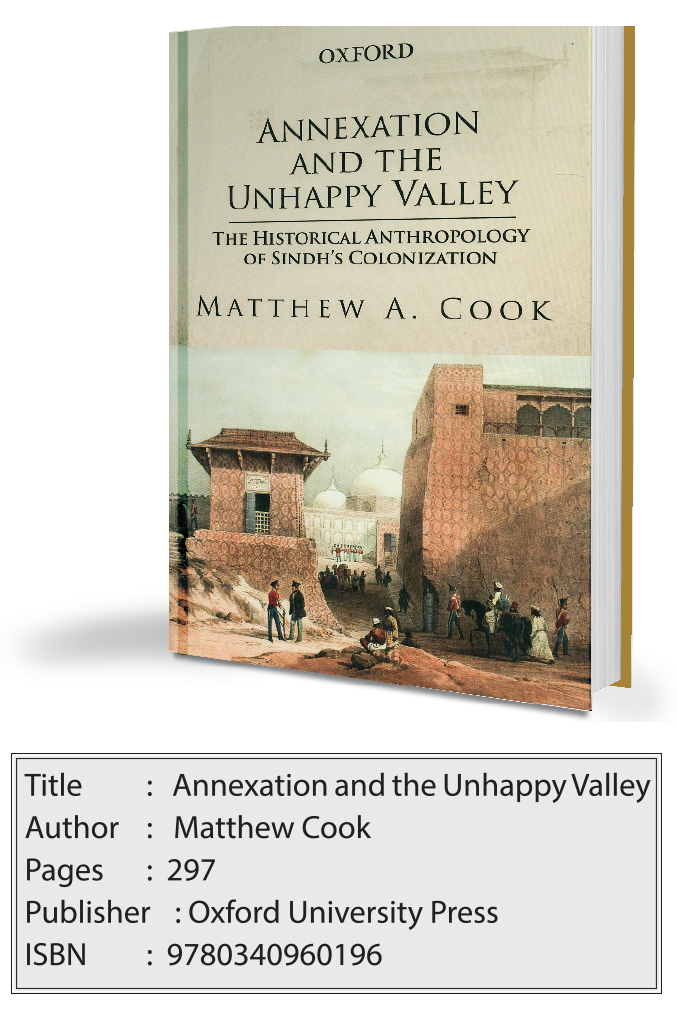
 Professor Matthew Cook’s treatise on the complexities of Sindh’s annexation by Charles Napier, was first published by the Dutch press Brill five years ago. It is pleasing to observe the Oxford University Press branch in Pakistan publish an affordable paperback version of this highly erudite and well-researched text. The book possesses a superb bibliography of which Cook appears to have made full and extensive use—his endnotes after every one of his four chapters are thorough to the point of being semi-exhaustive. In addition to this, his index helps one situate oneself ably as regards this complex book, much of which deals with the ongoing battle between the autocratic Charles Napier and one of his fiercest critics, James Outram.
But although that debate takes up much of the latter portion of the book, the first chapter is fascinating too in that it examines the role of the East India Company when it came to business affairs of Sindh, especially those taking place in Karachi, Mirpur, and Hyderabad. Cook is well-versed in the history of the indigenous people of Sindh, such as the Talpurs, the Ameers, the Bhaibands, the Lohanas and various kardars [deputies] who managed business and legal matters on behalf of the upper echelons of Sindhi society. We regard Napier as being arguably the most powerful man in Sindh during his heyday, but Cook astutely draws our attention to Seth Naomul of the Bhaiband clan who was in his own way so enormously influential that Napier was downright jealous of him. So too were members of the other Sindhi clans and Naomul’s coming under fire for corruption is described in avid detail by Cook who compares it to the most intense of Shakespearean dramas. It is interesting to note that Napier was reluctant to make too public a trial of this strong-willed businessman’s shady affairs because naturally that would have resulted in certain aspects of his own less than kosher dealings being exposed.
But if the Sindhis themselves were not capable of metaphorically hanging, drawing and quartering Charles Napier, some of his own countrymen had no such qualms. In the chapter following the one mentioned above, Cook informs us that James Outram wrote a strong critique of Napier in Britain’s prestigious Gentleman’s Gazette. The publication of this shocked both Charles as well as his brother William Napier, who had written fulsome praise of his sibling in a book on the conquest of Sindh. Some readers found it irritating that Napier was described in a manner that presented him as a Victorian Alexander the Great, but one should not forget that Napier had almost absolute power over the province. Cook posits that this was partly because he reported directly to the Governor-General, in spite of Charles Napier’s being fundamentally a Bombay Army officer.
Aside from Outram, some of Napier’s most die-hard critics came from the Bombay Civil service that deeply resented the high-handed manner in which Napier would go over their heads and divert precious resources and men to suit his colonial purposes in Sindh. Among others, Bombay’s most senior and respected civil servant, J A Willoughby, was supportive of many of Outram’s views. And Cook does a very fine job of delineating the power struggles between Napier’s despotic militarism and the gubernatorial cautions necessarily exercised by the civil service.

Leave a Reply