



 “Honour. A word that brought death to countless girls. How was it that a bunch of men sitting under the peepal tree got to decide whether a woman was honourable or not? How was it that they had the right to pass judgement on whatever she had or hadn’t done, that they had the audacity to rip a woman’s shirt and stone her to death. Or to drown her in a river. Why didn’t these jirgas have female representation?”
“How long would women in Pakistan continue to suffer like this?”
The questions weigh heavily on the protagonist, Abida’s mind. Will she be able to put an end to this practice so ‘deeply engrained?’
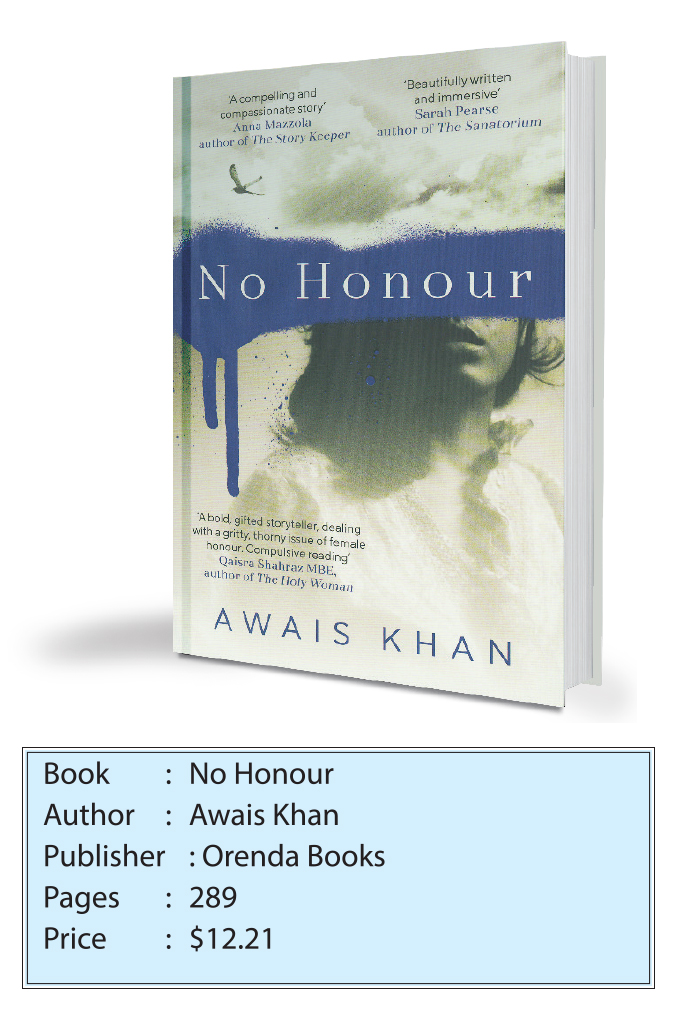
The title ‘No Honour’ is apt, given the theme of the novel by Awais Khan.
It opens on a grim note. Strained with a patriarchal current of misogyny and hatred for women, it creates a suffocating atmosphere.
Paraded naked through the streets, with the villagers throwing a string of abusive words such as ‘filth’ and ‘scum’ and drowning of their daughters in milk because they believed girls were a ‘curse,’ the village is no place for compassion and freedom to give to women. In the name of ‘honour’; several village girls were killed by the Pir.
As Abida escapes the wrench of the Pir and moves to the city with Kalim, she is happy at last, thinking she is safe, not knowing how shortlived the joy would be?
Is the city safe or is karokari or honour killing a common practice there as well?
With its perils of thievery, murder, abduction, drugs, domestic violence and prostitution, the city is no better than the village, if not worse.
Abida’s fate it seems had been decided. There was no escape from this patriarchal setup of exploitation of women. It was when she had lost all hope that she sees a ray of light.
Jamil, Abida’s father is not the typical man. He is a progressive, modern man with a liberal mindset.
Awais Khan beautifully delineates Jamil’s character - the complete opposite of what a man should be like in our society!
Torn between the love for his daughter and the norms or definition of a man set by society, Jamil goes against all odds to save his daughter from the menacing world out there.
Awais Khan, through the portrayal of Jamil as a kind, loving and affectionate father, reverts the common philosophy of male chauvinism. A man does not need to inflict pain on his wife, daughter or sister to prove that he’s a ‘man.’
Khan conveys the message of how our society can become healthier and happier if we were to educate our men to be endearing and tolerant of the women around them.
The grave issues our women are facing everyday can only be solved if men and women are at par with each other. Giving women rights through promoting gender equality and punishing the perpetrators of crime such as ‘rapists’ and ‘murderers’, is the only way forward.
The voices of Noor Makhdoom, Qandeel Baloch, Malala Yousafzai and a million others, shouldn’t drown in the humdrum of life. The victors should be hanged! Justice must be meted out to put a stop to these horrible practices, where women are treated like animals.
Henceforth, Abida becomes the voice of all such women and what gives her urgency is her ‘indomitable courage’ and determination.
Awais Khan shakes us out of our complacency with a jolt every now and then. He surprises us with what happens next each time and there is no denying that he has done justice to the issue of ‘honour killing.’ 
Leave a Reply