



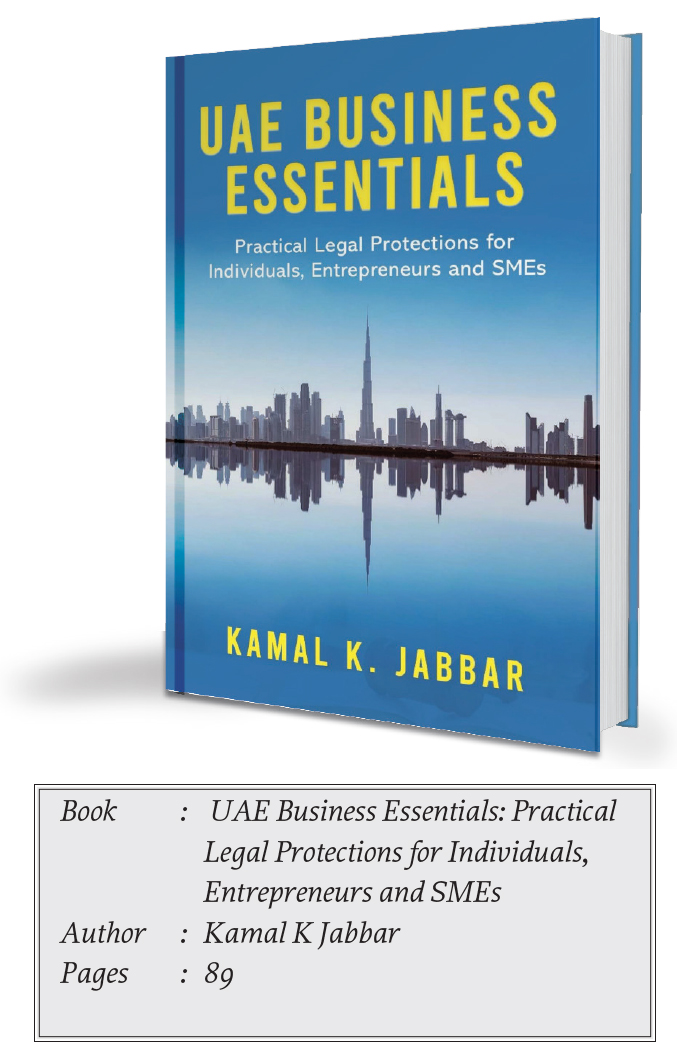
 Writers of self-help books are often advised against using heavy jargon that impedes our understanding of their chosen subject. In UAE Business Essentials, Kamal K Jabbar remains cognizant of this cardinal rule and never veers away from it. As a result, his book succeeds in providing simple yet meaningful insights into the various aspects involved in doing business in the UAE.
Well-structured and concise, Jabbar’s 89-page manual doesn’t promise readers a detailed appraisal of the business climate in the country. To the contrary, the focus remains on supplying them with just the right amount of information that can help them negotiate through a complex and unfamiliar business environment.
In a succinct prologue, Jabbar states that entrepreneurs from common-law countries find themselves “rudderless” in the UAE’s seemingly hybrid legal system. Such concerns are echoed by many professionals who are interested in establishing their business in the region. There is a pressing need to close the knowledge gap, especially if the UAE is to become the world’s most business-friendly country.
In this context, Jabbar’s book can be viewed as a noble endeavour that aims to eradicate a glaring information deficit. However, this manual isn’t targeted at a general readership. At the outset, the author provides a string of disclaimers to apprise readers about what they should expect from the book. We are told that UAE Business Essentials doesn’t profess to be a legal or academic treatise on the subject. In a similar vein, Jabbar offers an exhaustive list of potential customers for the book. This is arguably a clever move to attract readers who can obtain maximum benefits from the text. In an age where books are treated as commodities that must cater to the specific demands of readers, such tactics can allow authors to find a sincere audience for their work.
The value of a self-help book relies heavily on the credentials of its author. Jabbar is a legal practitioner who has worked with SMEs, regional corporations and global mega-caps. He is, therefore, well-placed to comment on the UAE’s business environment with some degree of authority.
In the initial chapter of UAE Business Essentials, the author affords a historical overview of the country’s legal system. Condensed notes on the role of Sharia as well as explanations of esoteric concepts and terminologies are presented in a crisp, unadorned style.
In subsequent chapters, Jabbar effectively employs hypothetical scenarios and real-life case studies to highlight how entrepreneurs can guard their assets, promote their own interests and protect confidential information. A thoroughly researched chapter on the value of non-disclosure agreements to the UAE’s business environment brings copious outlooks to the fore. Other sections deal with a diverse range of themes, such as consumer protection and bankruptcy.
The strongest aspect of the book is that it is up-to-date and extensively researched. For instance, readers who don’t usually stay abreast of developments within the UAE’s business climate will be fascinated to learn that the country lacked a unified insolvency regime until 2016. A detailed chapter on non-competing provisions in the context of the UAE is equally informative and comprehensive.
Fuelled by refreshing insights, UAE Business Essentials comes through as a useful guide that explores the salient features of business laws and practices in an engaging manner. The ideas put forward in this manual will be valuable for entrepreneurs who either aspire to do business in the UAE or find themselves in tight spots while navigating the country’s complex business milieu. A more academic approach to the subject would have turned this brief yet rewarding book into an inaccessible text. The author ought to be commended for giving preference to simplicity without compromising on research. 
Leave a Reply