



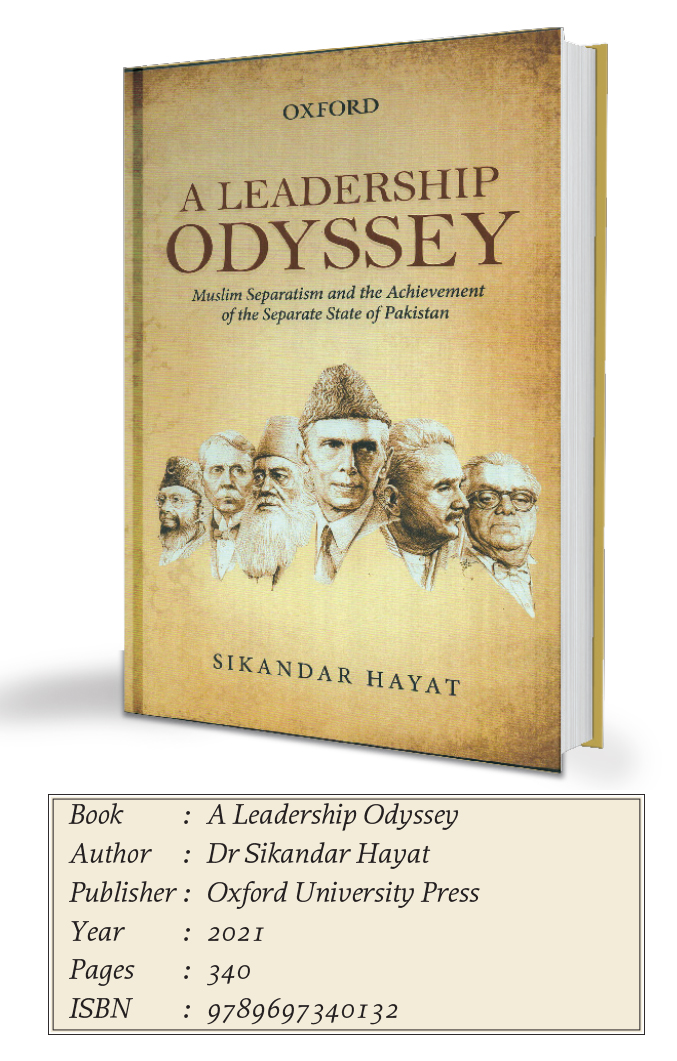
 Conspiracy theorists questioning the intentions of the Pakistan Movement’s leaders will now disappear into the shadows as Dr Sikandar Hayat’s masterpiece leaves no stone unturned in this book.
Hayat, in a series of chapters, one by one relates the profound impact of Sir Syed Ahmed Khan, Aga Khan the III, Syed Ameer Ali, Maulana Mohammed Ali, Allama Iqbal and Quaid-e-Azam Muhammad Ali Jinnah. The crux of the narration is the journey of an idea to tutor the Muslims of British India in English and Western education to attaina Muslim nation-state in a mere passage of ninety years.
Sir Syed floated the seminal idea of Indian Muslims as a ‘qaum’ but refrained from calling it a separate nation. His focus was on education for being able to get better government posts and other economic opportunities. The now world-famous Aligarh College was this cause’s fruit and helped give birth to the later Muslim educated class.
The leadership of Sir Syed was buttressed and competed upon by his contemporaries, Aga Khan III and Bengal’s Syed Ameer Ali. Much to the chagrin of Sir Syed, Ameer Ali wanted a political aspect added to the endeavour of providing modern education to Muslims while the Aga Khan supported his doctrine that the minority Muslim community was more important than the Indian national identity.
Aga Khan and Ameer Ali worked in tandem for the cause of attaining separate electorates for Muslims of India.
From Sir Syed to Aga Khan to Ameer Ali, the concept of Muslim separatism was evolving positively only to face the predicament of Britain designs against the Khilafat of Turkey. At that moment in history, Maulana Mohammed Ali happened to have taken the mantle of Indian Muslims’ leadership. He tried in vain to work with the Hindus to preserve the Turkish state.
The end result was communal riots between Muslims and Hindus along with Maulana Mohammed Ali realizing the true designs of the Indian National Congress. With this in mind, he set the stage for the leadership ropes to be passed on to Allama Iqbal.
Allama Iqbal gave real impetus to the Movement with his aligning the political needs of the Muslims with preserving the Islamic social structure where religion was not a mere aspect of an individual’s private life. While emphasising on this, Iqbal showed why the European concept of nation-states did not hold true for the Muslims of India.
With Allama Iqbal being of a philosophical nature, the Muslims needed a strong personality which could build on his ideals while being able to make the cause attain popularity amongst the masses as opposed to only the elite.
This role was masterfully played by Quaid-e-Azam Muhammad Ali Jinnah, whose articulate leadership cornered the designs of the British and Indian National Congress so that both were made to realize a separate State of the Muslims was an inevitable fact.
This academic read entails the up and downs and twists and turns, of the leaders’ political inclination and ideals which all progressively made the culminated idea of Pakistan a reality. However, there is a need to realize how the reasons still hold true for the present nation.
In 2021, we see a Pakistan where the fight against modern education endures and the debate of the nation’s social structure rages on. A vision of Sir Syed and Allama Iqbal proves to be still monumental for the nation as they were when the Indian Muslims utilised them to achieve the goal of Muslim separatism. 
Leave a Reply