


 Pakistan’s relations with the US underwent a paradigm shift after September 11, 2001. Soon after two passenger planes tore into the World Trade Centre, another plane hit the Pentagon building and a fourth crashed in a field, after a decade-long, sanction-heavy lull in ties, the country returned to Washington’s embrace.
At first, the development evoked memories of a previous alliance between both countries in 1979 that was geared towards resisting Soviet occupation in Afghanistan. However, analysts soon realized that Pakistan’s new partnership with the US wasn’t fuelled by the same spirit of convergence. On the contrary, the strategic alliance was governed by divergent agendas and the cold logic of a transactional relationship.
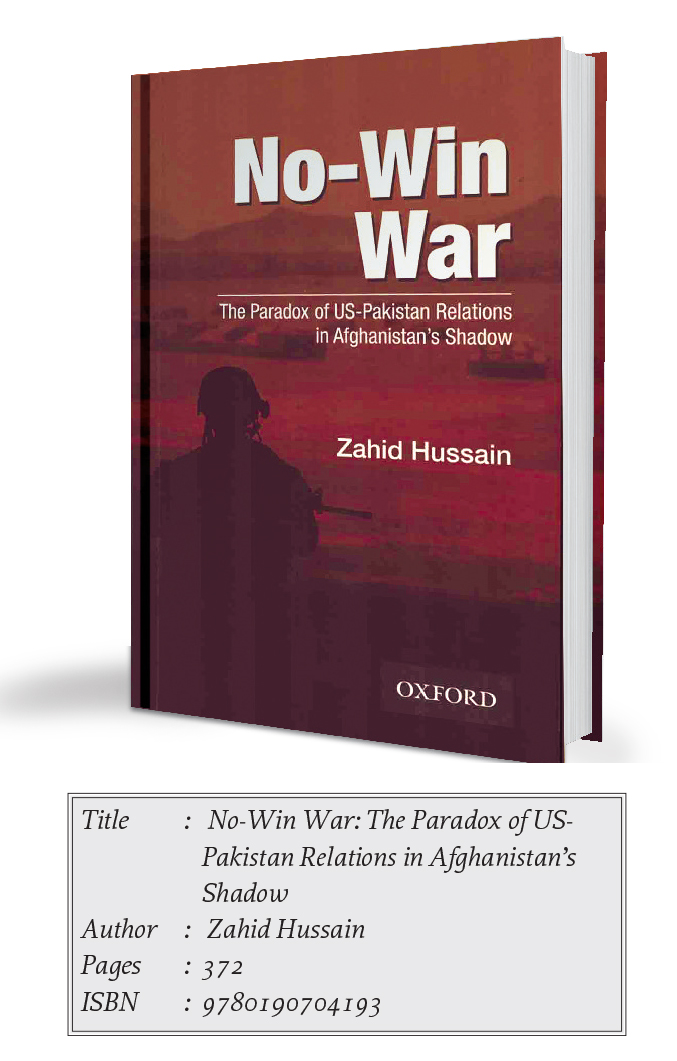
Using these tensions as a springboard, Zahid Hussain’s No-Win War offers a searingly honest glimpse into the root of divergence in Pakistan’s post 9/11 association with the US. With a keen eye for detail, the author forays deeply into the reasons why both countries have remained locked in an uneasy alliance despite endless tensions.
A comprehensive study of Pakistan’s role in America’s war on terror remains a necessity at this stage. Though it has almost been twenty years since the 9/11 attacks, the nature of the partnership that Pakistan and the US entered into hasn’t been understood in the right context. No-Win War serves to fill a vacuum in academic literature on the war on terror with a dispassionate account that appraises its effects within the power circles of Afghanistan, Pakistan and the US. An award-winning journalist and commentator, Hussain has witnessed crucial developments in our post-9/11 world from close quarters. Therefore, he is well-placed to provide credible and critical observations on the political wrangling that has spanned two decades.
The book’s introductory note highlights the far-reaching implications of the war on terror on Pakistan and, by extension, South Asia. The author states that the US-Pakistan alliance cultivated after 9/11 was steered by “expediency and compulsion” and resembled a “shotgun marriage”. According to Hussain, the partnership was laden with paradoxes. In order to illustrate this point, he argues that Washington and Islamabad have successfully combated al-Qaeda, but struggled to reach a consensus on dealing with the Afghan Taliban. With a steely grip on the finer details, the introduction excoriates America’s support of specific Afghan warlords. Furthermore, the section makes reference to the “cloak and dagger game” between the intelligence agencies of Pakistan and the US.
In its deftly braided eighteen chapters, No-Win War packages the themes brought up in the introduction into a detailed narrative that documents the highs and lows of a complex strategic partnership. The emphasis on showing the linear progression in ties enables readers to understand how a strategic alliance fuelled by global compulsions was strengthened and strained amid domestic pressures. For instance, the book turns an intimate gaze on the efforts made by the Musharraf regime to seek cooperation from Mullah Omar before the invasion. These sections reveal that Pakistan put its pre-existing relationship with the Afghan Taliban in jeopardy by deciding to join hands with the US. Hussain also adroitly demonstrates how Musharraf’s growing unpopularity after a simmering judicial crisis compelled the US to engineer a power-sharing agreement that eventually fell flat.
Domestic events are also skilfully examined in light of key developments on the global level. The impact of the Obama years; Osama bin Laden’s demise in a pre-dawn raid; Mullah Omar’s death; and Trump’s problematic presidency are analyzed through the prism of the Afghan conflict. What emerges through this juxtaposition is a powerful meditation on Afghanistan’s long, tumultuous journey from war to reconciliation.
No-Win War benefits from a richness of perspective that is devoid of a preoccupation with Western propaganda. Amid the glut of one-sided accounts on the war on terror, Hussain’s book glistens with rare domestic insights combined with a sound knowledge of global trends. 
Leave a Reply