
Region
New Directions
Will the Maldives create a holistic foreign policy to re-connect with the world or continue to live in isolation?

Under President Abdulla Yameen, the Maldives took a rather unusual decision to leave the Commonwealth in 2016. The Maldives government said that the Commonwealth was interrupting in its domestic affairs. The then administration said the Commonwealth was treating the Maldives unfairly. The Commonwealth had asked the Maldives to improve its democratic issues, crises and challenges or face expulsion. The Maldives became a multiparty democracy in 2008. It remained under autocratic rule for centuries (1117 to 1952) until the first President was elected (Mohamed Ameen Didi: 1953). The Commonwealth was largely concerned about the unstable democratic setup of the country. The Maldives rejoined the Commonwealth on February 1, 2020, as there were major constructive changes observed in its democratic domain.
In 2016, the Maldives also broke off its diplomatic ties with Iran. This came as a shock for the world, especially to the countries that had positive diplomatic ties with the Maldives and Iran. The Foreign Ministry of the Maldives in a statement soon after severing these ties said, “The Maldives believes that the policies that Iranian government pursues in the Middle East are detrimental to peace and security in the region, which, in many ways, is also linked to stability, peace and security of the Maldives.”
Such decisions that were taken by the former governments of the Maldives tarnished its relations with regional players and influential countries. Furthermore, President Yameen imposed limitations on the press and jailed political figures.
While President Yameen was restricting the Maldives’ democratic efforts and imposing unnecessary limitations, President Solih is poles apart. He is endeavouring to create links with the heads of state across the world.
The Minister of Foreign Affairs, Abdulla Shahid, has been developing ties with regional and global countries. He has been in contact with over 80 high-ranking officials in various countries. According to reports, these include presidents of 11 countries, prime ministers of 13 countries, 39 foreign ministers and envoys from 56 countries.
Under President Abdulla Yameen, the Maldives took a rather unusual decision to leave the Commonwealth in 2016.
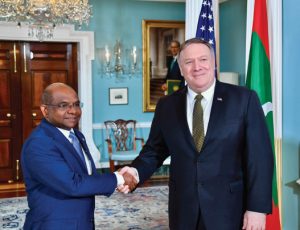
To engage in fruitful bilateral associations and to boost exchange of human resources, President Solih’s administration has also entered visa waiver agreements. Such arrangements have been made with Russia, the United Arab Emirates, Morocco, and Thailand. Another major diplomatic milestone was to organize an official visit to the Maldives by the U.S. Secretary of State Mike Pompeo on October 28, 2020. He became the first US official of that rank to visit the Maldives in 16 years. The US-Maldives relations have been moving ahead smoothly. The two countries have agreed on a “Defence and Security Relationship.” Under this plan, the two countries will enhance their military cooperation. It looks like President Solih’s foreign policy is pivoting his country away from China. This could create a political and economic tussle not only for China but also for Pakistan and those nations that are a part of China’s Belt and Road Initiative. It is yet to be seen how President Solih will handle the pivot away from his China policy in the long run. In November 2018, President Solih pulled the Maldives out from the Free Trade Agreement (FTA) with China. As per reports, President Solih thought it was a mistake to enter into such an agreement with China.
Indian Foreign Secretary Harsh Vardhan Shringla in November 2020 welcomed Maldives’ ‘India First’ policy. He said that India needs to “constantly build on its close bilateral ties with Ibrahim Solih’s government. Such a step will counter China’s growing influence in the Maldives. India has also provided a $1.3 billion financial package to the Maldives to undertake development projects. There has been much progress on the foreign policy front under President Solih’s regime. The Maldives still has a long way to go before implementing a holistic foreign policy to ensure it maintains productive relations with regional and international players in all domains. ![]()

The writer has a special interest in social and political affairs. He can be reached at omariftikhar82@gmail.com


Leave a Reply