


 The property of a business group was illegally occupied by the local leaders of a political party. Encroachers demanded half of the 100 shops of the commercial property in return for vacating the encroachment. The helpless owners had no other choice but to give up the ownership rights of fifty shops if they were to continue doing business in the city.
The unfortunate city of Karachi must have witnessed countless such cases and there is no one to guess the exact number of unreported cases.
For about two decades, the reins of Karachi were in the hands of an unruly and unguided mob, which worked for petty and selfish ends at the cost of the metropolitan city’s interests. The rulers were either part of the loot-and-plunder scheme, or deliberately overlooked every wrong that was thrust upon the city for the advantage of the apple-of-their-eye. China-cutting, land-grabbing, and lawlessness reigned supreme and only ‘Might is Right’ prevailed. In the process, the sole sufferer was the common resident of Karachi.
Before the Karachi Operation, various political stakeholders exploited the resources of Karachi. Land-grabbing was routine to such an extent that the fortunes of the powerful few started changing and they became rich overnight. ‘China-cutting’, a new term, emerged and gained notoriety. The nexus of politicians-bureaucrats and land-grabbing mafia converted public parks and other amenity areas into commercial plots. They did not face difficulty in preparing the documents. Later, these illegal properties were sold at exorbitant prices to innocent persons who invested their hard-earned money, believing that they would be living peacefully hereon.
Their dreams were shattered when investigations after the Karachi Operation revealed that they were swindled. A series of never-ending miseries started for them. - Their savings had been lost and they suffered mental agony for being honest citizens
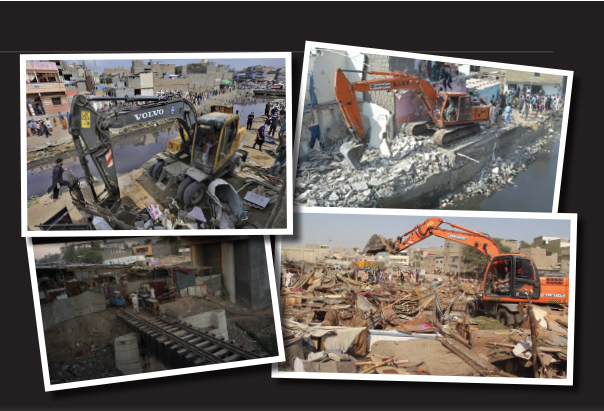
Land-grabbers had left no stone unturned to encroach upon the properties of anyone they came across and found him/her helpless. Amenity plots were fully or partially cut into pieces and sold at the most expensive rates because of the posh location of these properties following bogus documentation. As Faisal Siddiqui, counsel for the affectees, said, the lease of the houses was given by KDA, the Katchi Abadi Department and KMC. Neither the land-grabbers nor the victims had an iota of doubt that in the foreseeable future. the law would take its own course. Now the Supreme Court of Pakistan has ordered to raze to the ground all properties that have been illegally converted into commercial properties. UN human rights experts have called on Pakistan to “stop evicting close to 100,000 people living in two of Karachi’s narrow watercourses -the Gujjar and Orangi nullahs”.
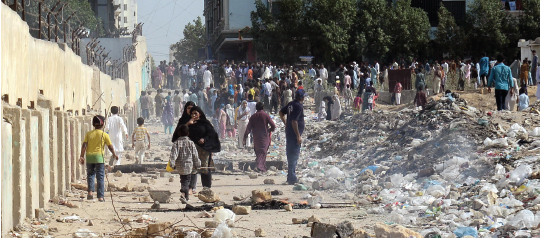
 The Sindh Government has announced a new compensation policy for the evictees of Orangi and Gujjar Nullahs. Although it is an appreciable move, it is not a permanent solution to three pressing issues: (1) In Karachi, no street is safe from the mischief of the land mafia. It is not known whether all the victims or hyped cases of anti-encroachment will be compensated (2) Whether the mafia, who have looted the innocent residents of Karachi, will be punished? (3) How about those who were at the helm of affairs during these loot-and-plunder schemes? Will they ever be held accountable?

This writer is a freelance contributor and can be reached at amjadsiyal@hotmail.com
Leave a Reply