


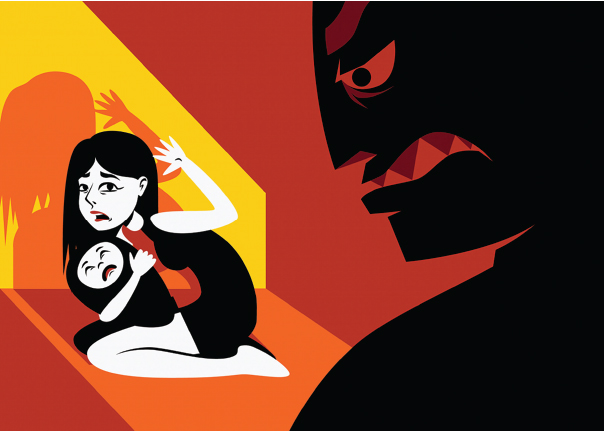
 Aiming to achieve gender equality and equal rights for all humans has now become a global aspiration. However, many forms of violence in the world are still highly gendered, such as domestic violence. In some countries, the issue of domestic violence is more acute than in others. Pakistan, being the fifth most populous country in the world, ranks as 151st out of 153 countries in the Global Gender Gap Index. Furthermore, only 46 percent of Pakistani women are literate, compared to 71 percent men. Pakistan’s Demographic and Health Survey (PDHS) conducted in 2012-13, in which 3 687 married women were interviewed, revealed that 32 percent of them had experienced physical violence while 39 percent experienced physical and/or emotional violence from their spouse.
Despite legislation that prohibits domestic violence, the issue is still prevailing. Change is always stressful, and the hectic world of the early 21st century has produced a global pandemic of stress. In a decade or so, a ‘useless’ class might emerge not only because of an absolute lack of jobs or lack of relevant education, but additionally because of insufficient mental stamina. The law has devised effective reporting, gender-sensitive, survivor-centric, quality services and preventive strategies for transformative change in society. The enactment of this act negates the belief that domestic violence is a private matter of any household; it has now become the state’s responsibility to protect women from violence.
The prospect of enacting legislation against domestic violence inevitably throws certain sections of society into a moral panic. Specious arguments referring to traditional and religious values are used to give a patina of legitimacy to what is essentially a desire to preserve a misogynistic culture predicated on men controlling women. Unfortunately, it seems that for many in the PTI government, the protection of women is subservient to pandering to these regressive elements. A Bill proposes stringent punitive measures against all forms of domestic violence and states that any act of domestic violence will be punishable with imprisonment of a maximum of three years and not less than six months. Moreover, fines ranging from Rs 20,000 to Rs 100,000 can be imposed on the perpetrator.
Pakistan Prime Minister Imran Khan’s advisor on parliamentary affairs has sought a review of the recently tabled domestic Violence Bill by the Council of Islamic Ideology (CII). A constitutional body, CII advises the legislature on whether a law conforms to the edicts of Islam. Most importantly, it is being highlighted that the Bill contravenes the Islamic [injunctions] and way of life as enshrined in the Responsibility of the State in Article 31 of the Constitution of Pakistan. The CII has taken a controversial stand on anti-domestic violence laws in the past. In 2016, the body proposed allowing a husband to ‘lightly’ beat up a wife if he deemed it necessary and declared that mothers must breastfeed kids for two years. In the same year, the constitutional body blocked women’s protection bills, which criminalized all forms of violence against women, by the Punjab Assembly and the Khyber Pakhtunkhwa (KP) government for being “un-Islamic”.
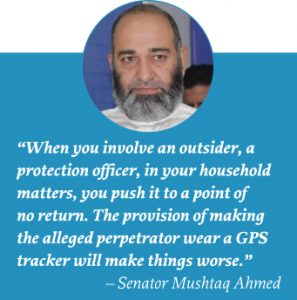 The Bill aims to protect women, children and the elderly, and other vulnerable groups from domestic violence. It also seeks to offer relief and rehabilitation to all individuals who are victims of domestic violence. It aims to establish an effective system of protection, relief, and rehabilitation of women, children, elders, and other vulnerable persons against domestic violence. It provides relief to the person who is in a domestic relationship and is related to by consanguinity, marriage. Article 230 (1) (b) of the Constitution, the letter says “empowers the Islamic Ideology Council (CII) to advise a House, a Provincial Assembly, a President or a Governor on any question referred to it as to whether a proposed law is or is not repugnant to the [injunctions] of Islam”.


The writer is a legal practitioner and columnist. He tweets @legal_bias and can be reached at shahrukhmehboob4@gmail.com
Leave a Reply