


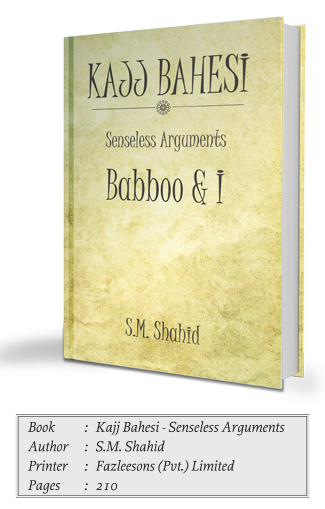
Turning one’s frustrations and failures, bittersweet experiences and unfulfilled dreams into candid humour is no less than an art. A genuine humourist must be able to make people smile and laugh without screwing up faces and without messing up with words and lingual expressions to get them to fit into a situation. The book ‘Kajj Bahesi - Senseless Arguments’ by S.M. Shahid, a well-known advertising practitioner and author of many books, is a textbook example of complex writing, which is too solemn to depict both funny and bitter aspects of life in a humorous way.
To start with, the bilingual title of the book ‘Kajj Bahesi - Senseless Arguments’ and the rest of the book’s contents boil down to the agony of the reader. From start to end, the book contains abundant references to Urdu terms and expressions that have been placed along with their English translations, enclosed in brackets, all through the book. This could be termed as the strongest as well as the weakest side of the book, a compendium of Shahid’s previously published articles from Dawn. The write-ups were later expanded and re-written by the author to add another book to his tally of 50 publications.
The polyglot flavour of ‘Kajj Bahesi’ embodies the author’s unique writing style. Perhaps this is the way he likes to put things down in black and white. However, the author’s over-reliance on using Urdu words and quasi-funny expressions from slang and colloquial phrases to cram the missing humour into an otherwise serious commentary, sounds distasteful on most occasions. The frequency of Urdu terms suggests that the writer just tried to translate his thoughts in English and the book could have been better if completely written in Urdu.
Without mincing the matter, if Urdu was meant to add to the pungency of the intended humour and satire, primarily written in English, the author in fact used his poetic licence repetitively to the point of abusing it. Many phrasal expressions have been concocted to put some humour in the text, e.g. ‘the soul was phoonked into it’ (page 28), ‘they were all line-hazir’ (page 132), and ‘Ziaul Haq bajaod the baja of secularism’ (page 234). The book is littered with misspelled words and inaccurate spacing between letters and even the word ‘jihalat’ is spelled differently in different places.
Throughout ‘Kajj Bahesi’, General Zia Ul Haq and maulvis are treated as figures of fun. In doing so, the author treads a beaten path, since such characters are often discussed with gusto and are poked fun at by the lot of pseudo intellectuals, who are actually good-for-nothing drawing room critics and claim to be secular-cum-liberal souls.
Typically a case of incidental humour, ‘Kajj Bahesi -Senseless Arguments’ by S.M. Shahid oscillates between spontaneous witticism and forcefully stuffed hilarity. To give vent to his feelings, the way the writer switches from one language to another bears a resemblance to the bhand tradition of the Punjab.
The bhands, or traditional folk entertainers, resort to making funny body movements, mixing lingual expressions, using common rural refrains in a straightforward parlance and pulling faces at audiences to make them laugh, either way. This style works well to entertain peasants, poor farmers and the rural citizenry by and large. They tend to chill out together at the end of the day to ward off their day-long toil without wasting their leftover energy to decode the puns and double entendres thrown in.
Depicting a world seen by a music-savvy advertising practitioner, ‘Kajj Bahesi’ is divided into a large number of small chapters with big headings. Interestingly, the price of the book is not mentioned as it is seemingly meant to be distributed only as a freebie in the author’s own circle of friends and acquaintances.
‘Kajj Bahesi - Senseless Arguments’ offers serious commentary, coated with episodic humour and overfilled aphorisms. It’s characters Babboo and the author himself have opposing views on almost every matter. A seemingly quasi-intellectual conversation tinged with slang and distorted vocabulary, the volume is indeed a thought-provoking read. It serves more satire than humour and has much more to be worried about than being a reason to smile.
Leave a Reply