



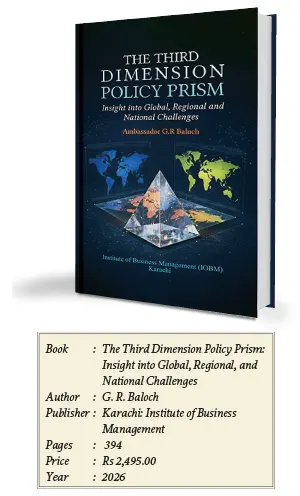
 A valuable source of information and deep insights, the book ‘The Third Dimension Policy Prism: Insight into Global, Regional, and National Challenges’ by G. R. Baloch comprises 54 essays and is divided into 5 chapters, covering a wide spectrum of themes, including South Asian and Middle East regions, global politics, and numerous academic and social issues. The author, G. R. Baloch, is Pakistan’s former ambassador and currently serves as Director of the Global and Regional Studies Center (GRSC) at the Institute of Business Management (IoBM) in Karachi.
On the question of ‘Operation Sindoor’ and the shattering myth of Indian military superiority, the author argues that, “for nearly a decade, India’s foreign and security policy rested on three assumptions: that it had neutralized Pakistan, drawn the West into strategic embrace, and could manage China from a position of confidence. Each now stands questioned.” (p. 31). A window of opportunity for Pakistan emerged following the failure of ‘Operation Sindoor’, as security and strategic ties between Islamabad and Dhaka strengthened. According to the author, Pakistan and Bangladesh cannot isolate themselves in a competitive South Asia and must focus on their reconciliation process.
India tried to compensate for its strained ties with Washington during the second term of U.S. President Donald Trump by mending fences with China. The meeting with Chinese and Indian leaders in Kazan in October 2025 produced a joint statement that stated, “China and India see each other’s development opportunity rather than a threat, and a cooperation partner rather than a competitor.” (p. 52). Henceforth, the Indian Prime Minister Narendra Modi’s visit to Tianjin, China, to attend the SCO meeting was termed a landmark in bettering China-India relations. Modi’s visit to China was welcomed by the Chinese Foreign Ministry, calling the summit a gathering of friendship and fruitful results. On this account, the author argues that, “India-China rapprochement, therefore, represents a pragmatic recalibration, a hedging mechanism to manage multiple pressures simultaneously: military, economic, and geopolitical. It allows India to redirect focus, reduce border tensions, and preserve space for maneuvering in the complex interplay with both Beijing and Washington”.
However, the book has some shortcomings, including a lack of focus when covering regional and international issues. Furthermore, the book has repetitive sentences on page 80 from page 40, when he describes Trump’s dismissal of India’s economy as dead, and on page 87 from page 34, when he discusses relations between Pakistan and Bangladesh. The book lacks documentation, references, and an index, reflecting its lack of scholarly touch.
The author terms the Pakistan-Afghanistan border conflict between October 10 and 12 of 2025 as a major flashpoint in South Asia. For Pakistan, its security dilemma stems from militant threats emanating from the Afghan soil, an emboldened Taliban regime gaining diplomatic space, and a potentially coordinated sub-conventional nexus involving India and Afghanistan. Therefore, Pakistan can meet challenges emanating from Afghanistan by ensuring resilient governance in Pakistan’s own border regions, investment in socio-economic integration of Balochistan and Khyber Pakhtunkhwa, and counter-narratives to extremist recruitment. To deal with geo-political imperatives and regional relevance, the author suggests that “in a world increasingly moving towards multipolarity, middle powers like Pakistan, Türkiye, and Azerbaijan are well placed to act as regional stabilizers and global connectors.”
Despite its many flaws, the book is a useful source of information on current affairs. Furthermore, the book needs to be understood in terms of major flashpoints in South Asia and the Middle East. The author’s emphasis on a multilateral rather than a unilateral world order is the need of the hour and enhances the value of the book. 
Leave a Reply