

Cover Story
Landslides:
Dark sides --- and a Bright side!
All the initial signs emanating from Dhaka in the glow of the big win herald hope for a constructive use of the strong mandate

On the face of it, a landslide is like a knock-out.
But what if the opponent is not inside the ring? Because s/he was not allowed to fight.
Even if that opponent had already exhibited such malignant unsportslike attributes that pre-bout disqualification was quite justified. Yet in an electoral context, there is a need to look beyond the unilateral, monolithic dimension of a landslide.
The winning of 209 seats out of 299 by the BNP in the 12th February 2026 polls in Bangladesh is a potent indicator of popularity. But even setting aside for the moment the non-participation of a major contestant like the Awami League, this writer is incorrigibly skeptical about the first-past-the-post electoral system used by Bangladesh, Pakistan, India, and many others. The system is selectively electoral and does not represent all voters, or even the majority of voters.
Only compulsory voting:
Only the system of compulsory voting long advocated by self --- as used in about 23 countries e.g. Singapore, Australia, Greece, Belgium, Argentina, to name only 5 --- and (my personal favourite!) the requirement that the winner must secure at least 50 per cent of the cast vote plus at least one more vote, to be an authentic representative of the majority --- these two features alone ensure that poll results become truly representative of the views of all citizens eligible to vote.
The total number of registered voters in Bangladesh in 2026 is 127 million. The relatively high turnout was a fraction less than 60 per cent, at 59.44 per cent. Yet that still means 40 per cent --- numbering about 50 million adults --- did not bother to vote at all. Possibly, a large number of those who stayed away were a deliberate boycott, such as by supporters of the banned Awami League. Or from apathy, or other insurmountable reasons.
Not a popular vote landslide:
BNP received about 38 million votes. Which was an impressive 50 per cent of the votes actually cast. But if we take into account those who did not vote at all, then the BNP received only 30 per cent of the total registered votes. While securing a two-thirds majority of seats, i.e., 209 out of 299. Which is yet another indicator of the non-representative nature of the first-past-the-post electoral system without compulsory voting.
Because the inconvenient fact is that an almost overwhelming majority of registered voters, i.e., about 80 million, did NOT vote for the BNP, which received about 38 million votes. The 80 million non-BNP voters comprised those who voted for other parties in 2026 (about 28/30 million) and those who did not vote at all (about 50 million).
There is a bizarre coincidence here. In 1970, the voter turnout of 59.8 percent was almost the same as in 2026, i.e., 59.44 percent. At that time in 1970, when there were only 56.9 million registered voters, 39.2 percent of then-eligible voters did not vote at all, and about 11 percent voted against the Awami League, totalling about HALF --- or 50 percent of all voters --- who did NOT vote for the Awami League. Yet the AL won 160 out of 162 seats from East Pakistan, i.e., 98.7 percent. The first-past-the-post system does not even deserve one cheer, leave alone three.
For the record: in the 2024 polls which were boycotted by BNP, and which, among others, the US State Department called “not free or fair,” and in which the voter turnout was only 41.8 percent out of then-registered 119 million voters, the Awami League --- despite enjoying all the advantages of State power and the absence of the BNP --- received only 32.1 million votes.
Landslide inside the Assembly:
In electorally enabling law-making terms, the BNP in 2026 certainly has a two-thirds majority. But even assuming that such a big margin will assure a term of office that is free of bumps, potholes, ditches, a landslide brings with it real, as well as unforeseeable uncertainty and hazards.
Hazards of landslides:
A landslide win tends to unduly encourage the winners to become complacent, even arrogant.
Negative traits previously curbed could resurge in the flush of a huge victory.
One old menace is corruption. The new Prime Minister, rightly or wrongly, was charged by the AL Government and convicted of this vice. He had to stay
abroad for 16 years after conviction to evade prison. Hopefully, he will commence a new phase of political life in which he completely eliminates the scope for even suspicion about bribery to be fostered. His initial words are encouraging.
With a large cabinet of 50 members, special vigilance will be needed to prevent power regained after a long period of persecution from becoming a covert, unwritten license for larceny, quietly justified as compensation.
Huge victories also tend to reinforce latent tendencies towards extremism previously obscured by other preoccupations when parties are not in office. Though fortunately, the BNP has rarely if ever shown the virulence of hate and imbalance personified by Hasina Wajid’s attitude and actions, especially against Pakistan, and those BNP and Jamaat-i-Islami leaders who she accused --- and even had some unjustly tried and brutally executed --- for being pro-Pakistani and anti-national, the BNP needs to guard against the temptation to turn populist in order to divert attention from possible setbacks or failure to fulfill promises. BJP in India, Trump Republicans in the USA, the Netanyahu coalition in Israel, all three elected by large popular vote margins, are ugly manifestations of how extremist poisons of one kind or another can come to infect the whole body politic.
With India virtually breathing down its neck from 3 sides on land --- and refusing to return Hasina Wajid to stand trial for her destructive, murderous misrule --- Bangladesh under BNP has to craft relations with its immediate neighbour with extraordinary care and courage
A domineering presence in the legislature brings with it the danger of bulldozing new laws or amending existing laws in the face of vociferous but numerically small opposition. In Pakistan, during the past and current tenures of the PML-N, we have seen horrid examples of Constitutional amendments being rammed through in less than 48 hours of introduction, without any public consultations or consent of the opposition. Building a consensus takes time and much patience, but is always preferable to the insensitive use of a big majority.
BD’s diversity:
Though Bangladesh is predominantly homogenous in terms of ethnicity, language, and religious faith, the country is also marked by diversity --- in ethnic composition, community-level languages, and a Hindu population of about 8 to 10 percent. The new order should take special interest in protecting the rights of non-Muslims and indigenous groups.
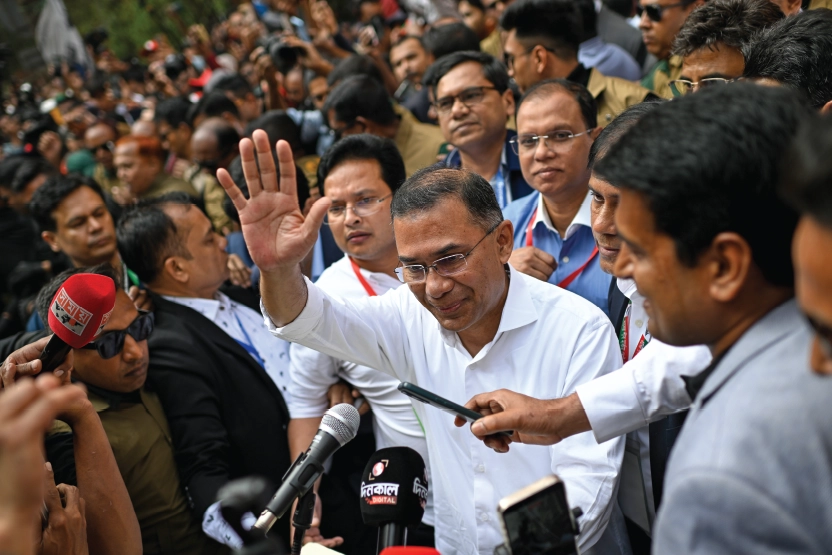
With a newly strengthened Jamaat-i-Islami whose ideological approach on certain basic issues of modernity and secularism is out-of-sync with enlightenment, PM Tarique Rahman will need tact and dexterity in coalescing cohesive outcomes. The great youth bulge that empowered the August 2024 revolution requires exceptional attention.
Interim Government’s example:
The BNP Government will surely draw strength in pursuing broad agreement on important legislation from the fine example set by the Interim Government led by Chief Adviser Dr Mohammad Younus. Often strongly criticized for allegedly unduly delaying the elections into early 2026 instead of early 2025, the interim PM demonstrated rare courage and perseverance in first formulating proposed Constitutional amendments before finalizing the polling date. As a result, for the first time, significant improvements such as increased representation for women, the creation of a bicameral parliament, and a two-term limit for Prime Ministers were strongly endorsed through the referendum vote cast alongside the vote for candidates and parties.
Economic challenges:
Even with a more balanced population growth rate than Pakistan’s, Bangladesh nevertheless faces the enormous challenges of creating livelihood opportunities for at least two million youth every year while it strives to retain its previous and continuing successes in the export of apparel, jute, and leather products. With a current GDP per capita of about $ 3000/- and a GDP of about $ 519 billion --- compared to Pakistan’s per capita of $ 1700/- and GDP of $ 410 billion --- Bangladesh is set to move from the status of a Least Developed Country (a status of LDC which gave it a decisive advantage over Pakistan in tariff exemptions, etc.) to a Developing Country, a progression that will pose new pressures for reform and adjustment. In a comprehensive sense, a reduction of severe inequality in incomes and improvement in the quality of governance, both through redistributive economic policy and practice vis-à-vis internal institutions and local government, are going to be abiding criteria by which the new Government will be judged.
New external conditions:
If the internal agenda is rife with priorities awaiting action, the external front in 2026 and beyond offers regional and global vistas of unprecedented turbulence and uncertainties. With India virtually breathing down its neck from 3 sides on land --- and refusing to return Hasina Wajid to stand trial for her destructive, murderous misrule --- Bangladesh under BNP has to craft relations with its immediate neighbour with extraordinary care and courage. Though comparatively distant, the country’s linkages with China, the EU, the USA, and Pakistan are yet crucially close to its economic and geostrategic interests.
The bright side:
The bright side of a landslide comprises the self-confidence that comes from mass endorsement of a manifesto. Grace and magnanimity must overcome the lure of transient glee. As 257 million well-wishers in Pakistan want it to do, the BNP Government should use its legislature-related landslide triumph with integrity and humility --- while always remembering that, outside parliament, the majority of voters did not vote for BNP. The new Government should always strive for the capability to address the complexity of shaping a new chapter of the country’s destiny. All the initial signs emanating from Dhaka in the glow of the big win herald hope for a constructive use of the strong mandate. From one’s own personal perspective while residing in the unique Sohni Dharti of Pakistan, one heartily cheers the beautiful land and people of Sonar Bangla as they commence a new journey to national fulfillment.
The writer is a former Federal Minister and film-maker, long associated with processes of cooperation in South Asia. In 2021, he wrote and produced the documentary film on the genesis of Bangladesh, titled, and accessible through https://www.1971untoldstory.co.
He can be reached at javedjabbar.2@gmail.com


Leave a Reply