



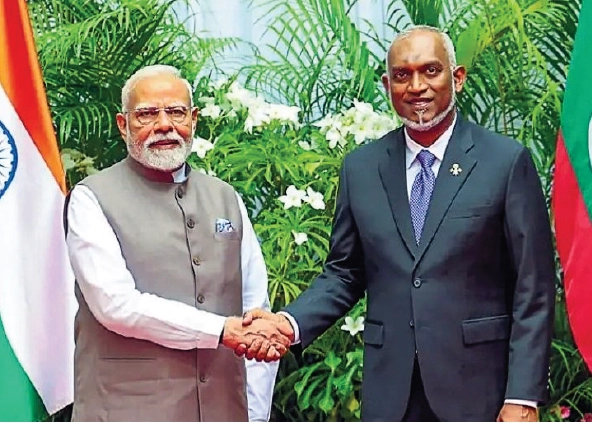
Indian Prime Minister Narendra Modi’s visit as the guest of honor to Malé for the Maldives’ 60th Independence Day was more than a ceremonial gesture. It marked the culmination of a two-year swing from political rancor to strategic rapprochement, with India announcing a $565 million credit line, opening free trade agreement (FTA) talks, and signing memorandums of cooperation in fisheries, tourism, health, and digital development. The pageantry masked a hard reality: both governments had learned the costs of confrontation and were now willing to test a cooperative reset in one of the Indian Ocean’s most contested spaces.
This reset does not mean New Delhi and Malé suddenly agree on all fronts. Political sensitivities remain, especially over sovereignty and defense arrangements. Yet the shift in tone and content is unmistakable. What began as a high-risk “India Out” stance under President Mohamed Muizzu has evolved into an interest-driven compact, where India gains sea-lane stability and the Maldives secures economic breathing room. The arc from confrontation to collaboration is visible in a series of incidents over the past two years.
Muizzu’s election in late 2023 represented a notable change. His campaign centered on promises to withdraw Indian military personnel operating donated aviation assets and to diversify the nation’s security partnerships. Compared with Abdulla Yameen’s tenure, the sharper tone resonated with supporters wary of dependence on New Delhi. To keep aircraft and helicopters operational while honoring sovereignty pledges, Muizzu proposed replacing uniformed Indian personnel with civilian technical staff.
This formula allowed both sides to step back from a rupture. For Malé, it delivered on a campaign promise without undermining essential airlift and medevac capabilities. For New Delhi, it preserved strategic access while signaling flexibility. In retrospect, it was the first indication that Muizzu’s “India Out” stance would yield to operational realities. This adjustment was crucial and opened the way for further engagement.
As 2024 approached, domestic politics threatened to overshadow foreign policy. Remarks by rising Maldivian politicians prompted a “Boycott Maldives” campaign in India, sharply reducing tourism. Malé’s decision to withdraw from a hydrography agreement with India and to permit a replenishment stop for a Chinese research vessel underscored the sovereignty theme. Yet security cooperation at sea never stopped. The Maldives joined India’s Milan naval exercise and co-hosted the Dosti-16 trilateral coast guard drills with Sri Lanka and India. These actions maintained strong security links while letting Muizzu uphold his nationalist image and preventing a strategic vacuum China could exploit. The approach demonstrated a strategic balance and was a prime example of small-state hedging in a multipolar maritime environment.
By late 2024, economic pressure was mounting. Falling reserves, a ratings downgrade, and slowing tourism created tighter fiscal conditions. In October, Muizzu visited New Delhi with a noticeably softer approach, promoting the idea of resolving differences “through open dialogue.” The visit secured Indian commitments on debt servicing, project financing, and supporting infrastructure works like the Thilamale Bridge and regional airport upgrades. While diversification towards China and Türkiye continued, macroeconomic dependence on India proved too significant to overlook. Malé realized managing multiple partnerships required maintaining older ones alongside new deals abroad.
The tentative reset was tested in early 2025 when a Washington Post report alleged an India-linked plot to unseat Muizzu. The story had the potential to reignite nationalist backlash, yet both governments moved quickly to dismiss the claims. Ministerial exchanges continued, and defense dialogues stayed on schedule. The delay was a deliberate choice to keep operational cooperation insulated from political turbulence.


Based in Lahore, the writer is a Ph.D. scholar and political analyst. She can be reached at gulnaznawaz1551@gmail.com
Leave a Reply