



 August 1947 marked a monumental turning point in the history of the Indian subcontinent, signifying the end of British colonial rule and the birth of two nations: India and Pakistan. Long before this partition, the Rashtriya Swayamsevak Sangh (RSS) was founded in September 1925, driven by specific aims and motivations. The organisation emerged as a response to British rule, aiming to unite Hindus, instil a sense of pride and nationalism, and foster a strong Hindu identity by viewing India as a Hindu nation. Additionally, the RSS sought to promote Hindu culture and traditions while addressing social issues by combating caste discrimination and social inequalities. It also aimed to counter rising communal tensions, particularly between Hindus and Muslims, by advocating for Hindu unity. Furthermore, the organisation focused on youth engagement, encouraging young people to participate in national service and cultural activities to instil discipline and leadership qualities. With these objectives, the RSS was positioned to become a significant and influential force in India’s socio-political landscape.
The modern resurgence of the RSS began in the early 1990s, particularly during the events surrounding the Babri Masjid and its demolition in Ayodhya in December 1992. This incident thrust the RSS back into the national spotlight, emphasising its role in promoting the Ram Janmabhoomi movement. The demolition triggered extensive riots and public tensions across the country, enabling the RSS, along with its affiliated group, the Bharatiya Janata Party (BJP), to leverage the situation to enhance their political influence. This ultimately set the stage for the BJP’s rise as a formidable political force against Congress, leading to successful electoral campaigns in the years to come.
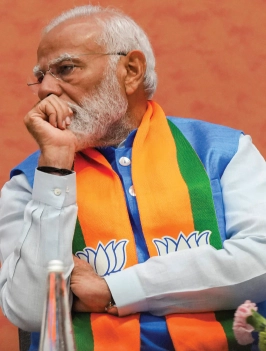
Later, in 2002, the role of RSS was pivotal in the communal violence and riots in the Indian state of Gujarat, during the tenure of then Chief Minister Narendra Modi, with allegations of his active support and influence.
India, significantly larger in size and population than Pakistan, has long been perceived as a rising power on the global stage. Since the secession of East Pakistan (now Bangladesh), India’s influence has grown, especially after its first nuclear tests named “Smiling Buddha” on May 18, 1974. It has been viewed as a counterbalance to China’s expanding influence in the Asia-Pacific region. Each year, India showcases its military might, enhancing its capabilities not only in terms of manpower but also through the acquisition of cutting-edge military equipment, signalling its ambitions to be a regional and global power.
While India consistently demonstrates its military prowess during Republic Day celebrations on January 26 every year, the events of February 27, 2019, marked a significant miscalculation. India attempted a military action against Pakistan, resulting in the downing of an Indian Air Force (IAF) MiG-21 Bison and the capture of the IAF pilot. Although the captured pilot was released on March 1, 2019, this incident starkly highlighted Pakistan’s air warfare capabilities and represented a significant blow to India’s military credibility.


Based in Karachi, the author writes on a range of topics, including military experiences. He can be reached at abrarkhan30c@gmail.com
India as a Hindu State of RSS brigade has NO future for its own people… Sub Continent Indo Pak Bangladesh has only one way to rise and that is as a region in peace with strong people to people contacts and open borders…
Thank you for taking the time to read and comment!
In depth good Analysis.
Well written
A very valuable article written by Mr Abrar Khan on the obtaining environment of South Asia where concocted hegemonic designs of India were challenged by arch rivals Pakistan while stricking the balamce in strategic position cum relation were redefined ….!!!
Good and shabash
Thanks for your kind words!
A very well articulated narrative on a country which has always boasted about its might, culture and history. They say …… you can’t befool everyone all the time. This is specially true in this modern age of communications and information. The world has now understood the real worth of a country which is likely to fall soon under its own weight.
Thanks! I appreciate your feedback.
Interesting analysis. The regional balance is delicate, and any shift in doctrine or posture by either side can have wide-ranging implications.
Thank you for taking the time to read and comment.
Excellent insight into major goals by HINDUTA mindset in spoiling the peace of the people of South Asia.
Thanks for your kind words.
Very well explained ❤️
A lot of effort has been put in this paper, well done
Deeply moving, your words capturing the emotions perfectly.
Keep it up 👍
Thank you for taking the time to read and comment.
Quite a good write up. Excellent analytical ability
Excellent professional analysis.
Good piece.. Exposed Indian drama
Excellent write up/article on India’s BURE DIN. Best part is that you have written this article using good language and not in Shakespearean language . Heartiest Congrats. I do read your urdu articles also. Keep enlightening us. Best Wishes
Capt Waris un Nabi Awan 6L
An exceptionally articulate article highlighting Indian designs, failures and vulnerabilities. Kudos to the writer.
A good read to understand the contaxt of India Pakistan relations.
Treat to read an in-depth study on Indo Pak relations and mutually affecting issues including Pakistan’ s response to recent Indian misadventure. RSS ideology and current extremist Modi regime is a great threat to regional peace. Very well summarised issues affecting regional peace; thanks for the wonderful work ❤️
Excellent article! You’ve provided a thorough and well-researched analysis of the RSS and explained how the events of August exposed the myth of India being a regional super-powerwhile also shedding light on the complex dynamics of India-Pakistan relations. Great job!
MashaAllah very informative article. 👍
I have been a fan of Colonel Abrar’s writings. Pakistan, India, especially India and its history, the emergence of RSS, the motivations behind it and the behavior of RSS. Overall, the impact of RSS on India’s policies, all this was explained by Colonel Abrar in a short but comprehensive manner. Not only this, but the damage caused to the region, especially to India-Pakistan relations and to India itself, due to the policies of India and the RSS behind it, was mentioned in a comprehensive manner. Colonel Abrar is requested to write another article in this regard on how this part of Asia could not develop only because of India’s hostility with other countries.
A wonderful article by Lt col Abrar Khan in the backdrop of Indian recent misadventure. Exposing the Indian military might, RSS mindset and Moodi’s failure at diplomatic forums.
A good effort to keep the history alive
A good article
Yes it’s good analysis based on history and current geopolitical situation
just went through the article , it gives a comprehensive rundown where India stands today. However , it should be noted that India still is a big country , the Indian nation is as resilient as we are , they are much a bigger economical power , and has big military arsenal as compare to its neighbouring countries . therefore it would be in the interest of India to curtail its hegemonic designs , the wish and desire to policing the region in particular and world in general, take good care of its poor citizen by investing more in their well being, otherwise the writer is right in thinking that BURE Din of India have begun and if continued will one day reduce it to size.
I just went through the article; it provides a comprehensive overview of where India stands today. However, it must be acknowledged that India remains a vast country with a resilient nation, a stronger economy, and a considerable military arsenal compared to its neighbours. In this context, it would be in India’s own interest to curtail its hegemonic ambitions and its desire to police the region—and the world at large. Instead, greater focus should be placed on the welfare of its own citizens, particularly the poor, by investing in their well-being. Otherwise, as the writer rightly suggests, the *“bure din”* of India may indeed have begun, and if such policies continue, they could eventually diminish its stature.
Well written pointing out the facts of the issue
You’re absolutely right..
India has always shown it’s evil designs which has exposed and unveiled it in front of the whole world.
In depth good Analysis.
Well written
Well written!
Such a well-written and insightful piece!.
You’ve captured the complexities of India’s current challenges in a very balanced and thoughtful way. I really enjoyed how you connected the diplomatic, economic, and strategic aspects together so clearly. Proud of your work — keep writing and sharing such powerful analyses!