



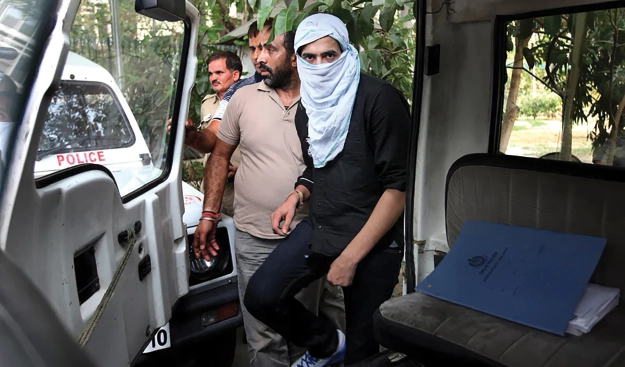
 Delhi, India’s political and economic nerve centre, is also home to a sprawling underworld dominated by 95 active criminal gangs, as confirmed by the Centre in a Supreme Court report. These gangs, with over 1,100 members and 5,000+ criminal cases in the past decade, engage in extortion, contract killings, drug trafficking, arms smuggling, and land grabs.
Delhi’s underworld operates a multi-billion-dollar criminal economy, thriving on various illicit activities. According to figures cited by Hindustan Times, in the last five years alone, reported cases include extortion worth over INR 500 crore, drug smuggling valued at INR 1,200 crore, arms trafficking at INR 300 crore, and kidnappings generating at least INR 200 crore in ransom. Additionally, more than 200 cases of contract killings have been recorded, though their financial value remains undocumented. This indicates that roughly INR 2,500 crore in crime-related money has been officially reported, while the unreported circulation is likely much higher.
These numbers tie into the broader issue of India’s shadow economy. The black money market in India is estimated at USD 1.06–1.4 trillion, a significant portion of which is laundered back into the country under the guise of foreign investments. Data from the Department of Industrial Policy and Promotion (DIPP) shows that between 2000 and 2011, funds routed via Mauritius and Singapore accounted for 41.8% of India’s total foreign direct investment. Analysts and enforcement agencies argue that the underworld remains deeply entangled with this black money network, serving as both a source and a channel for illicit wealth.
Reports suggest that the rise of Delhi’s crime syndicates is fuelled by political patronage, weak law enforcement, and widening socio-economic gaps, making the capital a hotspot for organized crime. Many gangs trace their roots to college rivalries, student politics, or neighbourhood disputes, before evolving into full-fledged criminal enterprises. For example, the Gogi and Tillu Tajpuria gangs emerged from a college election clash at Swami Shraddhanand College, spiraling into a deadly turf war. Similarly, Lawrence Bishnoi, now a notorious international crime figure, began with student clashes in Punjab before expanding into extortion and contract killings.
This raises a pressing question: Are India’s public educational institutes, particularly in Delhi, compromised to the extent that they have become breeding grounds for gangsters? Research indicates systemic failures—overcrowded classrooms, poor infrastructure, and lack of mentorship- leave youth vulnerable. With limited guidance and bleak career prospects, many students, especially from low-income families, are drawn into gangs that promise quick money and power. Studies also link educational disengagement directly to rising juvenile crime, showing how the underworld exploits the vacuum created by institutional neglect. Experts argue that while policymakers acknowledge the problem, there is little political will to address it.
Beyond weak public education, rapid population growth, and sharp financial disparities, India’s jails have become breeding grounds for crime. Imprisoned gangsters like Lawrence Bishnoi and Neeraj Bawana openly recruit members and expand their networks from behind bars. Juvenile jails, in particular, are overcrowded, understaffed, and plagued by neglect. Instead of rehabilitation centres, they often function as punitive holding spaces. Facilities such as Delhi’s Majnu ka Tila home frequently house double their capacity, with children confined in cramped, unsanitary conditions and denied access to proper education or counselling.


The writer is a Research Assistant at the Centre for International Strategic Studies Sindh (CISSS), Karachi. He can be reached at alihamza@cisss.org.pk
Leave a Reply