



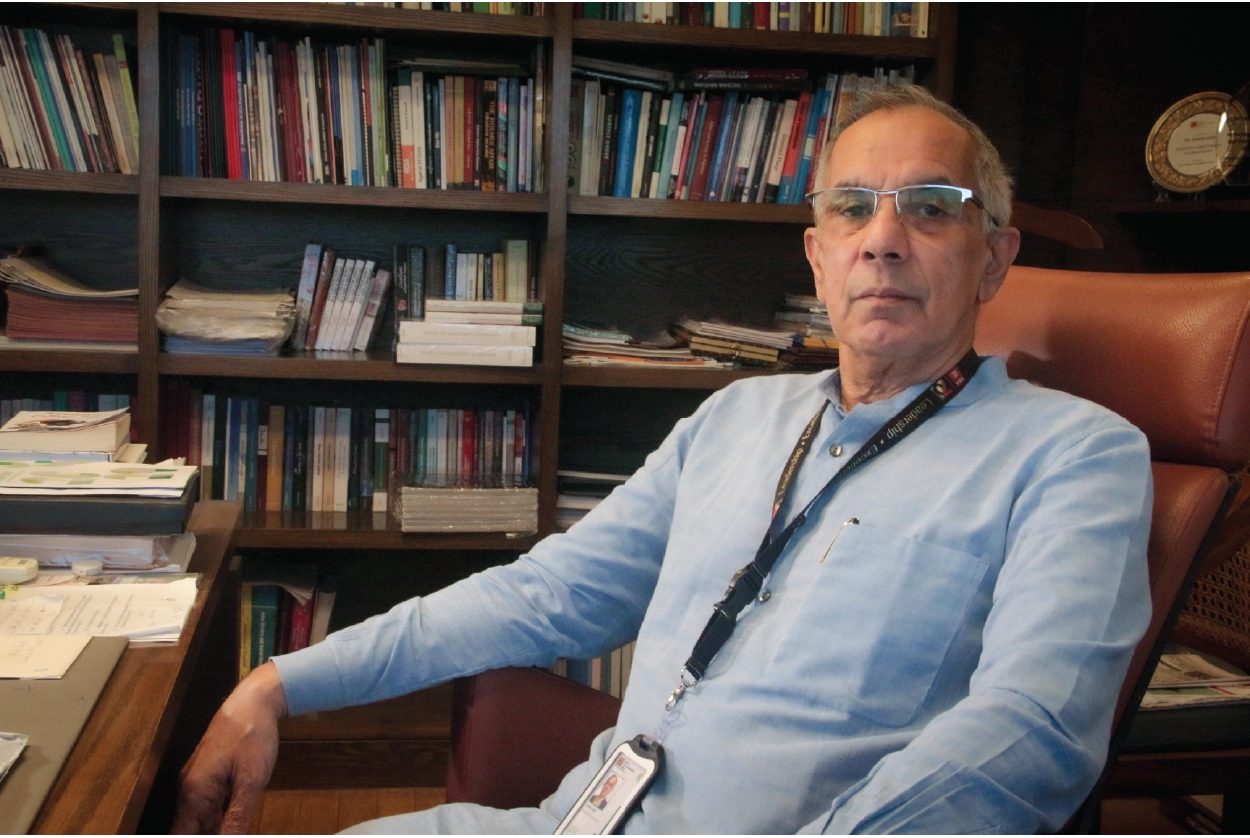
Question: IBA has a distinguished legacy as one of Pakistan’s premier educational institutions. In your view, what aspects of IBA’s past should the current generation of students and faculty be most proud of?
Answer: IBA was fortunate to get the support of key universities like the University of Pennsylvania’s Wharton School of Business and the University of Southern California when the IBA was founded in 1955. Without compromising quality, the IBA had the ‘early mover’ advantage and was one of the first Business Schools outside of North America. For many decades, it built on its reputation as the first and, subsequently, leading Business School in the region before other Business Schools emerged. The emphasis on not compromising on the quality in terms of faculty and students, admissions and teaching, a tradition that has only become stronger, has established the IBA as the leading Business School in Pakistan, an honour it still maintains.
Q. Under your leadership, how has IBA evolved in recent years to meet the challenges of a rapidly changing global and local academic landscape?
A: I have been the Executive Director/Vice-Chancellor at the IBA since January 2020 and am in my second term. Everything that we have done at the IBA has been done collectively by our outstanding faculty and staff. We develop ideas collaboratively, engage in thoughtful debate, make decisions, and implement policies that best serve IBA’s interests.
Collectively, we have undertaken numerous significant changes since January 2020. Perhaps the most important decision was to make what was known as the Institute of Business Administration into IBA, Karachi, by moving away from our singular focus of being only a Business School to an institution of higher learning when we set up three autonomous schools. Now, we have the School of Business Studies (SBS), the largest of the three schools, which inherits the mantle of the old Institute of Business Administration, along with the School of Mathematics and Computer Science (SMCS) and the School of Economics and Social Sciences (SESS). Each school is run by its own Dean, who has the autonomy to run their own school in accordance with IBA’s policies.
“Our students are required to be good academically and excel in values worth emphasizing in society.”
By allowing the three schools to emerge independently, yet in unison with the overall IBA mission, we have focused on areas that require particular and concentrated focus. We are now recognized as one of the best institutions for Computer Science in Pakistan. We have degrees in Data Science and are starting an undergraduate degree in Business Analytics at the School of Business Studies. We are also one of the few universities where students can specialize in Psychology, which is in much demand. Our School of Economics and Social Sciences offers specialization in Media Studies, History, and Political Science.
Q: IBA’s mission highlights merit, inclusivity, and critical thinking. What concrete steps have been taken to make IBA more accessible and relevant to a diverse student body, especially those from underserved backgrounds?
A: IBA does not compromise on its admission criteria and ensures strict compliance with our very high standards. This does not mean that students from diverse backgrounds do not get into IBA. Around 14,000 students apply for admission each year, and around one thousand or so are admitted. Many come from backgrounds where students and their families are unable to afford the fees of a quality university like IBA. We provide financial assistance to students who are smart enough to get admission to IBA but cannot afford our fees. Last year, the IBA spent Rs 1 billion on supporting deserving students. This is quite an astonishing and unprecedented amount, which, I believe, is the highest financial assistance amount given by any university to its students in Pakistan.
Q: How does IBA balance academic excellence with values like integrity, tolerance, and teamwork, particularly in an age of increasing societal polarization?
A: We ensure that our students learn in the classroom and outside of it as well. Our students are required to be good academically and excel in values worth emphasizing in society. There are always differences in values and perceptions, and we encourage such diverse points of view, but we also emphasize tolerance and acceptance of differing viewpoints. Our students come with diverse values from diverse backgrounds, and our society is not homogeneous either; hence, we try to teach our students to recognize and respect different values and views.

Leave a Reply